Institutional accounts only · Pricing and quotes released after verified laboratory registration
Institutional accounts only · Pricing and quotes released after verified laboratory registration
Reference data, Safety Data Sheets, and Certificates of Analysis for every catalog compound. Pricing and quotations are released to verified institutions only. For laboratory research use only.
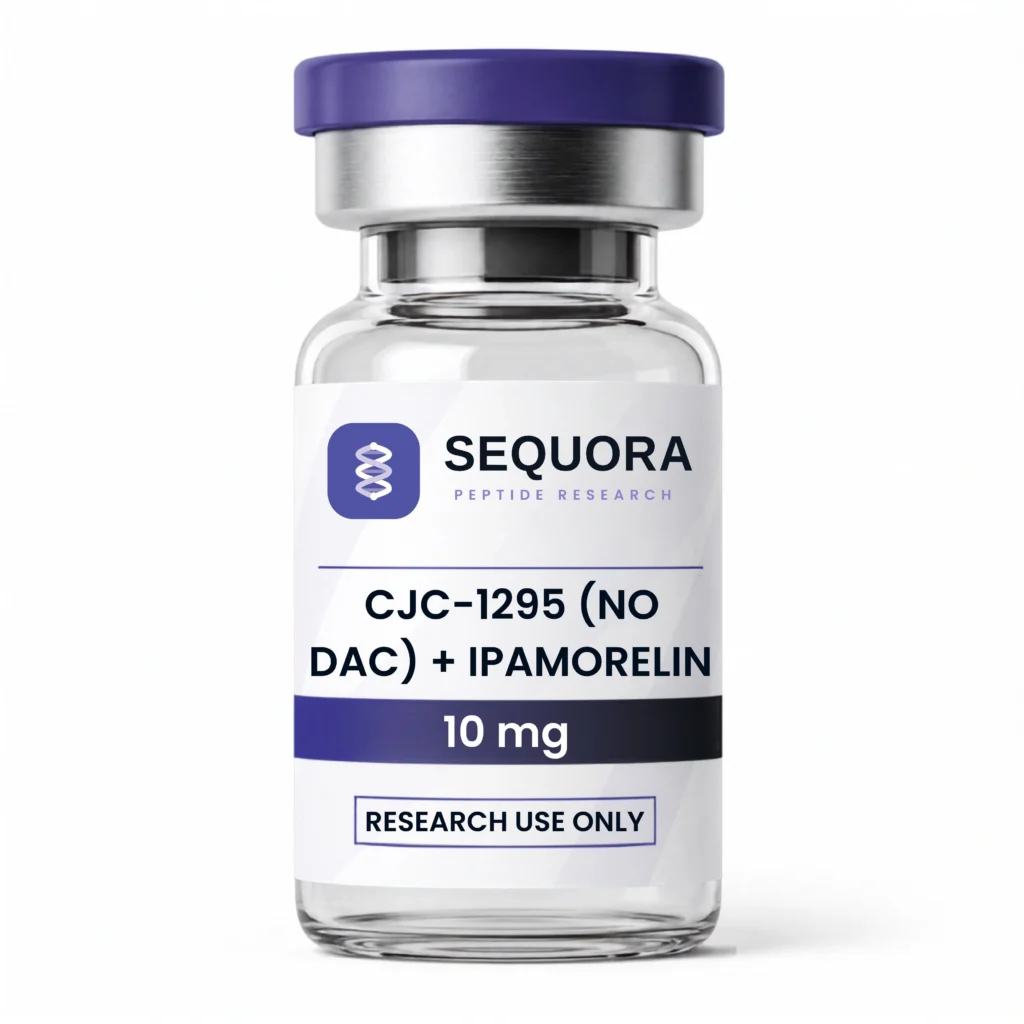
GHRH analogues are synthetic peptides modeled on growth hormone-releasing hormone (GHRH), the 44-amino-acid hypothalamic peptide first sequenced in 1982 [R1]. They bind the GHRH receptor, a G protein-coupled receptor found mainly in the anterior pituitary [R2]. This category holds sermorelin (GHRH 1–29) and tesamorelin, a full-length 44-residue analogue with an N-terminal hexenoyl group [R3][R4]. CJC-1295 No DAC, a modified GHRH(1–29), is supplied as a blend with ipamorelin [R5]. For background, read our research guide to GHRH analogues.
For laboratory research use only. Not for human or veterinary use.
COA ✓
COA ✓
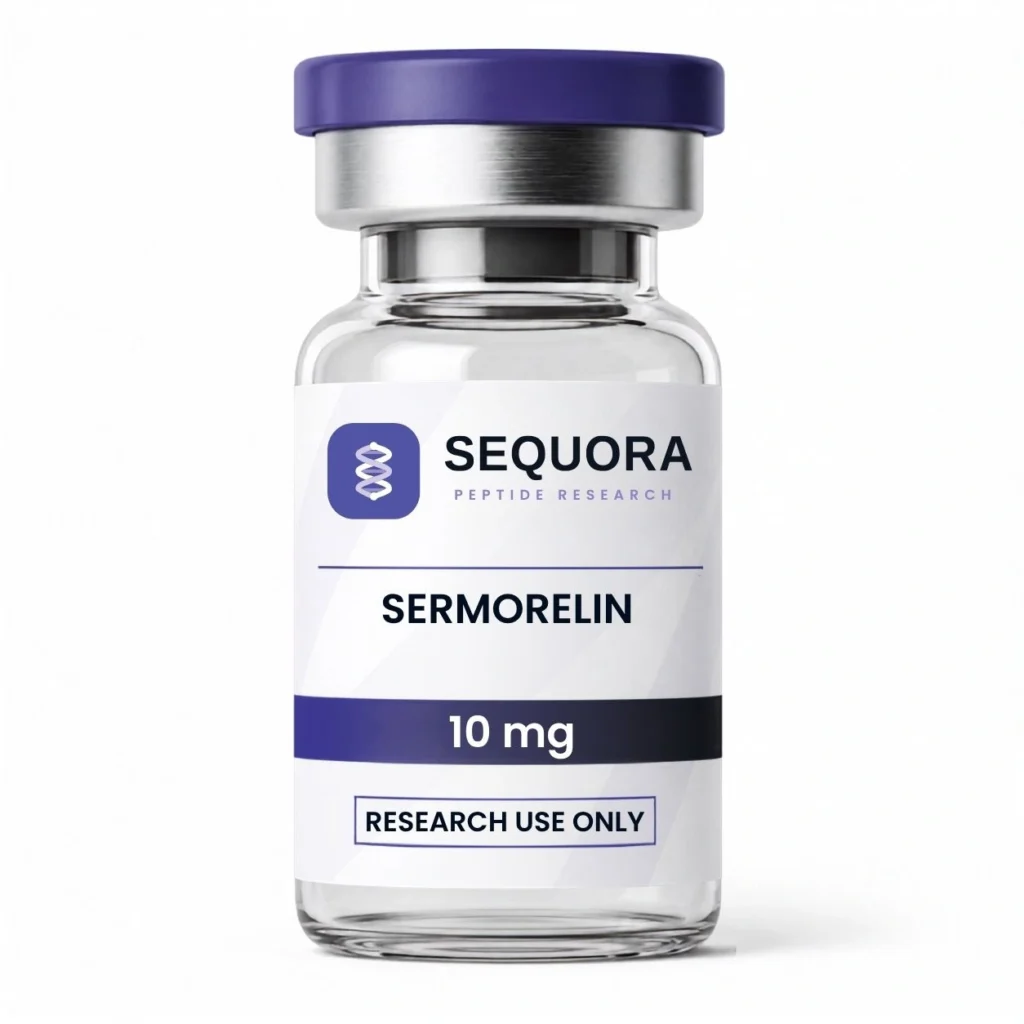
Sermorelin 10mg is a synthetic GHRH analog studied in growth hormone signaling and endocrine research. Supplied by Sequora Peptides strictly for laboratory research use only.

COA ✓
Tesamorelin 10mg is a synthetic GHRH analog studied for growth hormone signaling, endocrine function, and metabolic research. Supplied by Sequora Peptides strictly for laboratory research use only.
A GHRH analogue is a peptide built on the GHRH sequence that acts as an agonist at the GHRH receptor. Native human GHRH has 44 amino acids [R1]. Its receptor is a seven-transmembrane G protein-coupled receptor related to the secretin and VIP receptors, and it signals through cAMP [R2]. Sermorelin and tesamorelin are both listed as GHRH receptor agonists with the target GHRHR [R3][R4].
Analogues differ in length and in how they are modified. Sermorelin is the first 29 residues of human GHRH with a C-terminal amide [R3]. Tesamorelin keeps all 44 residues and adds a hexenoyl group to the N-terminal tyrosine [R4][R6]. Tetrasubstituted GRF(1–29), sold as CJC-1295 No DAC or Mod GRF 1–29, swaps four residues (D-Ala2, Gln8, Ala15, Leu27); CJC-1295 with DAC also adds a lysine with a maleimide linker that binds albumin [R5][R7].
Ipamorelin is not a GHRH analogue. It is a five-residue agonist of the ghrelin receptor (GHS-R1a), a separate receptor [R8][R9]. It is listed here only because it shares a vial with CJC-1295 No DAC. See sermorelin vs tesamorelin vs ipamorelin for the receptor-level comparison.
| Compound | Structure | Length | Target receptor | CAS | MW (g/mol) |
|---|---|---|---|---|---|
| Sermorelin | Human GHRH(1–29), C-terminal amide | 29 aa | GHRH receptor | 86168-78-7 | 3357.89 [R3] |
| Tesamorelin | Human GHRH(1–44) amide with N-terminal trans-3-hexenoyl group | 44 aa | GHRH receptor | 218949-48-5 | 5135.78 [R4] |
| CJC-1295 No DAC (Mod GRF 1–29) | GRF(1–29) amide with D-Ala2, Gln8, Ala15, Leu27 | 29 aa | GHRH receptor | No CAS confirmed in a primary registry; see batch COA | ≈3367.9 (calculated from sequence) [R5] |
| Ipamorelin (in the blend; not a GHRH analogue) | Aib-His-D-2-Nal-D-Phe-Lys-NH2 | 5 residues | Ghrelin receptor (GHS-R1a) | 170851-70-4 | 711.85 [R9] |
Tesamorelin is an FDA-approved drug for one indication: reducing excess abdominal fat in HIV-infected adults with lipodystrophy [R6]. Sermorelin was an approved US drug from 1990; its products were discontinued, approval was withdrawn in 2009, and FDA later found they were not withdrawn for safety or effectiveness reasons [R10]. CJC-1295 and ipamorelin are not approved; FDA advisers voted against adding either to the 503A compounding list in 2024 [R11][R12]. Research-labeled peptides sold here are none of those approved products.
A synthetic peptide modeled on growth hormone-releasing hormone that activates the GHRH receptor. Sermorelin and tesamorelin are two examples [R3][R4].
No. Ipamorelin is a ghrelin-receptor (GHS-R1a) agonist. In rat pituitary cells it acted through the GHRP receptor, not the GHRH pathway [R8].
Both share four amino-acid substitutions in GRF(1–29). CJC-1295 with DAC adds a lysine carrying a maleimide group that binds serum albumin; the No-DAC form lacks it [R5][R7]. Human data on CJC-1295 come from the DAC version [R13].
Not currently. Two sermorelin acetate drug products were approved in 1990 and 1997, then discontinued; FDA withdrew their approval effective June 18, 2009 [R10].
Store lyophilized powder at −20 °C, protected from light and moisture, and check each batch COA. See how to read a peptide COA.
For laboratory research use only. Not for human or veterinary use.
Our technical team can help with selection, reconstitution, and storage.
This site supplies chemicals strictly for laboratory research. You must confirm both statements below to enter.
Products are supplied for laboratory research use only and are not for human or veterinary use.