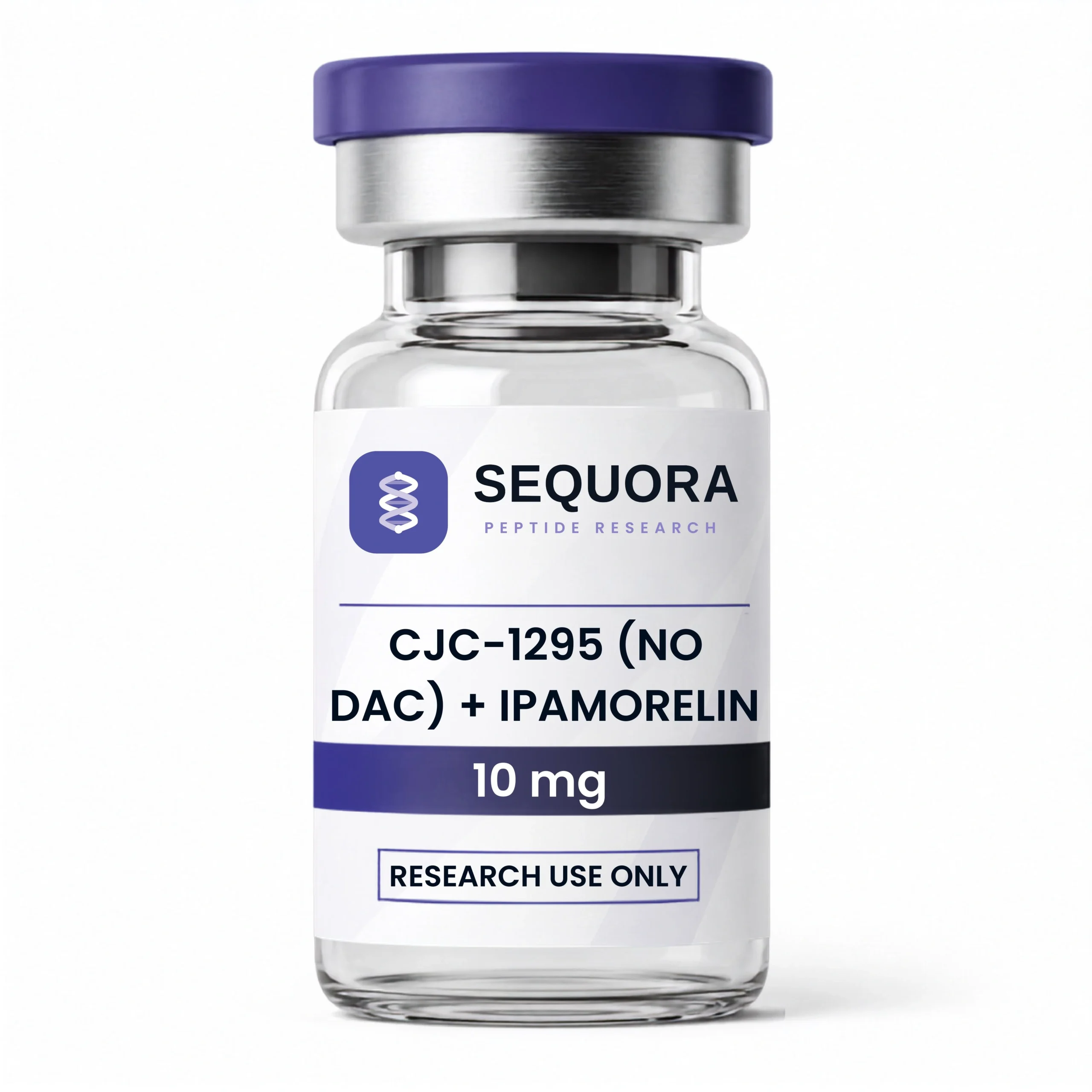
CJC-1295 (no DAC) + Ipamorelin 10 mg Blend For Sale
CJC-1295 (No DAC) + Ipamorelin 10 mg is a key formulation in peptide research. The objective of this combination is to optimize the GH ( growth hormone) axis. As stated in the study, The Mechanism of Action and Synergy of CJC-1295 and Ipamorelin Peptide Blend, this compound employs two distinct yet related physiological mechanisms to induce growth hormone production. The blend is studied because it acts through endogenous GHRH/GHS pathways rather than supplying GH directly.
Sequora Peptides supplies high-purity, lyophilized CJC-1295 (no DAC) + Ipamorelin 10 mg blend strictly for laboratory analysis and educational research.
Product Information
- Product Name: CJC-1295 (Without DAC) and Ipamorelin Combination
- Product Total Vial Weight: 10 mg (usually comes in two 5 mg portions)
- Product Molecular Structure: Growth Hormone Releasing Hormone (GHRH) Analogue coupled with Growth Hormone Secretagogue (GHS)
- Pathways Targeted: GHRH receptors and Ghrelin receptors (GHS-R1a) on anterior pituitary somatotrophs
- Product Features: High selectivity, growth hormone secretion in pulses, and lack of an albumin-bound complex
CJC-1295
According to the research article, prolonged stimulation of growth hormone (GH) and insulin-like growth factor I secretion by CJC-1295, a long-acting analogue of growth hormone-releasing hormone, in healthy adults, CJC-1295 without DAC is commonly marketed/referred to as Modified GRF(1-29), a modified GHRH(1-29) analogue.” FDA itself distinguishes CJC-1295-related substances by formulation.
In its “No DAC” form—frequently referred to in the literature as Modified GRF 1-29—it features specific amino acid substitutions that protect it against rapid enzymatic degradation by dipeptidyl peptidase-4 (DPP-4). According to the research article, Once-daily administration of CJC-1295, a long-acting growth hormone-releasing hormone (GHRH) analog, normalizes growth in the GHRH knockout mouse; the core utility of this peptide lies in its ability to bind directly to GHRH receptors, stimulating transcription and baseline synthesis of pituitary growth hormone.
Ipamorelin
According to the study, ipamorelin, the first selective growth hormone secretagogue, is a highly engineered, five-residue growth hormone-releasing peptide mimetic. Unlike earlier iterations of growth hormone secretagogues (such as GHRP-2 or GHRP-6), ipamorelin features unparalleled receptor selectivity. According to the study Pharmacokinetic-pharmacodynamic modeling of ipamorelin, a growth hormone-releasing peptide, in human volunteers, it activates the ghrelin receptor (GHS-R1a) to induce sharp, rapid GH release without triggering downstream elevations in stress-related or metabolic counter-hormones.
CJC-1295 (no DAC) + Ipamorelin: Mechanism of Action
The physiological synergy of this compound is mediated by a dual-pathway mechanism in the anterior pituitary gland.
According to The Mechanism of Action and Synergy of CJC-1295 and Ipamorelin Peptide Blend, CJC-1295 helps activate the intracellular cyclic adenosine monophosphate (cAMP) pathway while Ipamorelin affects the intracellular calcium levels. This simultaneous activation yields a compounding effect, releasing a volume of growth hormone up to five to ten times greater than either peptide could produce in isolation.
Ipamorelin stimulates GH release through GHS-R1a signaling and has demonstrated relative selectivity for GH release in experimental studies, according to the Expert assessment in the October 29, 2024 Meeting of the Pharmacy Compounding Advisory Committee. By neutralizing somatostatin—the body’s natural “brake” on growth hormone—it clears the path for CJC-1295 to amplify hormone production maximally.
Gun vs. Trigger Model
To simplify this intricate biochemical interplay of CJC-1295 and Ipamorelin, peptide researchers frequently employ the “Gun vs. Trigger” analogical model:
- The Gun (CJC-1295): This peptide acts as the firearm. It loads the system by stimulating the pituitary gland to make and accumulate a vast pool of growth hormone inside cellular reserves.
- The Trigger (Ipamorelin): This peptide acts as the physical mechanism that pulls the trigger. It signals the instantaneous, pulsatile release of that built-up hormone reserve directly into circulation.
So we simply say that without the gun, there is nothing to fire; without the trigger, the ammunition remains locked away. Together, they create a perfectly synchronized event
Research Applications of CJC-1295 (no DAC) + Ipamorelin
The combination of CJC-1295 (No DAC) + Ipamorelin gives researchers two unique ways to look at the regulation of growth hormones. While CJC-1295 (No DAC) acts via the GHRH receptor pathway, Ipamorelin targets the GHS-R1a. Such a combination of pathways makes it relevant to various laboratory research fields.
Some common applications include:
- Growth hormone signaling: study the pathway involved in growth hormone release from the pituitary gland.
- GHRH receptor research: study the signaling involved with GHRH and its analogs.
- GHS-R1a research: study the function of growth hormone secretagogue and ghrelin receptors.
- Endocrine research: study the interaction between hypothalamic and pituitary signaling pathways.
- Peptide pharmacology: compare the activity and pharmacological properties of various growth hormone secretagogues.
- Receptor pathway research: study the impact of distinct receptor systems on one endocrine axis.
The article “Ipamorelin, a New Highly Growth Hormone-Releasing Peptide” is one of the research papers that gives a background to the secretagogue activity of Ipamorelin. The research on CJC-1295 can be used to conduct research on GHRH pathways. Nonetheless, any research on synergistic effects of this combination should be scientifically proven.
Why “No DAC” Matters for Research
CJC-1295 exists in two forms :
| Feature | With DAC | Without DAC (Mod GRF 1-29) |
| Half-life | ~5.8–8.1 days | ~30 minutes |
| Receptor Stimulation | Sustained, continuous | Acute, pulsatile |
| Research Rationale | Stable GH elevation | Mimics natural pulsatility |
The no-DAC formulation preserves physiological pulse architecture, which is typically paired with Ipamorelin because their pulse timing matches. According to a study by Ionescu and colleagues, preservation of GH pulsatility during GHRH stimulation helps maintain receptor sensitivity and physiological feedback regulation.
Scientific Evidence
According to a study, prolonged stimulation of growth hormone (GH) and insulin-like growth factor I secretion by CJC-1295, a long-acting analog of GH-releasing hormone, in healthy adults, human subjects demonstrated safe, dose-dependent increases in plasma GH and a 1.5- to 3-fold elevation in IGF-1. According to a research paper, Ipamorelin, the first selective growth hormone secretagogue, showed a preclinical and early clinical profile that isolates growth hormone responses with absolute selectivity, leaving plasma ACTH, cortisol, prolactin, and thyroid-stimulating hormone completely unaffected.
The Research Gap
The combination of CJC-1295 (no DAC) and Ipamorelin has never been studied in humans through a randomized clinical trial that used dosing regimens typical of those used in research literature. Each peptide has been individually investigated in terms of human pharmacokinetics, while preclinical studies provide evidence for a synergistic mechanism, but the combination’s effects have not been put through the clinical trial process.
Product quality
To ensure the reliability of your lab results, it is critical to use analytical validation. High-quality peptides should have High-Performance Liquid Chromatography and Mass Spectrometry testing done to certify that the purity level is higher. Using low-quality products with heavy metal contaminants, incorrect isomer variants, or endotoxins may lead to misleading research findings and harmful side effects.
Storage
- Storage Conditions for Powder (Lyophilized): Peptides in powder form are stable at room temperature; however, they must be stored in a -20 freezer for an extended period.
- Storage Conditions for Reconstituted Peptides: After reconstitution, the peptide chain becomes unstable and should be stored in a refrigerator at a temperature between 2°C and 8°C. It is recommended to use the product within 20-30 days after reconstitution. Do not shake the vial vigorously.
Regulatory status
As of 2026, CJC-1295 and Ipamorelin are not FDA-approved peptides. Both were considered by the FDA’s Pharmacy Compounding Advisory Committee in October and December 2024. The FDA has advised against the addition of these two substances to the 503A Bulk Drug Substances Regulation.
Moreover, the World Anti-Doping Agency has added growth hormone secretagogues to its Prohibited List in the category of Anabolic Agents (S2).
FAQs
1. How does CJC-1295 with DAC differ from CJC-1295 without DAC?
While the version of CJC-1295 with DAC binds to albumin and thereby extends its half-life to approximately 5.8 to 8.1 days, causing sustained stimulation of GHRH receptors, the version without DAC has a half-life of about 30 minutes and results in acute, pulsatile GH release more similar to the natural one. The no-DAC version should be used in combination with Ipamorelin as their pulses align.
2. Why do researchers choose Ipamorelin for this combination?
As per the findings of the seminal study conducted by Raun et al. in 1998, Ipamorelin is the most selective ghrelin-receptor agonist discovered thus far. While it stimulates GH release without increasing the levels of ACTH, cortisol, or prolactin even 200 times more than the GH-releasing dose, this is not true for GHRP-2 and GHRP-6.
3. Are there any published human studies using this specific combination?
There are no published human randomized trials that have studied the combination of CJC-1295 (without DAC) + Ipamorelin at doses that are typical for research experiments. While both of these substances have their own sets of pharmacokinetic information (by Teichman, 2006, and Raun, 1998) and the cellular-level research shows synergy, the combination itself has not been clinically tested.
4. What purity standards should researchers expect?
Research-grade formulations typically achieve high purity verified by independent HPLC analysis, with each batch accompanied by a Certificate of Analysis.
5. How should this peptide blend be stored?
Lyophilized peptide combinations should be stored at cold temperatures (2-8°C). For long-term storage after initial reconstitution, -20°C is recommended. After reconstitution, peptides should be refrigerated and used within 4-6 weeks, protected from light and heat. Never freeze reconstituted peptides.
References
- https://www.irejournals.com/paper-details/1714043
- https://pubmed.ncbi.nlm.nih.gov/16352683/
- https://pure.johnshopkins.edu/en/publications/once-daily-administration-of-cjc-1295-a-long-acting-growth-hormon-4/
- https://scispace.com/pdf/ipamorelin-the-first-selective-growth-hormone-secretagogue-1t1xkfpaeo.pdf
- https://pubmed.ncbi.nlm.nih.gov/10496658/
- https://www.fda.gov/media/182088/download