Institutional accounts only · Pricing and quotes released after verified laboratory registration
Institutional accounts only · Pricing and quotes released after verified laboratory registration
Reference data, Safety Data Sheets, and Certificates of Analysis for every catalog compound. Pricing and quotations are released to verified institutions only. For laboratory research use only.
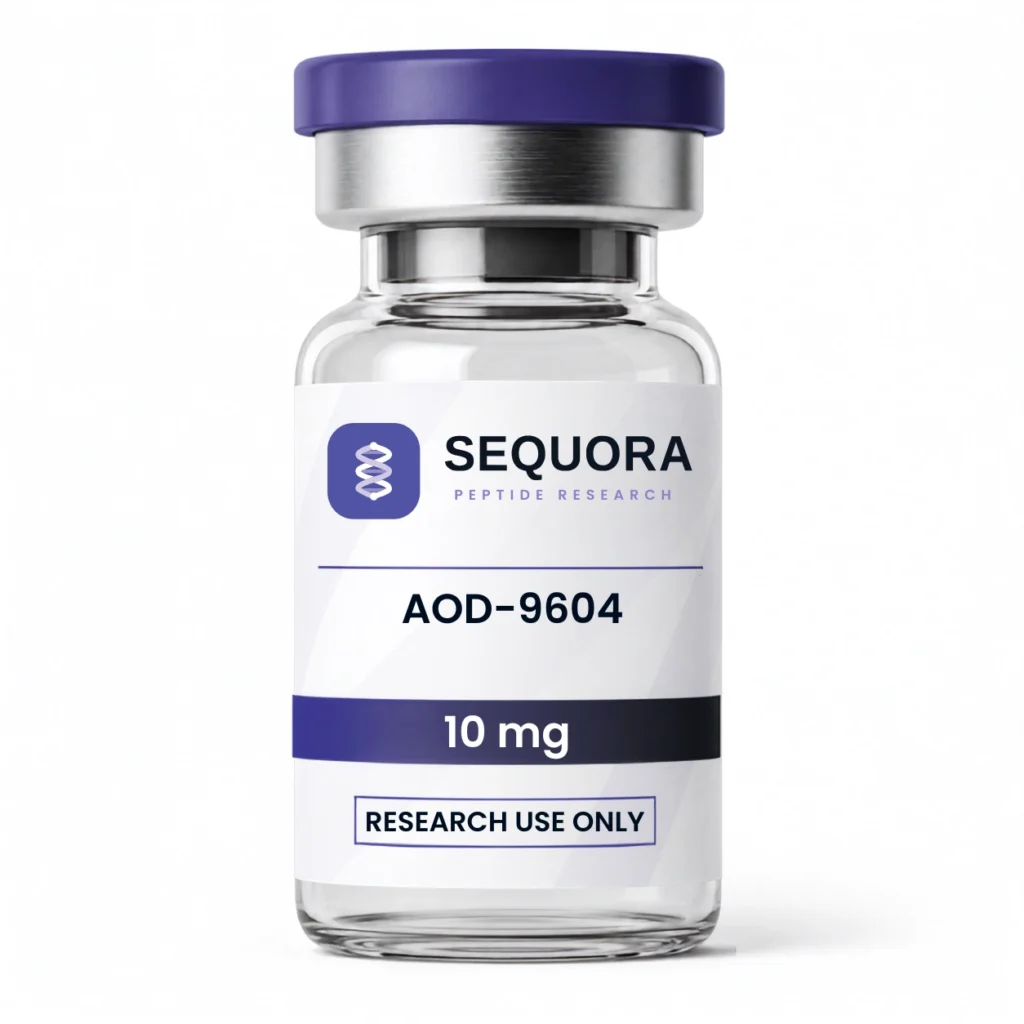
Growth hormone fragments are short synthetic peptides copied from the C-terminal end of human growth hormone (hGH), a 191-residue protein [R1]. The best-studied is AOD-9604, hGH residues 177–191 with an added N-terminal tyrosine, a 16-residue peptide closed by one disulfide bond [R2]. In laboratory tests AOD-9604 did not affect hGH binding to the growth hormone receptor [R2], and it has been studied in rodent fat-tissue models and a rabbit cartilage model. Read the full guide: What are growth hormone fragments? HGH 176-191 and AOD-9604.
For laboratory research use only. Not for human or veterinary use.
COA ✓
A growth hormone fragment is a peptide made from a short stretch of the hGH sequence rather than the whole protein. The fragments in this category come from the last 15–16 residues of hGH, a loop held together by the disulfide bond between Cys182 and Cys189 of the mature hormone [R1].
Research on this region began with a synthetic copy of hGH residues 177–191, which reduced lipogenesis in rat fat tissue in a way similar to the full hormone [R3]. AOD-9604 followed: the same 15 residues with a tyrosine added at the N-terminus [R2]. "HGH fragment 176-191" is a closely related name for residues 176–191, which starts with hGH's own phenylalanine at position 176 instead of tyrosine [R1].
The receptor that these fragments act on has not been identified. In mice, AOD-9604's effects did not depend directly on the β3-adrenergic receptor [R4], and in human trials it did not change serum IGF-1, a marker of growth hormone receptor signaling [R5]. That separates this class from GHRH analogues such as tesamorelin, which raise growth hormone release; see AOD-9604 vs tesamorelin.
| Peptide | Structure | Length | Target / pathway studied | CAS | MW (g/mol) |
|---|---|---|---|---|---|
| AOD-9604 | Tyr + hGH(177-191): YLRIVQCRSVEGSCGF, disulfide Cys7–Cys14 | 16 aa | Lipid metabolism in adipose tissue (rodent); receptor unknown | 221231-10-3 | 1815.1 (C78H123N23O23S2) |
| hGH fragment 176-191 (reference only, not sold) | hGH(176-191): FLRIVQCRSVEGSCGF, disulfide Cys7–Cys14 | 16 aa | Same C-terminal region; little indexed primary research under this name | — | ≈1799.1 (calculated from sequence) |
| hGH(177-191) (reference only, not sold) | LRIVQCRSVEGSCGF, disulfide Cys6–Cys13 | 15 aa | Lipogenesis in rat adipose tissue | — | ≈1651.9 (calculated from sequence) |
Sources: sequences from the hGH record [R1] and FDA [R2]; AOD-9604 CAS and formula from FDA [R2] and PubChem [R6]; hGH(177-191) activity [R3]. Calculated weights use average residue masses with one disulfide bond.
No growth hormone fragment is an FDA-approved drug. AOD-9604 was removed from FDA's 503A "Category 2" list in September 2024 after its nomination was withdrawn [R7], and FDA's advisory committee voted 12–0 against adding it to the 503A bulks list on December 4, 2024 [R8]. Growth hormone fragments, named as AOD-9604 and hGH 176-191, are on the World Anti-Doping Agency's 2026 Prohibited List [R9]. Sequora sells these compounds for laboratory research only; see RUO peptides explained.
An HGH fragment is a short synthetic peptide copied from part of the human growth hormone sequence. The common ones come from the hormone's C-terminal residues 176/177–191 [R1][R2].
No. Both have 16 residues and share the last 15. AOD-9604 starts with tyrosine; fragment 176-191 starts with phenylalanine, hGH's natural residue 176 [R1][R2].
No. Full hGH has 191 residues; these fragments have 15–16. In human trials AOD-9604 did not change serum IGF-1, unlike growth hormone itself [R5].
No. None is approved, and FDA's advisory committee voted against AOD-9604 for the 503A compounding list [R8].
Store lyophilized powder at −20 °C, protected from light and moisture, and follow the batch COA.
For laboratory research use only. Not for human or veterinary use.
Our technical team can help with selection, reconstitution, and storage.
This site supplies chemicals strictly for laboratory research. You must confirm both statements below to enter.
Products are supplied for laboratory research use only and are not for human or veterinary use.