
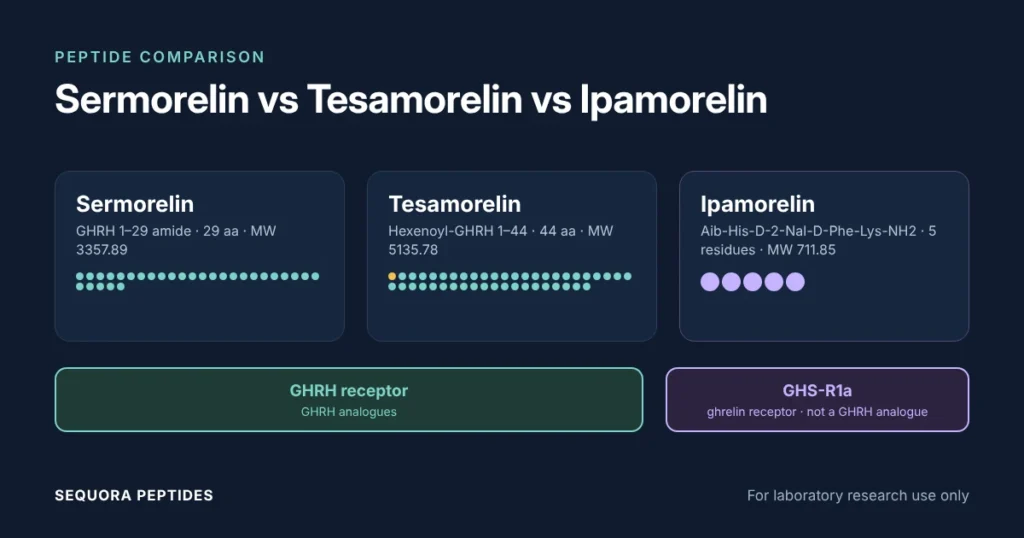
Sermorelin and tesamorelin are GHRH analogues that act on the GHRH receptor; ipamorelin is not — it is a ghrelin-receptor (GHS-R1a) agonist that reaches the pituitary through a different receptor [R1][R2][R3]. All three are peptides, but they differ in length, structure, clinical history and regulatory status. This article compares them point by point, with a source for each claim.
The Short Answer
| Sermorelin | Tesamorelin | Ipamorelin | |
|---|---|---|---|
| Class | GHRH analogue | GHRH analogue | Ghrelin-receptor agonist (growth hormone secretagogue) |
| Structure | Human GHRH 1–29, C-terminal amide [R1] | Human GHRH 1–44 amide + N-terminal hexenoyl group [R2][R4] | Aib-His-D-2-Nal-D-Phe-Lys-NH2 [R5] |
| Length | 29 amino acids | 44 amino acids | 5 residues |
| Receptor | GHRH receptor [R1] | GHRH receptor [R2] | GHS-R1a (ghrelin receptor) [R5] |
| Formula | C149H246N44O42S [R1] | C221H366N72O67S [R2] | C38H49N9O5 [R5] |
| MW (g/mol) | 3357.89 [R1] | 5135.78 [R2] | 711.85 [R5] |
| CAS | 86168-78-7 | 218949-48-5 | 170851-70-4 |
| US status | Approved 1990/1997; discontinued; approval withdrawn 2009 [R6] | Approved 2010 for one indication [R4][R7] | Never approved [R8] |
Two Receptors, Not One
The pituitary has two separate receptors that these peptides use. The GHRH receptor is a G protein-coupled receptor, cloned in 1992, found mainly in the anterior pituitary, and it signals through cAMP [R9]. The growth hormone secretagogue receptor (GHS-R1a) is a different G protein-coupled receptor, cloned in 1996 [R10]; its natural ligand, ghrelin, was identified in the stomach in 1999 [R11].
Sermorelin and tesamorelin bind the first. Ipamorelin binds the second. In primary rat pituitary cells, antagonist profiling showed that ipamorelin acts through the GHRP (ghrelin) receptor, like GHRP-6, and not through the GHRH pathway [R3]. This is why “sermorelin vs ipamorelin” is not a comparison of two versions of one thing; it is a comparison of two mechanisms.
Sermorelin vs Tesamorelin
Both are GHRH analogues; tesamorelin is longer and capped, while sermorelin is the bare 1–29 fragment.
- Length. Sermorelin is residues 1–29 of human GHRH [R1]. Tesamorelin keeps all 44 [R4].
- Modification. Tesamorelin adds a hexenoyl group (a six-carbon chain with a double bond at position 3) to the N-terminal tyrosine [R4]. Sermorelin has no added group.
- Half-life. Tesamorelin’s label reports a mean elimination half-life of 11 minutes in healthy subjects [R4]. By comparison, CJC-1295 with DAC, an albumin-binding analogue, had an estimated half-life of 5.8–8.1 days in healthy adults [R12].
- Clinical history. Sermorelin was approved as a pituitary diagnostic in 1990 and for children with idiopathic growth hormone deficiency in 1997; both products were later discontinued [R6]. Tesamorelin was approved in 2010 [R7].
Tesamorelin trial evidence. In a 26-week randomized, double-blind trial of 412 HIV-infected adults with excess abdominal fat, visceral adipose tissue fell 15.2% with tesamorelin and rose 5.0% with placebo, and IGF-I rose 81.0% in the tesamorelin group [R13]. A pooled analysis of two phase 3 trials reported similar findings and maintenance through 52 weeks in patients who continued treatment [R14]. Its label limits the indication to that population, states it is not indicated for weight-loss management, and notes that long-term cardiovascular safety has not been established [R4].
Sermorelin vs Ipamorelin
Sermorelin mimics GHRH; ipamorelin mimics ghrelin. They share a downstream hormone but not a receptor.
- Structure. Sermorelin is a 29-residue chain of natural L-amino acids [R1]. Ipamorelin is a five-residue peptide containing non-natural residues: Aib (2-aminoisobutyric acid), D-2-naphthylalanine and D-phenylalanine [R5].
- Selectivity. In the 1998 discovery paper, ipamorelin released growth hormone in rat pituitary cells with potency similar to GHRP-6. In swine it did not significantly raise ACTH or cortisol, unlike GHRP-6 and GHRP-2, and it did not affect FSH, LH, prolactin or TSH [R3].
- Clinical history. Sermorelin reached approval [R6]. Ipamorelin reached a phase 2 trial for postoperative ileus after bowel resection: in 114 analyzed patients, median time to first tolerated meal was 25.3 hours with ipamorelin versus 32.6 hours with placebo, a difference that was not statistically significant (p = 0.15) [R15]. It has never been approved.
Tesamorelin vs Ipamorelin
Tesamorelin is a 44-residue approved GHRH analogue; ipamorelin is a five-residue, never-approved ghrelin-receptor agonist. Tesamorelin is about seven times heavier (5135.78 vs 711.85 g/mol) [R2][R5]. Their clinical programs targeted unrelated conditions: HIV-associated abdominal fat for tesamorelin [R13], postoperative ileus for ipamorelin [R15]. Research blends that pair tesamorelin with ipamorelin combine the two receptor pathways; we found no published randomized trial of such a combination.
Where CJC-1295 Fits
CJC-1295 is a third kind of GHRH analogue. It is GRF(1–29) with four substitutions (D-Ala2, Gln8, Ala15, Leu27). The version with DAC adds a lysine carrying a maleimide linker that binds serum albumin; the No-DAC version, also called Mod GRF 1–29, does not [R16]. The published human study used the DAC version [R12]. Sequora’s CJC-1295 No DAC + Ipamorelin blend pairs a GHRH analogue with a ghrelin-receptor agonist in one vial. For the DAC vs No-DAC difference in detail, see What are GHRH analogues?
Limits of the Evidence
- Head-to-head human studies comparing sermorelin, tesamorelin and ipamorelin do not exist in the published literature we reviewed.
- Tesamorelin’s trial data come from one population, HIV-infected adults with lipodystrophy [R13][R14].
- Ipamorelin’s largest trial missed its primary endpoint [R15].
- A review of growth hormone secretagogues found few long-term, rigorously controlled studies [R17].
Regulatory Status
Tesamorelin is an approved drug for reducing excess abdominal fat in HIV-infected adults with lipodystrophy [R4]. Sermorelin’s approved products were discontinued and approval withdrawn effective June 18, 2009; in 2013 FDA found this was not for safety or effectiveness reasons [R6]. Ipamorelin was never approved: an FDA advisory committee voted 0–12 (one abstention) against adding it to the 503A compounding list on October 29, 2024, citing a lack of safety and efficacy information, and ipamorelin acetate is in Category 2 for 503B outsourcing facilities [R8][R18]. Research-labeled versions of all three are research chemicals, not approved drug products. See RUO peptides explained.
FAQ
Is ipamorelin a GHRH analogue?
No. It is a ghrelin-receptor (GHS-R1a) agonist. Sermorelin and tesamorelin are GHRH analogues [R3][R5].
What is the main difference between sermorelin and tesamorelin?
Length and modification: sermorelin is GHRH 1–29; tesamorelin is GHRH 1–44 with an N-terminal hexenoyl group [R1][R4].
Which of the three is FDA-approved?
Only tesamorelin, for one indication. Sermorelin was approved but its products were discontinued and approval withdrawn in 2009. Ipamorelin was never approved [R4][R6][R8].
Why are GHRH analogues and ipamorelin studied together?
They reach the pituitary through two different receptors, the GHRH receptor and GHS-R1a, so researchers use them to study both pathways [R9][R10].
Is CJC-1295 more like sermorelin or ipamorelin?
Sermorelin. CJC-1295 is a modified GRF(1–29) that acts on the GHRH receptor [R16].
References
How we select and verify sources: Research Sources & Editorial Standards
- KEGG DRUG. Sermorelin, D08509. kegg.jp/entry/D08509
- KEGG DRUG. Tesamorelin, D06655. kegg.jp/entry/D06655
- Raun K, Hansen BS, Johansen NL, et al. Ipamorelin, the first selective growth hormone secretagogue. Eur J Endocrinol. 1998;139(5):552–561. doi:10.1530/eje.0.1390552. PMID 9849822.
- U.S. Food and Drug Administration. Tesamorelin prescribing information, BLA 022505, revised 3/2025. accessdata.fda.gov (PDF)
- FDA Global Substance Registration System. Ipamorelin, UNII Y9M3S784Z6. precision.fda.gov
- U.S. Food and Drug Administration. Determination that sermorelin acetate (GHRH 1–29) drug products were not withdrawn from sale for reasons of safety or effectiveness. Fed Regist. 2013;78(42):14095–14096. govinfo.gov (PDF)
- U.S. Food and Drug Administration. Drugs@FDA: BLA 022505 (tesamorelin acetate). accessdata.fda.gov
- U.S. Food and Drug Administration. Pharmacy Compounding Advisory Committee, October 29, 2024: final summary minutes. fda.gov
- Mayo KE. Molecular cloning and expression of a pituitary-specific receptor for growth hormone-releasing hormone. Mol Endocrinol. 1992;6(10):1734–1744. doi:10.1210/mend.6.10.1333056. PMID 1333056.
- Howard AD, Feighner SD, Cully DF, et al. A receptor in pituitary and hypothalamus that functions in growth hormone release. Science. 1996;273(5277):974–977. doi:10.1126/science.273.5277.974. PMID 8688086.
- Kojima M, Hosoda H, Date Y, Nakazato M, Matsuo H, Kangawa K. Ghrelin is a growth-hormone-releasing acylated peptide from stomach. Nature. 1999;402(6762):656–660. doi:10.1038/45230. PMID 10604470.
- Teichman SL, Neale A, Lawrence B, Gagnon C, Castaigne JP, Frohman LA. Prolonged stimulation of growth hormone (GH) and insulin-like growth factor I secretion by CJC-1295, a long-acting analog of GH-releasing hormone, in healthy adults. J Clin Endocrinol Metab. 2006;91(3):799–805. doi:10.1210/jc.2005-1536. PMID 16352683.
- Falutz J, Allas S, Blot K, et al. Metabolic effects of a growth hormone-releasing factor in patients with HIV. N Engl J Med. 2007;357(23):2359–2370. doi:10.1056/NEJMoa072375. PMID 18057338.
- Falutz J, Mamputu JC, Potvin D, et al. Effects of tesamorelin (TH9507), a growth hormone-releasing factor analog, in human immunodeficiency virus-infected patients with excess abdominal fat: a pooled analysis of two multicenter, double-blind placebo-controlled phase 3 trials with safety extension data. J Clin Endocrinol Metab. 2010;95(9):4291–4304. doi:10.1210/jc.2010-0490. PMID 20554713.
- Beck DE, Sweeney WB, McCarter MD; Ipamorelin 201 Study Group. Prospective, randomized, controlled, proof-of-concept study of the ghrelin mimetic ipamorelin for the management of postoperative ileus in bowel resection patients. Int J Colorectal Dis. 2014;29(12):1527–1534. doi:10.1007/s00384-014-2030-8. PMID 25331030.
- Jetté L, Léger R, Thibaudeau K, et al. Human growth hormone-releasing factor (hGRF)1–29-albumin bioconjugates activate the GRF receptor on the anterior pituitary in rats: identification of CJC-1295 as a long-lasting GRF analog. Endocrinology. 2005;146(7):3052–3058. doi:10.1210/en.2004-1286. PMID 15817669.
- Sigalos JT, Pastuszak AW. The safety and efficacy of growth hormone secretagogues. Sex Med Rev. 2018;6(1):45–53. doi:10.1016/j.sxmr.2017.02.004. PMID 28400207.
- U.S. Food and Drug Administration. Bulk drug substances nominated for use in compounding under section 503B of the FD&C Act (updated March 21, 2025). fda.gov
Reference compounds
This article summarizes published research and public regulatory documents for educational purposes. Sequora Peptides supplies research chemicals for laboratory use only; nothing here describes use in humans or animals.
For laboratory research use only. Not for human or veterinary use.