
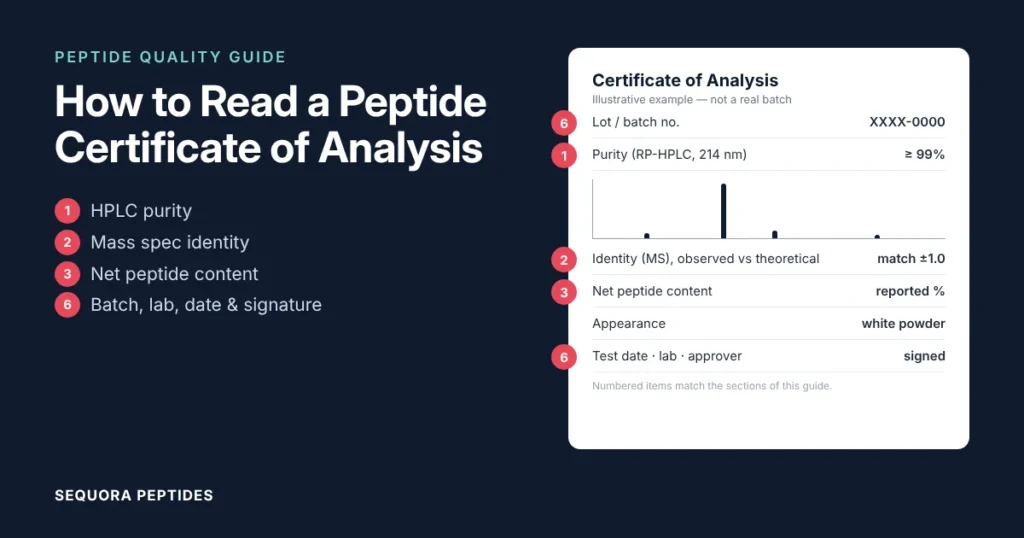
A peptide certificate of analysis (COA) answers two separate questions: is the peptide in the vial the right molecule (identity, usually by mass spectrometry), and how much of it is that molecule versus impurities (purity, usually by HPLC) [R1]. A COA that reports only one of the two leaves the other open. This guide explains each line you will find on a peptide COA and what to check.
1. HPLC Purity: How Much of the Sample Is the Target Peptide
Reversed-phase high-performance liquid chromatography (RP-HPLC) separates the peptide from related impurities, and a UV detector, typically set at 210–220 nm, records each component as a peak [R2]. Purity is reported as the area of the main peak as a percentage of the total area of all peaks [R2]. A result of “≥99% by HPLC” means the target peptide accounts for at least 99% of the UV-detectable material.
What to check: the COA should state the method (HPLC), the purity percentage, and ideally include the chromatogram, so you can see one dominant peak.
2. Mass Spectrometry: Is It the Right Molecule?
HPLC purity does not prove identity. A sample can be 99% pure and still be the wrong peptide. Mass spectrometry (MS) measures the molecular mass of the main component and compares it with the theoretical mass of the expected sequence [R1]. In the USP expert panel’s description, an MS identity result should fall within ±1.0 mass unit of the theoretical value [R1]. Research peptide facilities commonly pair MALDI-TOF MS with analytical RP-HPLC for this reason [R3].
A limit to know: MS cannot distinguish isomers with identical mass, such as leucine vs isoleucine or D- vs L-amino acids [R1].
3. Purity Is Not the Same as Peptide Content
A lyophilized peptide powder is not 100% peptide by weight, even at 99% HPLC purity. It also contains counter-ions and residual water. Net peptide content is the fraction of the powder’s weight that is peptide, measured by nitrogen (elemental) analysis or amino acid analysis [R4]. Typical values run from about 50% to 90%, and lower for peptides rich in basic residues such as arginine [R4][R5].
Why counter-ions are there: trifluoroacetic acid (TFA) is used to cleave peptides from the synthesis resin and in the HPLC mobile phase, so most peptides end up as TFA salts after freeze-drying [R6]. TFA can be exchanged for chloride (HCl salt) or acetate in an extra processing step [R6][R2].
4. What the Impurities Are
The small peaks in a chromatogram are usually peptide-related impurities created during synthesis or storage. A 2014 review in the Journal of Pharmaceutical and Biomedical Analysis classifies the main types [R7]:
- Deletion and insertion sequences (a residue missing or added)
- Truncated sequences (chains cut short at either end)
- Incompletely deprotected sequences (protecting groups left on)
- Oxidation and deamidation products
- Racemization products (diastereomers)
- Dimers and oligomers
For context on how strict pharmaceutical standards are: FDA’s 2021 guidance for generic synthetic peptides asks applicants to identify each peptide-related impurity present at 0.10% or more, and limits any new specified impurity to no more than 0.5% [R8]. That guidance applies to approved drug products, not research chemicals, but it shows what “highly purified” means at the regulatory level.
5. Other Lines You May See
| COA line | What it means |
|---|---|
| Appearance | Visual check against the specification, e.g. “white lyophilized powder” [R9] |
| Water content | Measured by Karl Fischer titration; many peptides absorb moisture [R2] |
| Counter-ion content | Amount of TFA, acetate, or chloride in the powder [R6] |
| Endotoxin | Bacterial endotoxin measured by the LAL test, reported in endotoxin units (EU) [R10] |
| Solubility | Depends on the peptide’s net charge and hydrophobicity [R11] |
Water, counter-ion, and endotoxin results usually appear on pharmaceutical-grade certificates; research-grade COAs typically focus on HPLC purity and MS identity [R9].
6. How to Tell if a COA Is Trustworthy
The World Health Organization’s model certificate of analysis lists what a credible COA carries [R12]:
- A batch or lot number that matches the label on your vial
- The name and address of the testing laboratory
- The test date
- Each test’s result next to its acceptance limit, with the method referenced
- The signature and date of an authorized approver
Two further signs of a strong COA: the raw chromatogram and mass spectrum are attached, and the testing lab is accredited to ISO/IEC 17025:2017 for the specific methods used. ISO/IEC 17025 is the international standard for the competence and impartiality of testing laboratories [R13]. Accreditation covers only the methods on a lab’s scope, which you can look up through accreditation bodies such as NIST’s NVLAP [R14].
How Sequora Tests Every Batch
Every batch is tested by HPLC for purity and by mass spectrometry for identity, and the COA for your batch is shown on each product page, for example Epitalon 10mg.
Frequently Asked Questions
What does “≥99% by HPLC” mean on a peptide COA?
The target peptide’s peak accounts for at least 99% of the total peak area in the chromatogram [R2]. It does not confirm identity or mean the powder is 99% peptide by weight.
Is HPLC enough to verify a peptide?
No. HPLC measures purity; mass spectrometry is needed to confirm the molecule’s identity [R1].
What is TFA on a peptide COA?
Trifluoroacetic acid, a counter-ion left from synthesis and purification [R6].
What is the difference between purity and net peptide content?
Purity compares the target peptide with peptide impurities. Net peptide content compares the peptide with everything in the powder, including counter-ions and water [R4].
References
How we select and verify sources: Research Sources & Editorial Standards
- Verlander M, Rode H. Control strategies for synthetic therapeutic peptide APIs, Part I: analytical consideration. BioPharm International. 2014;27(3). biopharminternational.com
- Bachem. Quality control of amino acids & peptides: a guide. bachem.com
- UNC Peptides Core Facility, University of North Carolina at Chapel Hill. Services. med.unc.edu
- Bachem. What does net peptide content mean? bachem.com
- AmbioPharm. Net peptide content. ambiopharm.com
- Erckes V, Streuli A, Chamera Rendueles L, Krämer SD, Steuer C. Towards a consensus for the analysis and exchange of TFA as a counterion in synthetic peptides and its influence on membrane permeation. Pharmaceuticals. 2025;18(8):1163. doi:10.3390/ph18081163.
- D’Hondt M, Bracke N, Taevernier L, Gevaert B, Verbeke F, Wynendaele E, De Spiegeleer B. Related impurities in peptide medicines. J Pharm Biomed Anal. 2014;101:2–30. doi:10.1016/j.jpba.2014.06.012.
- U.S. Food and Drug Administration. ANDAs for certain highly purified synthetic peptide drug products that refer to listed drugs of rDNA origin. Guidance for industry, May 2021. fda.gov
- AmbioPharm. Certificate of analysis contents. ambiopharm.com
- U.S. Food and Drug Administration. Pyrogen and endotoxins testing: questions and answers (Edition 2). March 2026. fda.gov
- GenScript. Peptide solubility guidelines. genscript.com
- World Health Organization. Model certificate of analysis. WHO Technical Report Series No. 1010, Annex 4, 2018. who.int
- International Organization for Standardization. ISO/IEC 17025:2017 — General requirements for the competence of testing and calibration laboratories. iso.org
- National Institute of Standards and Technology. National Voluntary Laboratory Accreditation Program (NVLAP). nist.gov