
Institutional accounts only · Pricing and quotes released after verified laboratory registration
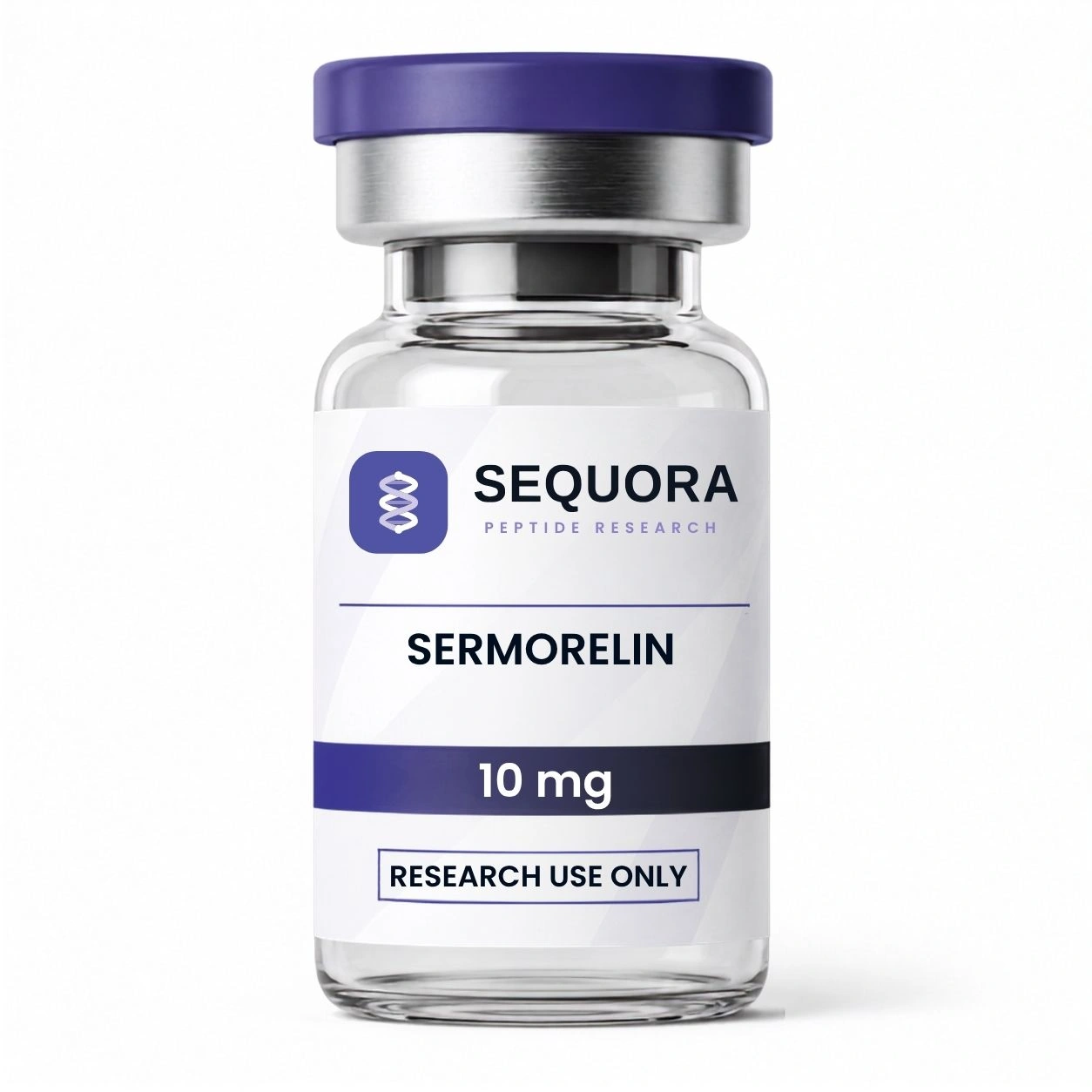
Sermorelin 10mg is a synthetic GHRH analog studied in growth hormone signaling and endocrine research. Supplied by Sequora Peptides strictly for laboratory research use only.
| Molecular Formula | C149H246N44O42 |
|---|---|
| Molecular Mass | 3358 g/mol |
| Monoisotopic Mass | 3355.834460 g/mol |
| Polar Area | 1440 Ų |
| Complexity | 8210 |
| XLogP | -26.5 |
| Heavy Atom Count | 235 |
| Hydrogen Bond Donor Count | 52 |
| Hydrogen Bond Acceptor Count | 60 |
| Rotatable Bond Count | 122 |
Every batch is verified for identity and purity by an independent lab before release.
Scan your batch code to pull the full certificate — chromatogram included.
Material compromised in transit is replaced against the original procurement record.
Sermorelin represents a synthetic analogue that contains a fragment consisting of 1-29 amino acids of human Growth Hormone-Releasing Hormone (GHRH). Being shorter than naturally occurring GHRH (44 amino acids), this analogue maintains almost full biological activity and activates secretion of endogenous growth hormone by stimulating pituitary GHRH receptors. Sermorelin has been studied extensively due to the ability to maintain physiological control of the GH-IGF-1 axis.
The background of Sermorelin development is connected with the identification of hypothalamic GHRH. In the key paper “Neuroendocrine control of growth hormone secretion,” researchers showed that synthetic GHRH caused growth hormone secretion in humans, thus establishing GHRH as a physiological regulator of growth hormone secretion by the pituitary gland.
Further research identified the biologically active portion of the hormone. In the study “Synthesis and in vitro bioactivity of C-terminal deleted analogs of human growth hormone-releasing factor,” published in Biochemical and Biophysical Research Communications, researchers demonstrated that the GHRH(1–29) fragment retained substantial growth hormone-releasing activity despite being considerably shorter than the native peptide. These findings provided the scientific rationale for developing Sermorelin, a stable synthetic GHRH(1–29) analogue, for endocrine and peptide research.
The findings from a review titled “Sermorelin: A Review of its Use in the Diagnosis and Treatment of Children with Idiopathic Growth Hormone Deficiency,” published in BioDrugs indicate that clinical trials have proven that Sermorelin promotes the production of endogenous growth hormones and acts as a diagnostic tool to assess somatotroph functioning in case of growth hormone deficiency.
Sermorelin 10 mg produced by Sequora Peptide is a highly purified lyophilized peptide, produced exclusively for Research Use Only (RUO).
| Characteristics | Specification |
| Product Name | Sermorelin 10 mg |
| Generic Name | Sermorelin Acetate |
| Peptide Type | Synthetic GHRH (1–29) analogue |
| Amino Acid Sequence | Tyr-Ala-Asp-Ala-Ile-Phe-Thr-Asn-Ser-Tyr-Arg-Lys-Val-Leu-Gly-Gln-Leu-Ser-Ala-Arg-Lys-Leu-Leu-Gln-Asp-Ile-Met-Ser-Arg-NH₂ |
| Molecular Formula | |
| Molecular Weight | 3357.9 g/mol |
| CAS Number | 86168-78-7 |
| PubChem CID | 16132413 |
| Purity | High purity |
| Appearance | White lyophilized powder |
| Solubility | Sterile Water or Bacteriostatic Water (Laboratory Research) |
| Storage | Store refrigerated at 2–8°C |
| Research Use | Research Use Only (RUO) |
Sermorelin is a synthetic analog of GHRH developed as a tool for studying the physiological control of endogenous secretion of growth hormone. Contrary to recombinant human growth hormone, Sermorelin acts by stimulating the anterior pituitary via the GHRH receptors, thus providing an opportunity to study the physiological functioning of the hypothalamic-pituitary axis without any interference from negative feedback. This peculiarity makes Sermorelin a powerful research peptide for endocrinological studies.
One of the most important publications in this area is the article “Growth hormone-releasing hormone receptor (GHRH-R) and its signaling,” in Reviews in Endocrine and Metabolic Disorders. Halmos et al. outlined the molecular biology of GHRH receptors, their presence in somatotroph cells of the pituitary gland, and the intracellular signaling pathways that provide the synthesis and secretion of growth hormone. This publication became the scientific background of studies with synthetic GHRH analogs, such as Sermorelin.
Further information about the endogenous growth hormone regulation was provided by “Neuroendocrine Control of Growth Hormone Secretion,” reviewed in Physiological Reviews. Muller, Locatelli, and Cocchi found that growth hormone secretion is dependent on the interaction of GHRH, somatostatin, and ghrelin. As a result, the pulsatile pattern of hormone release is created. The authors pointed out why GHRH analogues can be used as an effective way to study the endocrine regulation of growth hormone secretion.
Further studies have shown that the biologically active site of the human Growth Hormone-Releasing Hormone exists within its N-terminal sequence. According to the article “Synthesis and in vitro bioactivity of C-terminal deleted analogs of human growth hormone-releasing factor” from Biochemical and Biophysical Research Communications, the researchers Ling et al. found that GHRH (1-29) was still highly active even though it was much shorter compared to the native 44-amino acid peptide. This discovery laid the foundation for further development of the GHRH (1-29) analogue called Sermorelin.
Later, the review article titled “Sermorelin: A Review of Its Use in the Diagnosis and Treatment of Children with Idiopathic Growth Hormone Deficiency,” published in BioDrugs highlighted evidence that supports the view that Sermorelin promotes endogenous growth hormone release by acting on GHRH receptors in the pituitary gland without altering normal physiological endocrine feedback processes. This makes Sermorelin a valuable tool for pituitary studies.
Sermorelin acts as a chemical analog of Growth Hormone Releasing Hormone (GHRH). Instead of providing the actual growth hormone, it works on GHRH Receptors (GHRH-R) of the anterior pituitary somatotrophs to produce growth hormone from within the body. Due to its physiological endocrine regulation characteristics, Sermorelin is now a vital research peptide to study pituitary function and growth hormone signaling.
Activation of pituitary GHRH receptors constitutes the first step in the action mode of Sermorelin. In their review entitled “Growth hormone-releasing hormone receptor (GHRH-R) and its signaling,” which appeared in Reviews in Endocrine and Metabolic Disorders, Halmos et al. indicated that the binding of GHRH to the receptors activates adenylate cyclase via G-protein coupling, leading to increased cAMP and secretion of growth hormone.
Upon receptor activation, intracellular cAMP signaling causes the secretion of growth hormone from somatotrophs of the pituitary gland. Horváth et al. reported that the Growth Hormone-Releasing Hormone increased the intracellular level of cAMP in rat pituitary cells, showing that cAMP is a critical secondary messenger during GHRH receptor signaling. These results reveal the mechanism behind the effect of synthetic GHRH agonists such as Sermorelin.
In contrast to recombinant human growth hormone, Sermorelin preserves the normal hypothalamo-pituitary feedback mechanism. As mentioned in the review, “Neuroendocrine Control of Growth Hormone Secretion,” from the journal Physiological Reviews, physiological secretion of growth hormone requires the interaction between GHRH, somatostatin, and ghrelin. Since Sermorelin mimics this physiological process, it has been a useful model for endocrine research.
Once the release of growth hormone from the pituitary gland is stimulated, the circulating growth hormone will cause increased synthesis of Insulin-like Growth Factor-1 (IGF-1) by the liver. This was detailed in the review titled “The Somatomedin Hypothesis: 2001,” published in Endocrine Reviews by Le Roith et al. For this reason, Sermorelin is commonly used in research laboratories studying the physiology of the GH-IGF-1 axis and not in the replacement of hormones.
Though decades of study have yielded significant knowledge about the biology of Sermorelin, continued studies still explore issues like receptor sensitivities, intracellular signaling pathways, endocrine feedback mechanisms, and peptide pharmacology.
The use of Sermorelin in various laboratory studies and clinical trials has been conducted for several decades now. The majority of the existing literature concerning the drug is devoted to pituitary function, growth hormone secretion tests, hormone regulation, and the GH-IGF-1 axis. Although there are many scientific studies that prove its biological effectiveness, further investigation is still being conducted.
Based on the study “Sermorelin: A Review of Its Use in the Diagnosis and Treatment of Children with Idiopathic Growth Hormone Deficiency,” in the journal BioDrugs, clinical trials have shown that Sermorelin is effective in stimulating the production of endogenous growth hormone and acts as an important diagnostic agent in assessing the function of pituitary somatotrophs in patients with suspected growth hormone deficiency.
Much research has been conducted regarding pituitary physiology through the use of Sermorelin. “Growth hormone-releasing hormone receptor (GHRH-R) and its signaling,” which was published in Reviews in Endocrine and Metabolic Disorders, reports the ability of synthetic GHRH analogues to specifically stimulate the somatotroph cells of the anterior pituitary gland without affecting hypothalamic control mechanisms.
The stimulation of endogenous growth hormone results in the release of growth hormone that stimulates IGF-1 production in the liver. “The Somatomedin Hypothesis: 2001” is an article that appeared in the Endocrine Reviews journal and which discusses how the GH-IGF-1 system influences physiological functions such as protein metabolism and endocrine feedback. Therefore, Sermorelin remains under extensive investigation as a physiological modulator of the endocrine system.
Based on the review of Prakash and Goa found in BioDrugs, the studies conducted on children during growth hormone stimulation test revealed that Sermorelin have shown that the GHRH stimulation test was very useful for understanding pituitary secretory function and could help researchers differentiate between hypothalamic disorders and pituitary disorders. This knowledge has helped in developing standard endocrine stimulation methods.
Whereas recombinant growth hormone is a form of direct hormone replacement, Sermorelin causes endogenous hormone secretion via the natural process of the endocrine system. Hence, researchers still aim to determine whether the receptor-mediated stimulation will be better suited to preserving physiological feedback control compared to the latter. While there are consistent endocrine responses during controlled studies, the need for more clinical research in this regard has been suggested repeatedly by researchers.
Sermorelin remains a research peptide for use in the fields of endocrinology, neuroendocrine physiology, and peptide pharmacology. Research studies conducted have mainly centered on the ability of Sermorelin to cause endogenous growth hormone secretion via activation of the GHRH receptor, which makes it an ideal tool for the investigation of the pituitary and hormonal regulation. Whereas recombinant growth hormone does not preserve physiological feedback, Sermorelin allows researchers to test this.
Laboratory studies of Sermorelin currently being conducted include:
“Growth hormone-releasing hormone receptor (GHRH-R) and its signaling,” an article appearing in Reviews in Endocrine and Metabolic Disorders, highlights the ongoing relevance of synthesized GHRH analogues in studies regarding the pituitary receptors’ biology, signal transduction pathways, and physiological control of growth hormone release. Recent studies continue to focus on the pharmacology of receptors, peptide stability, and signaling pathways, whereas researchers have recommended further long-term studies to describe endocrine responses.
Nevertheless, the regulatory standing of sermorelin is country-specific. Investigators must first check with the local regulatory agency on any relevant regulations regarding the acquisition or handling of research peptides.
Growth Hormone-Releasing Hormone analogues are being studied through clinical trials on “Effect of Short Term Growth Hormone Releasing Hormone in Healthy Men” (ClinicalTrials.gov Identifier: NCT00850564) in association with endocrine physiology, pituitary-related conditions, and growth hormone stimulation tests. The investigations have enhanced our scientific knowledge on hypothalamic-pituitary regulation and highlighted areas that still need further research.
Sequora Peptide is a manufacturer of Sermorelin 10 mg RUO only for Research Use Only (RUO). This product is exclusively made for qualified research laboratories for research purposes only and not for any human or animal use as a drug, dietary supplement, or device.
Proper storage is an important way of ensuring peptide stability and maintaining product quality for laboratory investigations.
Peptides may benefit through proper storage and aseptic technique.
Sermorelin is an artificial peptide that represents the first 29 amino acids of human growth hormone-releasing hormone (GHRH).
The peptide is studied because of its capability to induce the secretion of endogenous growth hormone via activating GHRH receptors of the pituitary gland.
From the scientific evidence, Sermorelin binds to Growth Hormone-Releasing Hormone receptors of anterior pituitary cells, stimulates the intracellular cAMP signal transduction pathway, and promotes the synthesis and secretion of growth hormone in vivo while preserving the natural endocrine regulation system.
Researchers should check the latest recommendations provided by their regulating agency regarding the research peptides. The regulations vary from country to country and for different purposes.
Lyophilized powder should be stored at 2-8° C before dissolving. After Sermorelin is dissolved, it should be stored in a refrigerator away from contamination and multiple freeze/thaw cycles.
No. The Sermorelin 10 mg that is supplied by Sequora Peptide is formulated for Research Use Only (RUO).
Sermorelin 10 mg from Sequora Peptide is produced for research purposes only (RUO).
The product is meant to be used strictly for research only and should be handled by professionals under proper research conditions. This product should never be ingested or used for diagnosis, treatment, curing, mitigating, or prevention of diseases.
No claims are made by Sequora Peptide regarding its application for therapeutic or clinical purposes. The researcher is liable for making sure that the purchase, storage, handling, and application of this product are in accordance with appropriate policies and regulations.
COA ✓
COA ✓

COA ✓
TB-500 is a synthetic research peptide related to thymosin beta-4 and is studied for its role in cell migration, tissue repair pathways, and angiogenesis. It is intended strictly for laboratory research and is not approved for human or veterinary use.
This site supplies chemicals strictly for laboratory research. You must confirm both statements below to enter.
Products are supplied for laboratory research use only and are not for human or veterinary use.