
Institutional accounts only · Pricing and quotes released after verified laboratory registration
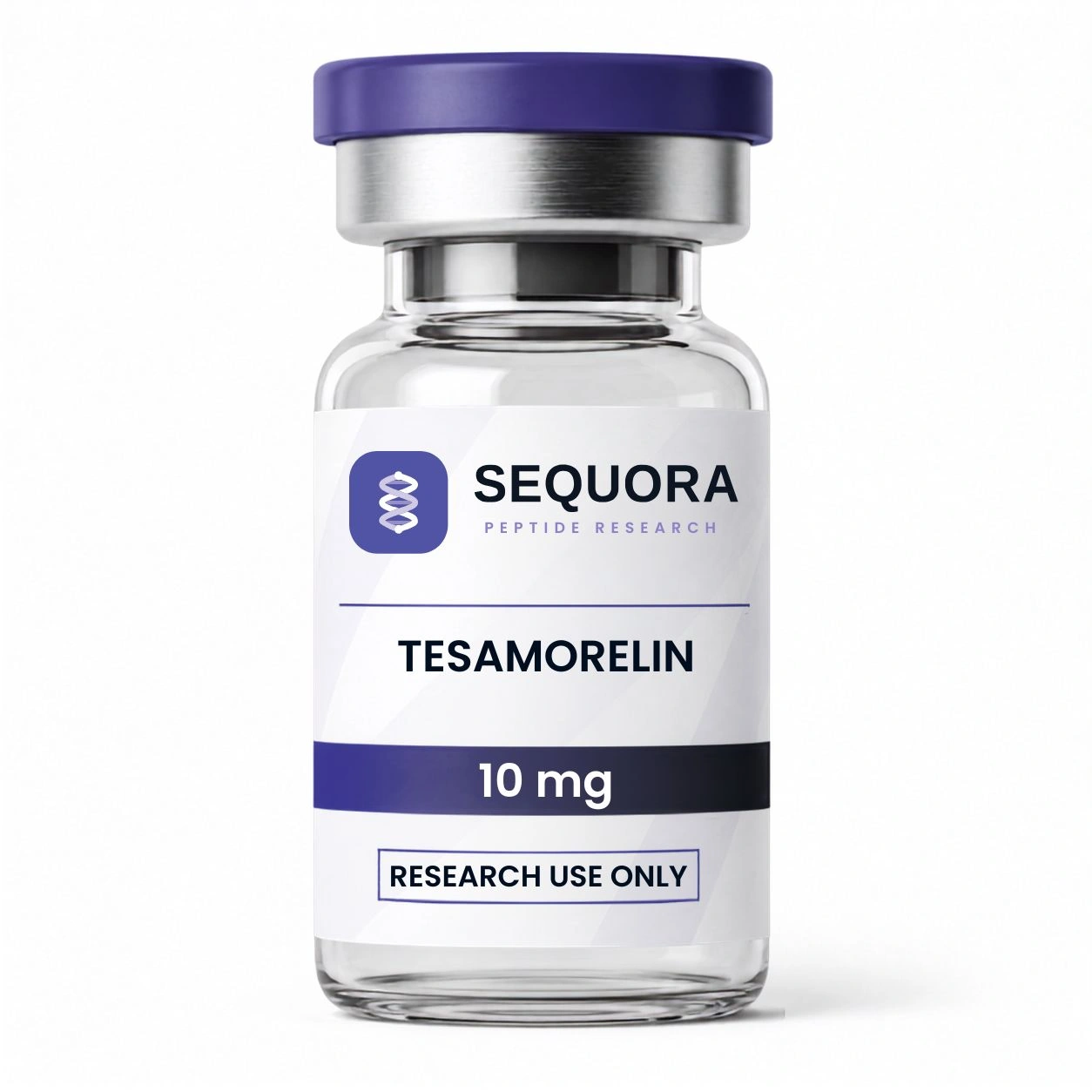
Tesamorelin 10mg is a synthetic GHRH analog studied for growth hormone signaling, endocrine function, and metabolic research. Supplied by Sequora Peptides strictly for laboratory research use only.
| Molecular Formula | C221H366N72O67S |
|---|---|
| Molecular Mass | 5136.9 g/mol |
| Monoisotopic Mass | 5133.693410 g/mol |
| Polar Area | 2370 Ų |
| Complexity | 13800 |
| XLogP | -44.6 |
| Heavy Atom Count | 361 |
| Hydrogen Bond Donor Count | 82 |
| Hydrogen Bond Acceptor Count | 97 |
| Rotatable Bond Count | 191 |
Every batch is verified for identity and purity by an independent lab before release.
Scan your batch code to pull the full certificate — chromatogram included.
Material compromised in transit is replaced against the original procurement record.
Tesamorelin 10mg is a synthetic analog of human growth hormone-releasing hormone (GHRH) supplied by Sequora Peptides for laboratory research purposes. Tesamorelin is a 44-amino-acid peptide with a trans-3-hexenoic acid modification at the N-terminus. This structural modification was designed to improve stability against enzymatic breakdown.
Tesamorelin works by binding to growth hormone-releasing hormone receptors (GHRHR) in the pituitary gland. Activation of these receptors stimulates the natural pulsatile release of growth hormone (GH), which can also increase levels of insulin-like growth factor-1 (IGF-1). This mechanism has made tesamorelin an important peptide in research related to growth hormone signaling and endocrine physiology.
The scientific development of tesamorelin is based on decades of research into the biological role of endogenous GHRH. Thorner et al. (1997) discussed the role of GHRH in stimulating pituitary growth hormone secretion, providing an important foundation for the development of synthetic GHRH analogs. Later clinical research, including work by Falutz et al. (2010), further examined tesamorelin and its effects on endocrine and metabolic markers.
Research involving tesamorelin peptide has explored areas such as growth hormone physiology, body composition, metabolic signaling, endocrine function, and age-related metabolic changes. Researchers continue to study its biological activity, receptor signaling, pharmacology, and longer-term effects.
At Sequora Peptides, Tesamorelin 10mg is supplied specifically for controlled laboratory investigation. Researchers should evaluate peptide identity, purity, formulation, sequence, and analytical documentation when selecting tesamorelin for experimental work.
Research Use Only: Tesamorelin 10mg sold by Sequora Peptides is intended strictly for laboratory research and is not intended for human or veterinary use.
| Specification | Details |
|---|---|
| Product Name | Tesamorelin 10 mg |
| Peptide Type | Synthetic Growth Hormone-Releasing Hormone (GHRH) analogue |
| Composition | Tesamorelin acetate |
| Peptide Length | 44 amino acids |
| Molecular Formula | C₂₂₁H₃₆₆N₇₂O₆₇S |
| Molecular Weight | Approximately 5135.9 g/mol |
| CAS Number | 218949-48-5 |
| PubChem CID | 16137808 |
| Purity | Research-grade quality |
| Appearance | White to off-white lyophilized powder |
| Solubility | Sterile water or bacteriostatic water for laboratory research |
| Storage | Store at 2–8°C before and after reconstitution |
| Research Use | Research Use Only (RUO) |
The development of Tesamorelin involved peptide engineering of native human Growth Hormone-Releasing Hormone to increase its pharmacodynamic stability without loss of biological interaction with the Growth Hormone-Releasing Hormone receptor. As per Thorner et al. (1997), scientific research on the natural GHRH showed that the stimulation of somatotroph cells of the pituitary gland governs the pulsatile secretion of growth hormone.
Unlike recombinant human growth hormone, Tesamorelin is designed to stimulate the secretion of growth hormone physiologically by way of receptor-mediated mechanisms. According to Bowers (1999), scientific investigations of synthetic GHRH analogues proved that modifications of the peptide structure increased its stability against enzymatic degradation and retained its biological activity. It provided a basis for further research of stabilized GHRH analogues, including Tesamorelin.
In addition, pharmacologic development of Tesamorelin included optimization of the receptor specificity, peptide stability, and pharmacokinetic properties. As per Falutz et al. (2007), clinical trials showed that Tesamorelin stimulates the secretion of endogenous GH physiologically through the process of feedback regulation via the IGF-1 level in circulation.
One of the major fields of study for Tesamorelin includes endocrine physiology and the regulation of the growth hormone-IGF-1 axis. According to Falutz et al. (2010), the influence of Tesamorelin on growth hormone secretion, IGF-1 concentrations, and other metabolic markers was studied using controlled clinical trials.
Further investigation into the biological mechanism of Tesamorelin-induced GH secretion and subsequent endocrine signal transduction is being conducted. Published research indicates that pituitary GHRH receptor activation activates intracellular signal transduction pathways leading to growth hormone production and secretion.
Currently, Tesamorelin is being studied in various scientific disciplines, some of which are listed below:
Despite the results obtained in some scientific disciplines, researchers continue to stress the need for further randomized clinical studies.
While the exact molecular mechanism by which Tesamorelin exerts all biological effects has not yet been fully elucidated, there has been extensive research carried out on the activation of Growth Hormone-Releasing Hormone (GHRH) receptors. As stated in the U.S. FDA Prescribing Information for Tesamorelin, Tesamorelin is known to bind to GHRH receptors present on the somatotrophs of the pituitary gland. This activates the secretion of growth hormone (GH) in a pulsatile manner, leading to increased levels of insulin-like growth factor-1 (IGF-1).
One of the well-studied features of Tesamorelin is that it selectively activates pituitary GHRH receptors. Tesamorelin causes natural secretion of growth hormone without substituting the hormone, thus maintaining the normal control of the hypothalamic-pituitary-growth hormone axis, according to Falutz et al. (2007).
In contrast to recombinant growth hormones, Tesamorelin leads to the release of natural hormone via the mechanism of receptor binding, according to Falutz et al. (2010). Thus, Tesamorelin activates the growth hormone-releasing hormone receptor and causes the release of growth hormone.
Once the receptors are activated, Tesamorelin induces the physiological secretion of growth hormones, which further leads to the secretion of IGF-1 by the liver. According to Falutz et al. (2010), the use of Tesamorelin led to increased levels of IGF-1 while maintaining physiological endocrine feedback control.
Further studies have been conducted regarding how the physiological manipulation of the GH–IGF-1 axis affects metabolic physiology and body composition and endocrine homeostasis. Nevertheless, it should be noted that more research is required.
Another important aspect of Tesamorelin studies focuses on metabolic physiology and body composition. According to Falutz et al. (2010), clinical trials have shown that Tesamorelin was studied concerning its impact on metabolic factors and visceral adipose tissue in the highly controlled experimental conditions of these studies.
It has been shown in some studies that physiological changes in endocrine functions due to the GH stimulation can affect lipid metabolism and adipose tissue functioning. Still, scientists keep studying the biological implications of such findings.
In contrast to treatment with exogenous growth hormone, the mechanism of action for Tesamorelin takes place through natural endocrine mechanisms. According to FDA prescribing information, growth hormone produced by Tesamorelin is still subject to hypothalamic feedback control, such that production of hormones can still take place biologically.
The receptor-mediated approach has continued to be one of the major reasons for which Tesamorelin has received much attention scientifically.
Clinical investigations by Falutz et al. (2010) demonstrated that Tesamorelin was evaluated in randomized placebo-controlled clinical trials, with additional long-term studies continuing to investigate its biological effects and safety profile.
Published research has investigated Tesamorelin in areas including:
Randomized double-blind clinical studies conducted by Falutz et al. (2010) indicated notable physiological stimulation of natural GH production along with certain modifications of visceral adipose tissue parameters under research circumstances.
Additional clinical trials discussed by Stanley et al. (2014) included analysis of Tesamorelin effects on visceral adipose tissue, liver fat, and other metabolic markers, thus making a great contribution to current knowledge about the pharmacology of Tesamorelin.
Nevertheless, although encouraging results were achieved in the course of clinical studies, researchers have stressed the necessity for further long-term studies in this respect.
Compared with many investigational peptide compounds, Tesamorelin possesses a relatively extensive body of published clinical literature. Multiple randomized controlled trials have evaluated its endocrine activity, pharmacokinetics, and metabolic effects in selected research populations.
According to Falutz et al. (2010), Tesamorelin remains one of the best-characterized synthetic GHRH analogues described in the scientific literature. Subsequent clinical investigations have continued to evaluate its long-term outcomes and endocrine mechanisms.
Current scientific investigations involving Tesamorelin include:
Researchers continue evaluating Tesamorelin in both laboratory and clinical settings to improve understanding of endocrine physiology and peptide biology.
Tesamorelin is a synthetic peptide that has undergone extensive scientific evaluation. According to the U.S. Food and Drug Administration (FDA), Tesamorelin has received regulatory approval for a specific medical indication under approved prescribing conditions. However, Tesamorelin 10 mg supplied by research peptide manufacturers is commonly marketed exclusively as a Research Use Only (RUO) material and is intended solely for laboratory investigation.
Research-grade Tesamorelin supplied for experimental purposes is not intended for human consumption, self-administration, veterinary use, diagnosis, treatment, mitigation, cure, or prevention of disease unless specifically manufactured, approved, and prescribed under applicable regulatory requirements.
Proper storage maintains the stability of the peptides while performing laboratory tests.
Tesamorelin 10 mg is a synthetic analog of Growth Hormone-Releasing Hormone (GHRH) that is used in scientific research concerning growth hormone physiology and endocrinology.
Studies with the use of Tesamorelin include the areas of growth hormone physiology, endocrine physiology, IGF-1 physiology, body composition, metabolic physiology, and peptide pharmacology.
As per scientific literature, Tesamorelin acts on pituitary GHRH receptors and induces the secretion of growth hormone physiologically, which, in turn, increases the level of IGF-1 physiologically without disturbing the endocrine feedback control.
Tesamorelin is approved for one FDA purpose. But the research-grade Tesamorelin 10 mg from peptide suppliers is meant for Research Use Only (RUO).
Store lyophilized peptide under refrigerated laboratory conditions at 2–8°C. Following reconstitution, continue refrigeration and avoid repeated freeze-thaw cycles.
No. Laboratory-grade Tesamorelin 10 mg from the manufacturers of peptides is meant only for research purposes and not for human consumption.
The Tesamorelin 10 mg produced by research peptide companies is produced only for Research Use Only (RUO).
This research product is meant to be used only for conducting research in the laboratories by properly trained researchers.
It is not meant to be taken as food supplements or medicine for any type of disease.
Researchers will have to make sure that the handling of the product is done in compliance with all the guidelines and policies.
COA ✓
COA ✓
Sermorelin 10mg is a synthetic GHRH analog studied in growth hormone signaling and endocrine research. Supplied by Sequora Peptides strictly for laboratory research use only.

COA ✓
This site supplies chemicals strictly for laboratory research. You must confirm both statements below to enter.
Products are supplied for laboratory research use only and are not for human or veterinary use.