Institutional accounts only · Pricing and quotes released after verified laboratory registration
Institutional accounts only · Pricing and quotes released after verified laboratory registration
Reference data, Safety Data Sheets, and Certificates of Analysis for every catalog compound. Pricing and quotations are released to verified institutions only. For laboratory research use only.
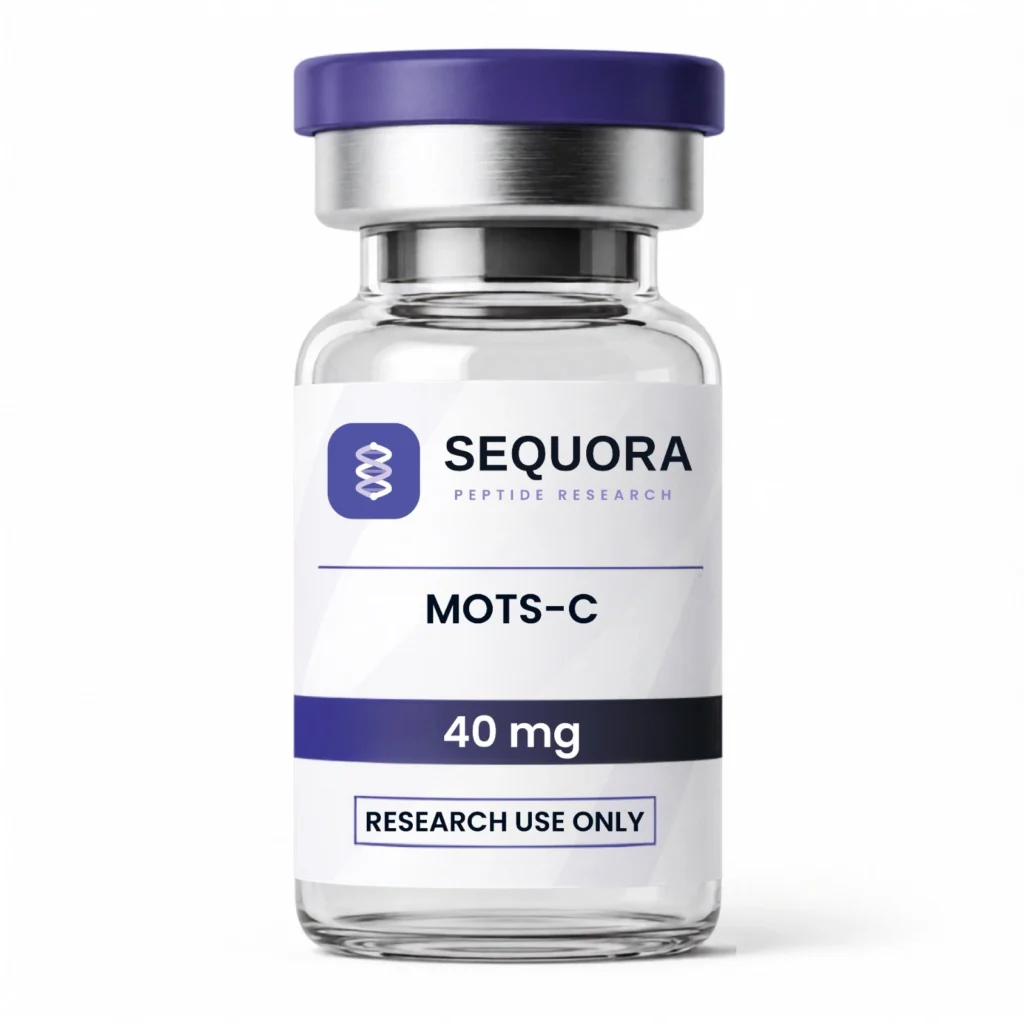
Mitochondrial peptides are short peptides that either come from the mitochondrial genome or are built to act at the mitochondrion. This category holds one of each. MOTS-c is a 16-amino-acid peptide encoded in the mitochondrial 12S rRNA gene [R1]. SS-31 (elamipretide) is a synthetic tetrapeptide that binds cardiolipin in the inner mitochondrial membrane [R2]. Both are supplied as lyophilized research chemicals with a batch certificate of analysis. For background, read our research guide to mitochondrial peptides.
For laboratory research use only. Not for human or veterinary use.
COA ✓

COA ✓
The term covers two different groups. The first is mitochondrial-derived peptides: short peptides read from small open reading frames inside mitochondrial DNA. MOTS-c belongs here. It was described in 2015 as a 16-residue peptide encoded in the 12S rRNA gene, studied mainly in mouse skeletal muscle and cultured cells [R1]. Later work in cells reported that it can move to the nucleus under metabolic stress [R3].
The second group is mitochondria-targeted synthetic peptides. These are designed in the lab, not encoded in any genome. SS-31 is the best-known example. It alternates aromatic and basic residues and was reported to concentrate in the inner mitochondrial membrane [R4], where it binds the phospholipid cardiolipin [R2].
So the two compounds share a location, not a mechanism. For a side-by-side look, see MOTS-c vs SS-31.
| Property | MOTS-c | SS-31 (elamipretide) |
|---|---|---|
| Group | Mitochondrial-derived peptide (natural sequence) | Synthetic mitochondria-targeted peptide |
| Sequence | MRWQEMGYIFYPRKLR | D-Arg-Dmt-Lys-Phe-NH2 (Dmt = 2,6-dimethyl-L-tyrosine) |
| Length | 16 amino acids | 4 amino acids |
| Origin | Encoded in the mitochondrial 12S rRNA gene (MT-RNR1) | Designed peptide; not genome-encoded |
| Target studied | Folate cycle and AMPK signaling in muscle and cell models; nuclear gene regulation | Cardiolipin in the inner mitochondrial membrane |
| CAS number | 1627580-64-6 | 736992-21-5 |
| Molecular formula | C101H152N28O22S2 | C32H49N9O5 |
| Molecular weight | 2174.6 g/mol | 639.8 g/mol (free base) |
| FDA UNII | A5CV6JFB78 | 87GWG91S09 |
Sources: MOTS-c identity from the FDA briefing document and FDA UNII record [R5][R6]; SS-31 identity from the FDA UNII record and FDA prescribing information [R7][R8]. SS-31 molecular weight is calculated from its formula.
MOTS-c is not an approved drug. FDA states it is not a component of any FDA-approved drug and found no clinical studies of it in humans [R5]. It was removed from FDA's 503A "Category 2" list in April 2026 after its nomination was withdrawn [R9]. In July 2026 an FDA advisory committee voted 7–5–2 to recommend it for the 503A bulks list; the vote is non-binding and FDA rulemaking is still required [R10].
Elamipretide received FDA accelerated approval on September 19, 2025, as a drug product for one rare mitochondrial disease, Barth syndrome, in patients weighing at least 30 kg; continued approval depends on a confirmatory trial [R11]. Sequora's SS-31 is a research chemical, not that approved drug product.
They are short peptides linked to mitochondria. Some, like MOTS-c, are encoded in mitochondrial DNA [R1]. Others, like SS-31, are synthetic peptides designed to reach the inner mitochondrial membrane [R4].
No. SS-31 is a synthetic tetrapeptide containing a D-amino acid and a modified tyrosine. It is not encoded in any genome [R8].
MOTS-c is not approved for any use [R5]. Elamipretide has accelerated approval for Barth syndrome only [R11]. Research-labeled SS-31 is not an approved product.
Store the lyophilized powder at −20 °C, protected from light and moisture. Check the batch COA for lot-specific handling notes; our guide on how to read a peptide COA explains each field.
No. These compounds are sold for in-vitro and laboratory research only. See research-use-only peptides explained.
For laboratory research use only. Not for human or veterinary use.
Our technical team can help with selection, reconstitution, and storage.
This site supplies chemicals strictly for laboratory research. You must confirm both statements below to enter.
Products are supplied for laboratory research use only and are not for human or veterinary use.