Institutional accounts only · Pricing and quotes released after verified laboratory registration
Institutional accounts only · Pricing and quotes released after verified laboratory registration
Reference data, Safety Data Sheets, and Certificates of Analysis for every catalog compound. Pricing and quotations are released to verified institutions only. For laboratory research use only.
Thymosin peptides are research peptides named after the thymosins, a group of polypeptides first isolated from calf thymus tissue [R1]. Despite the shared name, the two compounds in this category are structurally unrelated. Thymosin alpha-1 is a 28-amino-acid acetylated peptide [R2]. TB-500 is a seven-amino-acid synthetic fragment (residues 17–23) of thymosin beta-4, a 43-amino-acid actin-binding protein [R3]. Each batch ships with a certificate of analysis. For background, read our guide: What are thymosin peptides?
For laboratory research use only. Not for human or veterinary use.
COA ✓

COA ✓
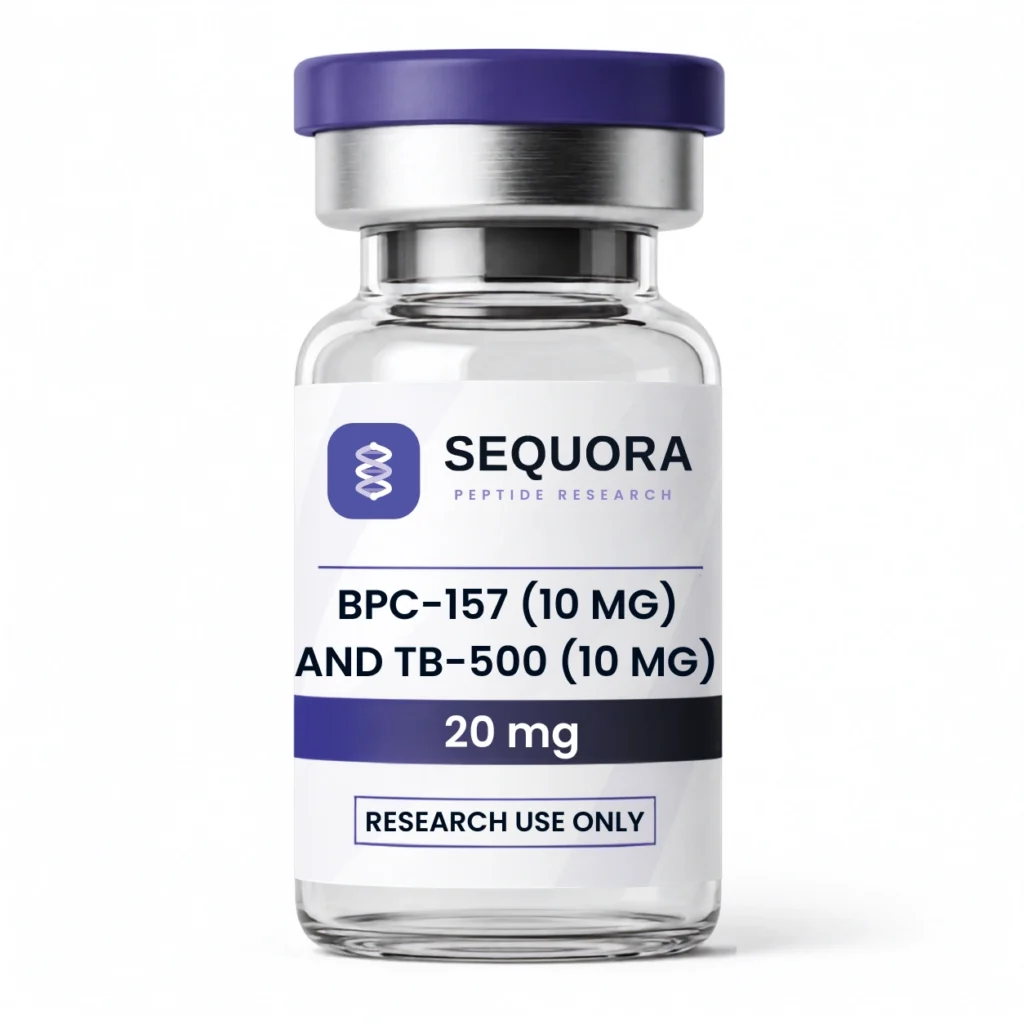
TB-500 10mg is a synthetic peptide studied in cell migration, tissue repair pathways, and actin-related biological research. Supplied by Sequora Peptides strictly for laboratory research use only.

COA ✓
TB-500 is a synthetic research peptide related to thymosin beta-4 and is studied for its role in cell migration, tissue repair pathways, and angiogenesis. It is intended strictly for laboratory research and is not approved for human or veterinary use.

COA ✓
"Thymosin" is a historical family name, not a single structure or receptor. In 1977, researchers sequenced thymosin alpha-1, a 28-residue peptide from a calf-thymus extract called thymosin fraction 5, and proposed a naming system for the related polypeptides [R1]. Thymosin beta-4 was sequenced from the same tissue in 1981 as a 43-residue peptide with an acetylated N-terminus [R4].
The two families are studied for different things. Thymosin beta-4 binds and sequesters monomeric (G-) actin, so it is investigated in models of cytoskeleton organization and cell migration [R5]. Thymosin alpha-1 is investigated in immunology models, for example dendritic-cell signaling in mice [R6].
FDA defines TB-500 as N-acetyl-Leu-Lys-Lys-Thr-Glu-Thr-Gln (Ac-LKKTETQ), residues 17–23 of thymosin beta-4, with a molecular weight of 889.01 g/mol. FDA states that "thymosin beta-4 and TB-500 are not the same substance" [R3]. Doping-control laboratories identified the same acetylated heptapeptide as the key ingredient of products sold as TB-500 [R7][R8]. Some vendors and papers still use "TB-500" for full-length thymosin beta-4, so check the mass on the COA. See TB-500 vs thymosin beta-4.
| TB-500 | Thymosin Alpha-1 | Thymosin beta-4 (reference, not sold) | |
|---|---|---|---|
| Structure | Ac-LKKTETQ (thymosin β4 residues 17–23) | Ac-SDAAVDTSSEITTKDLKEKKEVVEEAEN | Ac-SDKPDMAEIEKFDKSKLKKTETQEKNPLPSKETIEQEKQAGES |
| Length | 7 aa | 28 aa | 43 aa |
| Target studied | Actin-binding region of thymosin β4; cell-migration models | Immune signaling (dendritic cells, Toll-like receptor pathway) in models | G-actin sequestration |
| CAS | 885340-08-9 | 62304-98-7 | 77591-33-4 |
| Formula / MW | C38H68N10O14 / 889.0 g/mol | C129H215N33O55 / 3108.3 g/mol | C212H350N56O78S / 4963.5 g/mol |
Sources: [R3][R2][R9][R5]. Thymosin β4 formula and weight calculated from the UniProt sequence with N-terminal acetylation.
Neither compound is an FDA-approved drug in the United States. Thymosin alpha-1 (thymalfasin) is approved as a medicine in a number of other countries; FDA has approved no product containing it [R10]. Both appear on FDA's list of substances nominated but withdrawn from Category 2 of the 503A interim compounding policy [R11]. In July 2026, an FDA advisory committee voted 8–6 (one abstention) to recommend TB-500 for the 503A bulks list; the vote is non-binding [R12]. In December 2024, the same committee voted 4–17 against listing thymosin alpha-1 [R13].
They are peptides named after the thymosins, polypeptides first isolated from calf thymus. The family includes thymosin alpha-1 and the beta-thymosins such as thymosin beta-4, which differ in structure and in what they are studied for [R1][R4].
No, by FDA's definition. TB-500 is the acetylated seven-residue fragment 17–23 of the 43-residue thymosin beta-4 protein [R3].
Only by name and tissue of origin. Their sequences differ, and they are studied in different research areas [R2][R5].
Check the mass-spectrometry result on the batch COA. TB-500 has a molecular weight near 889 g/mol, thymosin alpha-1 near 3108 g/mol, and full-length thymosin beta-4 near 4963 g/mol. See how to read a peptide COA.
No. Sequora supplies them as research chemicals for laboratory use only. See RUO peptides explained.
For laboratory research use only. Not for human or veterinary use.
Our technical team can help with selection, reconstitution, and storage.
This site supplies chemicals strictly for laboratory research. You must confirm both statements below to enter.
Products are supplied for laboratory research use only and are not for human or veterinary use.