Institutional accounts only · Pricing and quotes released after verified laboratory registration
Institutional accounts only · Pricing and quotes released after verified laboratory registration
Reference data, Safety Data Sheets, and Certificates of Analysis for every catalog compound. Pricing and quotations are released to verified institutions only. For laboratory research use only.
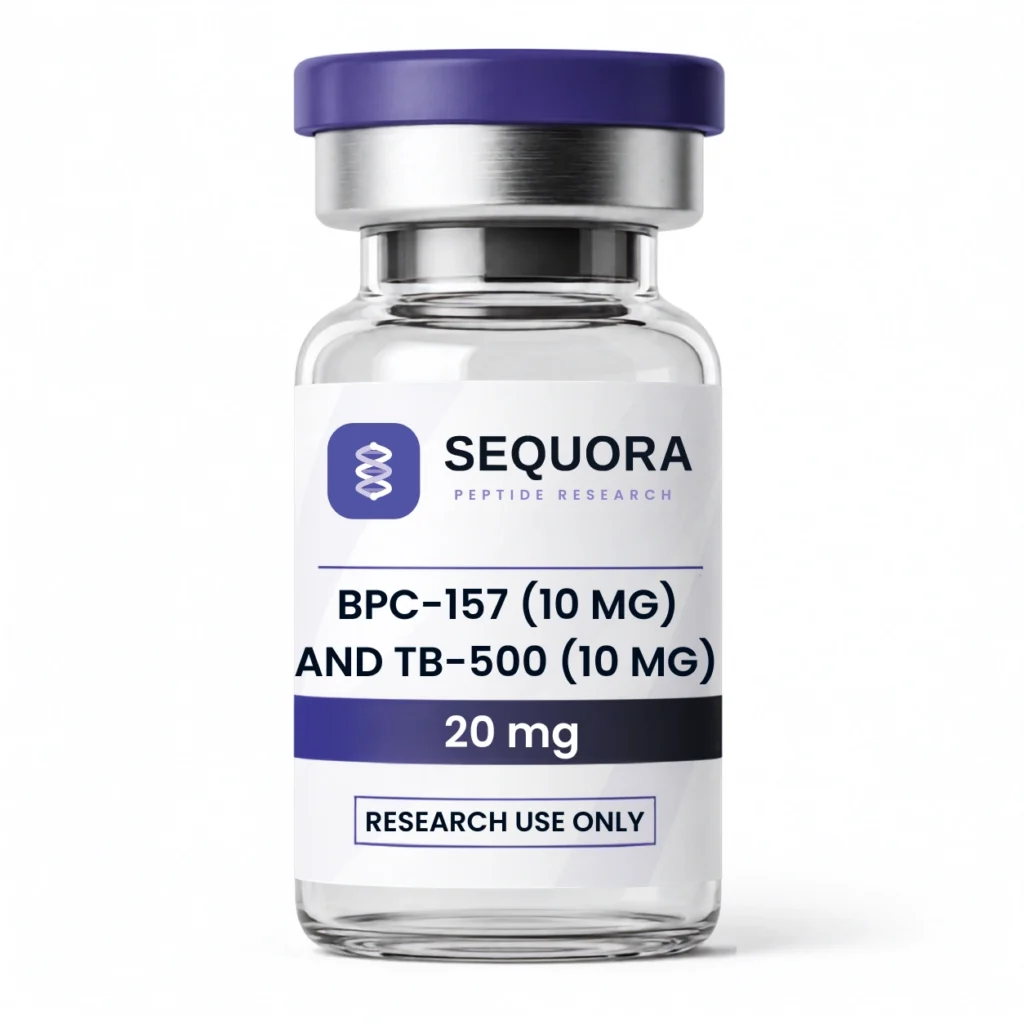
A peptide blend is two separately synthesized peptides, co-lyophilized in one vial. Each peptide is made and purified on its own. They are then combined and freeze-dried together. The blend does not create a new molecule. Each component keeps its own sequence and mass, such as BPC-157 [R1] and TB-500 [R2]. Each component is characterized on the batch COA. For data on the single peptides, see gastric pentadecapeptides, thymosin peptides and GHRH analogues.
For laboratory research use only. Not for human or veterinary use.
COA ✓
COA ✓
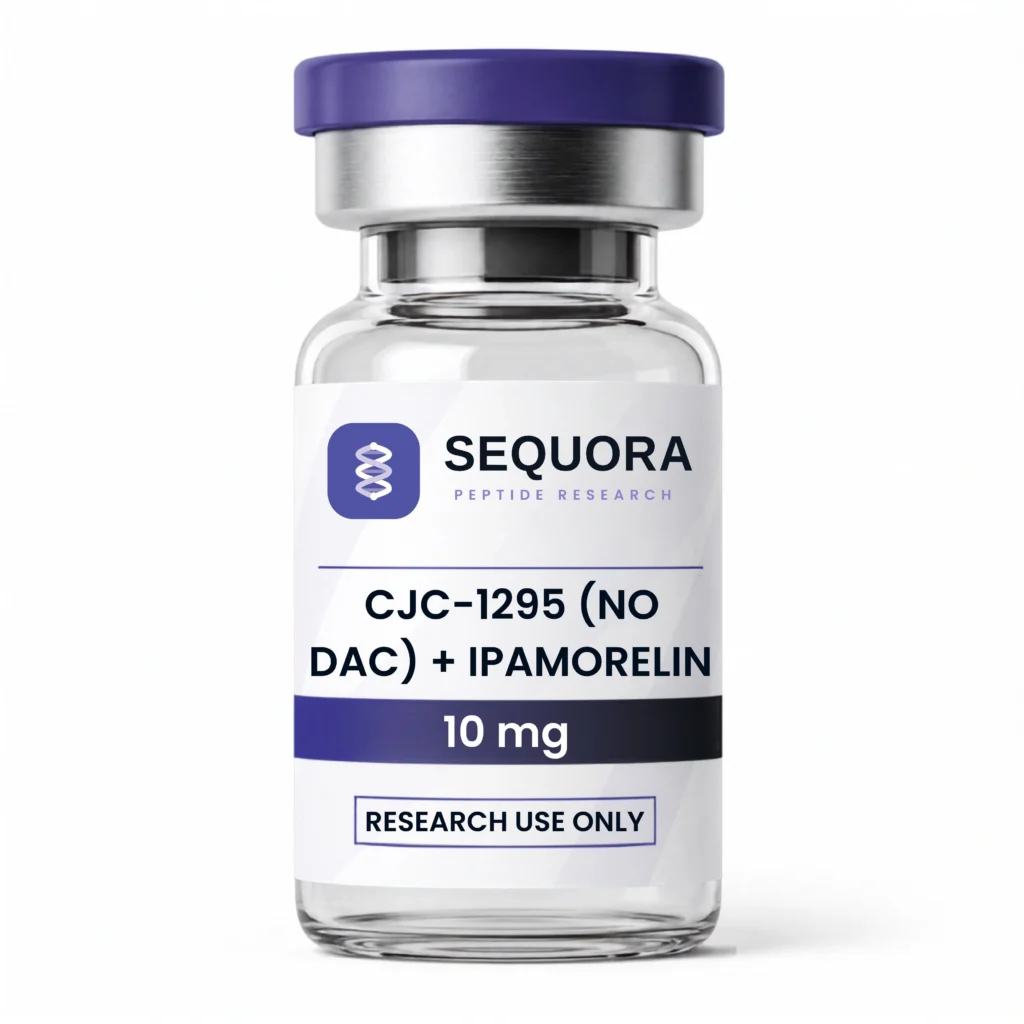
A peptide blend holds two peptides in one vial. Each peptide is synthesized and purified on its own. The two are then mixed and freeze-dried together. No chemical bond links them. Each one keeps its own sequence, mass and identity. BPC-157 is a 15-residue peptide, GEPPPGKPADDAGLV, CAS 137525-51-0 [R1]. TB-500 is Ac-LKKTETQ, a seven-residue fragment of thymosin β4 (residues 17–23) [R2]. CJC-1295 (no DAC) is GRF(1–29) amide with four substitutions: D-Ala2, Gln8, Ala15 and Leu27 [R3]. Ipamorelin is Aib-His-D-2-Nal-D-Phe-Lys-NH2 [R4][R5].
| Blend | Component 1 identity | Component 2 identity | Receptor/pathway studied per component | Total peptide per vial |
|---|---|---|---|---|
| BPC-157 (10 mg) and TB-500 (10 mg) Blend | BPC-157: GEPPPGKPADDAGLV, 15 aa, C62H98N16O22, MW 1419.5, CAS 137525-51-0 | TB-500: Ac-LKKTETQ, 7 aa, MW 889.0, CAS 885340-08-9 | BPC-157: no receptor established. TB-500: no receptor established; fragment of thymosin β4 residues 17–23 | 20 mg (10 mg + 10 mg) |
| CJC-1295 (no DAC) + Ipamorelin 10 mg Blend | CJC-1295 (no DAC): GRF(1–29) amide with D-Ala2, Gln8, Ala15, Leu27 | Ipamorelin: Aib-His-D-2-Nal-D-Phe-Lys-NH2, MW 711.85, CAS 170851-70-4 | CJC-1295: GHRH (GRF) receptor. Ipamorelin: ghrelin receptor (GHS-R1a) agonist | 10 mg total; per-component amounts on the batch COA |
A single purity number is not enough for a blend. The COA must show data for each peptide. HPLC should resolve two separate peaks, one per component. Each peak should be identified and integrated. Mass spectrometry should show both expected masses. For the BPC-157 and TB-500 blend, that means signals consistent with about 1419.5 Da and 889.0 Da. For the CJC-1295 (no DAC) and ipamorelin blend, it means a GRF(1–29) analogue mass and about 711.85 Da for ipamorelin. If only one mass appears, one component is unconfirmed. Check that the batch number on the COA matches the vial. For a step-by-step guide, read how to read a peptide COA.
Almost all published research studies these peptides one at a time. Findings on a single peptide do not transfer to a blend. We found one peer-reviewed study that tested BPC-157 and TB-500 together. It was an exploratory rat study of Achilles tendon tissue with four groups of eight animals. The authors reported that the combined group showed no additional benefit compared with either peptide alone [R6]. They called their findings hypothesis-generating. They also listed limits, such as one time point and small histology subsets. We did not find a peer-reviewed study that tested CJC-1295 (no DAC) and ipamorelin together. The Jetté study tested the DAC-linked form of CJC-1295, not the no-DAC peptide on its own [R3].
None of the peptides on this page is an FDA-approved drug. In a May 2026 briefing document, FDA stated that TB-500 is not a component of an FDA-approved drug. The same document states that thymosin beta-4 and TB-500 are not the same substance [R2]. A blend of two unapproved peptides is also unapproved. These products are sold for in vitro and laboratory research only. Learn more in RUO peptides explained.
No. A blend is a physical mixture of two separately made peptides. No bond joins them. Each keeps its own sequence and mass.
Check the batch COA. HPLC should show two resolved peaks. Mass spectrometry should show the expected mass of each peptide.
One exploratory rat study tested it in 2026. The combined group did not outperform either peptide alone [R6]. We found no peer-reviewed study of the CJC-1295 (no DAC) and ipamorelin pairing.
No. TB-500 is a seven-residue fragment. FDA states the two are not the same substance [R2].
For laboratory research use only. Not for human or veterinary use.
Our technical team can help with selection, reconstitution, and storage.
This site supplies chemicals strictly for laboratory research. You must confirm both statements below to enter.
Products are supplied for laboratory research use only and are not for human or veterinary use.