
Institutional accounts only · Pricing and quotes released after verified laboratory registration
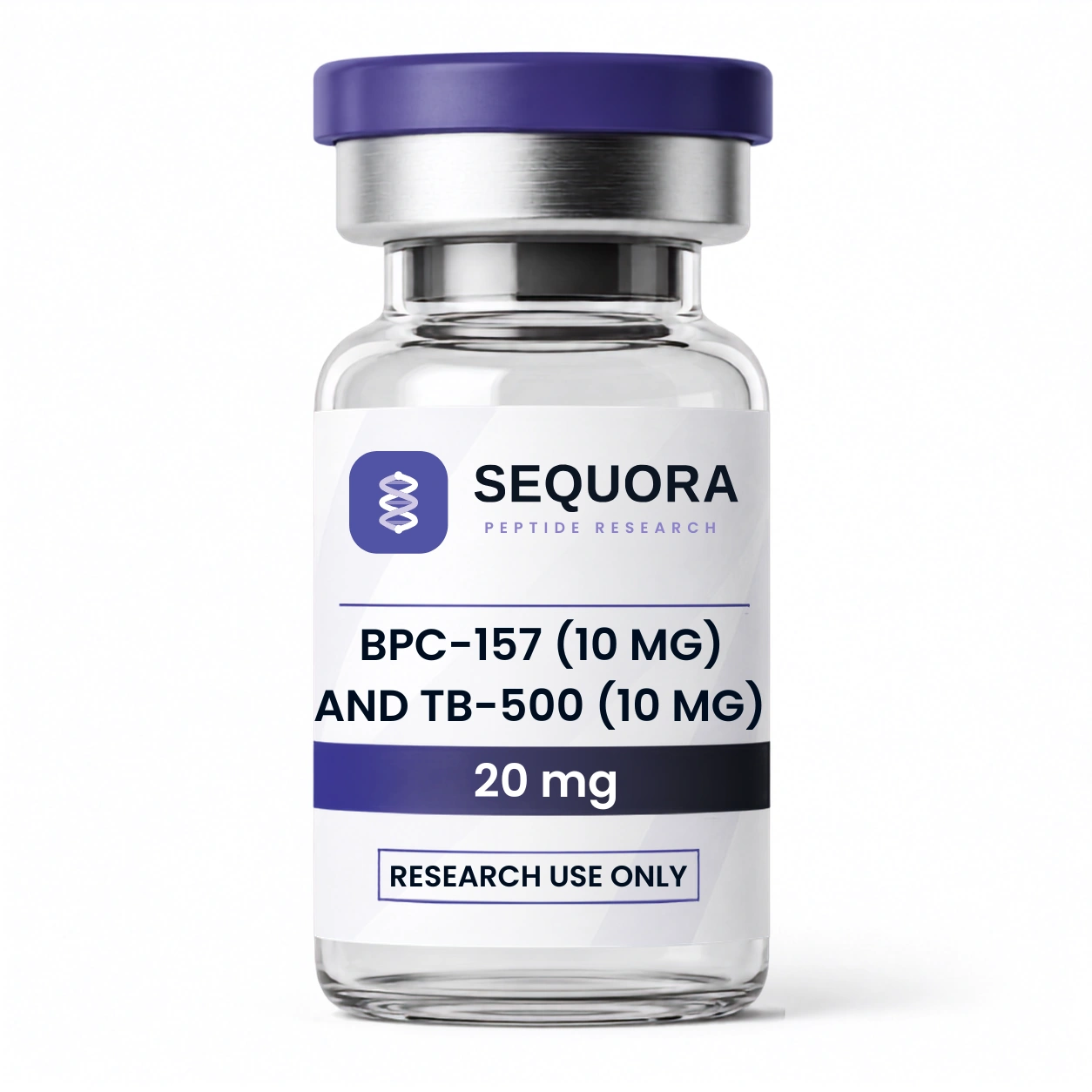
The BPC-157 10mg and TB-500 10mg Blend combines two peptides that have been investigated separately across different areas of peptide research. Researchers can study the individual properties of BPC-157 and TB-500 within a combined research formulation. Offered by Sequora Peptides for laboratory research.
Every batch is verified for identity and purity by an independent lab before release.
Scan your batch code to pull the full certificate — chromatogram included.
Material compromised in transit is replaced against the original procurement record.
The BPC-157 (10 mg) + TB-500 (10 mg) Blend (also called Wolverine) combines two synthetic peptides in a single vial, providing 20 mg total at a 1:1 mass ratio. Supplied as a lyophilized powder, this fixed-ratio blend is intended for controlled laboratory studies involving both compounds. Its premixed format provides equal amounts by mass, while experiments requiring independent adjustment of each component need separate materials.
Research on the individual peptides provides context for investigating the combination, but does not establish that the blend produces enhanced or synergistic effects.
All products sold at Sequora Peptides are for laboratory research only. Not for human or animal use.
| Specification | Details |
| Product Name | Wolverine 20 mg |
| Product Type | Research Peptide Blend |
| Composition | BPC-157 10 mg + TB-500 10 mg |
| BPC-157 Peptide Type | Synthetic pentadecapeptide |
| BPC-157 Sequence | Gly-Glu-Pro-Pro-Pro-Gly-Lys-Pro-Ala-Asp-Asp-Ala-Gly-Leu-Val |
| BPC-157 Molecular Formula | C₆₂H₉₈N₁₆O₂₂ |
| BPC-157 Molecular Weight | 1419.55 g/mol |
| BPC-157 CAS Number | 137525-51-0 |
| BPC-157 PubChem CID | 9941957 |
| TB-500 Peptide Type | Synthetic thymosin beta-4 fragment |
| TB-500 Sequence | Not publicly standardized; associated with thymosin beta-4-derived peptide research |
| TB-500 Research Basis | Derived from thymosin beta-4 studies |
| Appearance | White to off-white lyophilized powder |
| Purity | Research-grade quality |
| Solubility | Sterile water or bacteriostatic water for laboratory research |
| Storage | 2–8°C before and after reconstitution |
| Research Use | Research Use Only (RUO) |
Wolverine 20 mg is developed based on continuing scientific interest in two major areas of peptide research: BPC-157 biology and thymosin beta-4-related cellular studies. Both peptides are interesting for scientific investigation due to their participation in complicated biological processes such as cell communication, vascular signaling, and tissue response mechanisms.
BPC-157 was initially studied as a stabilized peptide sequence associated with body protection compound research. Sikiric et al. analyzed the peptide sequence in various experimental models with respect to its connection to the gastrointestinal tract, vascular effects, and signaling pathways.
Various studies on BPC-157 have looked at the role of various molecular pathways. According to research conducted by Sikiric et al., studies have been done regarding the connection between BPC-157 and the nitric oxide pathway, growth-factor-related pathway, and cell-to-cell communications. The actual mechanism, however, is not yet known.
Studying TB-500 is also linked with the studies of thymosin beta-4, which is a peptide that occurs naturally in numerous tissue types. In the article published in Annals of the New York Academy of Sciences, Goldstein et al. noted that thymosin beta-4 has been determined to be an important regulator of actin dynamics. This is critical for many cellular functions, such as cellular movement, organization, and intracellular transportation.
Moreover, scientists have investigated thymosin beta-4 regarding vascular biology. In a study published in Nature, Smart et al. investigated thymosin beta-4 in cardiovascular development and found that the peptide is involved in processes related to endothelial cell migration and vascularization.
The use of the BPC-157 and TB-500 combination in Wolverine 20 mg is due to the scientific community’s effort to test several peptide pathways together. Although BPC-157 science involves a lot of research into signaling pathways and tissue response models, thymosin beta-4 science deals more with cell migration and structural regulation. But scientific investigation of the Wolverine 20 mg combination is still rather rare.
However, the precise mechanism by which Wolverine 20 mg acts as a complex peptide combination is not yet completely known. All existing scientific knowledge is derived from independent studies done on BPC-157 and the TB-500/thymosin beta-4 pathway. Scientists are trying to discover the way in which these peptides work together.
One of the main focuses of BPC-157 studies is the study of its involvement in cellular communication mechanisms. As stated in the article by Sikiric et al., BPC-157 was studied as a compound involved in various experimental models related to different biological processes, such as gastrointestinal tract functions, vascular reactions, and tissue-related communication pathways.
The study of BPC-157’s connection to vascular signaling pathways has been conducted by researchers. According to Hsieh et al., BPC-157 was investigated in terms of the effects of this compound on the activation of vascular endothelial growth factor (VEGF) signaling pathways. These observations facilitated additional research about the potential molecular signaling functions of BPC-157. Despite the results obtained through experiments, scientists state that the exact mechanism of BPC-157 remains unknown.
The investigation of TB-500 is mostly related to the study of thymosin beta-4, a natural peptide that takes part in cellular structure and motility. As stated in the article by Goldstein et al. in the Annals of the New York Academy of Sciences, thymosin beta-4 binds with actin – a protein that is needed for structural organization and cell motility.
Actin regulation is a crucial biological process necessary for:
According to Huff et al., investigations published in the European Journal of Biochemistry on the association of thymosin beta-4-like peptides with actin have contributed to our knowledge of thymosin beta-4 in cytoskeletal control.
As a synthetic peptide fragment connected with the thymosin beta-4 investigation, TB-500 continues to be investigated as a part of laboratory models of cellular processes.
The study of vascular biology has also been a subject of focus in studies involving BPC-157 and thymosin beta-4.
According to Smart et al., thymosin beta-4 was investigated for its role in vascular development and endothelial cell migration. Studies were carried out on how thymosin beta-4 pathways play a part in blood vessel development.
Likewise, in research on BPC-157, interactions with vascular signaling pathways have been investigated. In the work done by Sikiric et al., experiments have been conducted on how BPC-157 interacts with nitric oxide pathways.
This has prompted more investigation into peptide interactions with vascular biology; however, the significance of these results clinically is still being researched.
In this regard, both BPC-157 and thymosin beta-4-related peptides have been tested using models of cellular adaptation and tissue biology.
As reported by Smart et al., the scientific literature on thymosin beta-4 has described the biological mechanisms related to cell migration, cardiovascular development, and cellular repair processes. This body of work has provided valuable insights into the function of naturally occurring peptides within the cellular environment.
The body of work on BPC-157 has also studied cellular response mechanisms. As demonstrated by studies performed by Sikiric and coworkers, experimental models have been used to study BPC-157 within the context of signaling interactions with the tissue.
Nevertheless, Wolverine 20 mg has not been tested much in the form of a combination of the two peptides.
The majority of the existing research on BPC-157 and TB-500-like peptides is carried out using laboratory and animal studies.
Sikiric et al. reported that animal studies were performed in multiple physiological systems for a better understanding of the molecular interaction of BPC-157.
The research on thymosin beta-4 has comprised studies on:
Smart et al. reported that thymosin beta-4 showed biological activity with respect to endothelial cell migration and vasculogenesis in experimental models.
The above-mentioned research provides scientific data on the nature of peptide biology; however, the preclinical results cannot be extrapolated to clinical outcomes.
Wolverine 20 mg and its constituent peptides have been linked to areas of study such as:
More investigation is being carried out by researchers in order to understand more about the properties of the molecules.
Presently, Wolverine 20 mg has not received approval from the U.S. FDA, EMA, and other global regulatory agencies to be marketed as a prescription drug.
As per the information available in the regulatory database and scientific literature, BPC-157 and TB-500 are both considered investigational research peptides and are not yet approved as therapeutic drugs by any major regulatory body.
Wolverine 20 mg offered by the research peptide suppliers is to be used only for research purposes. It is not meant for human consumption, animal use, diagnostic purposes, treatment, mitigation, cure, or prevention of any disease.
Wolverine 20 mg should be stored according to laboratory storage guidelines for peptides.
These guidelines include the following:
Proper storage is important for the stability of the peptides in laboratory research.
It is a combination of two synthetic peptides supplied together as a lyophilized powder. Each vial contains 10 mg of BPC-157 and 10 mg of TB-500 for laboratory research.
Each vial contains 20 mg total peptide content (Strength): 10 mg of BPC-157 plus 10 mg of TB-500.
The blend has a 1:1 ratio by mass. This means it contains equal weights of the two peptides, rather than equal numbers of molecules.
Both peptides are combined in one vial. This differs from a bundle containing separate BPC-157 and TB-500 vials.
The ratio is fixed in this premixed product. Experiments requiring independent adjustment of each component need separate peptide materials.
Check the batch number, testing laboratory, report date, methods and reported results. Confirm whether the analysis covers the finished blend or the individual components. Purity, identity and peptide content should be reviewed separately.
Wolverine 20 mg is a product made specifically for Research Use Only (RUO).
This product is meant to be used strictly for research in a laboratory setting by trained professionals.
This product is not meant for human or veterinary use, nor does it claim to diagnose, treat, mitigate, cure, or prevent any disease or illness.
The purchaser and researcher are responsible for proper handling, storage, and usage of this product under all applicable laws.

COA ✓
COA ✓

COA ✓
TB-500 is a synthetic research peptide related to thymosin beta-4 and is studied for its role in cell migration, tissue repair pathways, and angiogenesis. It is intended strictly for laboratory research and is not approved for human or veterinary use.
This site supplies chemicals strictly for laboratory research. You must confirm both statements below to enter.
Products are supplied for laboratory research use only and are not for human or veterinary use.