
Institutional accounts only · Pricing and quotes released after verified laboratory registration
TB-500 10mg is a synthetic peptide studied in cell migration, tissue repair pathways, and actin-related biological research. Supplied by Sequora Peptides strictly for laboratory research use only.
| Molecular Formula | C212H350N56O78S |
|---|---|
| Molecular Mass | 4963 g/mol |
| Monoisotopic Mass | 4960.508211 g/mol |
| Polar Area | 2310 Ų |
| Complexity | 13900 |
| XLogP | -48.2 |
| Heavy Atom Count | 347 |
| Hydrogen Bond Donor Count | 79 |
| Hydrogen Bond Acceptor Count | 95 |
| Rotatable Bond Count | 188 |
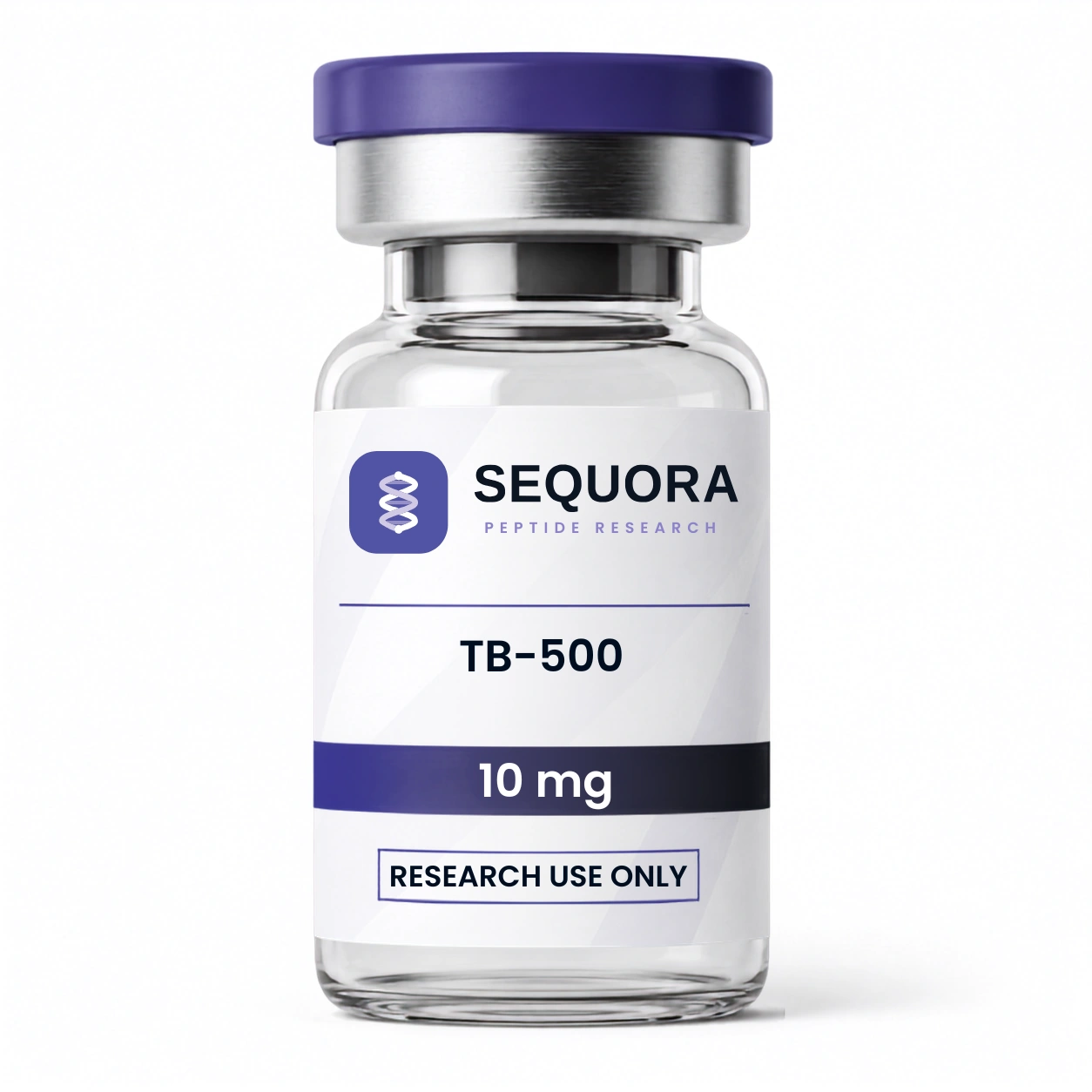
Every batch is verified for identity and purity by an independent lab before release.
Scan your batch code to pull the full certificate — chromatogram included.
Material compromised in transit is replaced against the original procurement record.
TB-500 is a synthetic research peptide derived from Thymosin Beta-4 (Tβ4), a naturally occurring protein involved in cell migration, tissue repair, and wound healing. Researchers developed TB-500 to investigate the biological functions associated with Thymosin Beta-4 in a stable, laboratory-produced peptide. Today, it remains an investigational compound studied across several areas of regenerative and cellular biology.
Over the past two decades, scientists have investigated TB-500 in in vitro studies and animal models involving tendon and ligament healing, muscle regeneration, angiogenesis, cardiovascular research, corneal repair, and inflammation. These studies have expanded scientific understanding of the peptide, although most published evidence remains preclinical, and well-designed human clinical research is still limited.
If you are looking for TB-500 10mg or searching for a trusted source of research-grade TB-500, Sequora Peptides provides high-purity, third-party tested TB-500 manufactured exclusively for laboratory research purposes.
Since its development, TB-500 has been investigated using cell-based studies, animal models, and a limited number of clinical trials using the naturally occurring peptide from which TB-500 is derived, Thymosin Beta-4. It has been studied for its involvement in wound healing, tissue regeneration, angiogenesis, inflammation, cardiovascular biology, and regenerative medicine. These studies have led to a better understanding of TB-500 from a scientific point of view, but most of the evidence that exists to date is preclinical. Here are the most important points of research in chronological order.
The interest in TB-500’s scientific properties actually started with the discovery of Thymosin Beta-4 (Tβ4) in various human tissues. Initial studies suggested that it regulates the level of the protein actin, which is critical to cell structure and movement. This prompted the researchers to explore the effect of Thymosin Beta-4 on wound healing, tissue repair, and cell migration. Further research resulted in the development of TB-500 as a synthetic peptide that can be used to study the many biological activities in the laboratory.
In the early 2000s, researchers went beyond wound healing and angiogenesis, and began to study the mechanisms underlying these processes. In animal studies, improved cell migration, better blood vessel formation, and quicker tissue remodeling after injury were reported. These results led to the conclusion that TB-500 is a peptide of interest in regenerative biology, and further studies were undertaken to explore musculoskeletal and vascular repair.
During this time, research was performed on the application of TB-500 in experimental models of tendon, ligament and muscle injury. It was also used to study its effects in cardiac repair, corneal healing, inflammatory signalling and fibrosis after tissue damage. While some studies had promising results in pre-clinical models, the studies in humans were still quite small.
Research is ongoing on TB-500 in various areas of regenerative research. Current research investigates its role in cell migration, extracellular matrix remodeling, angiogenesis, inflammation, and tissue regeneration. Its biological activity is also being studied in cardiovascular, neurological, and ocular models, which helps to understand its underlying mechanisms and possible applications for research.
Scientists are still exploring TB-500 for various peptide research fields, such as:
Research has increased significantly over the last two decades, but TB-500 is still a research peptide. The majority of the published data is from laboratory and animal studies, and further human clinical trials are required to assess its biological activity.
It is not known exactly how TB-500 works. In preliminary experiments, though, the peptide has been shown to affect several biological processes that are related to tissue repair, cell movement, and blood vessel formation, the latter of which is known as angiogenesis. The evidence available is largely from laboratory and animal studies, but not from large-scale clinical trials in humans.
The scientific studies mainly focused on TB-500 for its use in:
The results have sparked great scientific interest, but further clinical studies are required to assess the clinical relevance of these findings in humans.
In in vitro studies and animal models, TB-500 has been extensively researched. It has been studied for its biological activity in various fields of regenerative medicine, with most published evidence available being preclinical.
The results remain relevant to the scientists’ interest in TB-500, but further properly designed, human clinical trials are required to establish its safety, effectiveness, and therapeutic uses.
The amount of human research on TB-500 is rather limited, with most of the published research focusing on Thymosin Beta-4 (Tβ4), the natural precursor peptide of TB-500. There is very little direct clinical data about TB-500 itself.
In early clinical and translational research on Thymosin Beta-4, the focus was on wound healing, corneal injuries, and tissue repair. While some of the results were promising, they cannot be applied directly to TB-500, since the structure of both peptides differs.
That is why TB-500 is still considered an investigational research peptide, and more clinical studies should be conducted to learn more about its pharmacology, safety, and possible uses.
TB-500 is an investigational research peptide and is not approved by the U.S. Food and Drug Administration (FDA) for the diagnosis, treatment, cure, or prevention of any disease. It is sold solely for research use only (RUO) and is not for human consumption.
TB-500 is a synthetic research peptide that is made from Thymosin Beta-4 (Tβ4). It is a naturally occurring peptide that is involved in cell migration, wound healing, tissue repair, and angiogenesis. Researchers have done studies of TB-500 using laboratory and animal models to investigate its biological activity in wound healing, musculoskeletal research, cardiovascular biology, and regenerative medicine. It is still being investigated as a research peptide and has not yet been approved for any therapeutic use in humans.
Thymosin Beta-4 is a naturally occurring peptide with 43 amino acid residues and can be found throughout the human body. TB-500 is a synthetic peptide that has been designed for research and replicates the same biological functions as Thymosin Beta-4. Though both peptides are related, most of the clinical research available for the two peptides has been published for Thymosin Beta-4.
Not at all. The U.S. Food and Drug Administration (FDA) has not approved TB-500 for the treatment, diagnosis, cure, or prevention of any disease or condition.
COA ✓
Semax 10mg is a synthetic research peptide studied for its activity in neurological, cognitive, and neuroprotective research models. Each vial is intended strictly for laboratory research use only and is not for human use.
COA ✓
Oxytocin 5mg is a synthetic peptide studied in neuroendocrine signaling, receptor activity, and behavioral research. Supplied by Sequora Peptides strictly for laboratory research use only.
COA ✓
This site supplies chemicals strictly for laboratory research. You must confirm both statements below to enter.
Products are supplied for laboratory research use only and are not for human or veterinary use.