
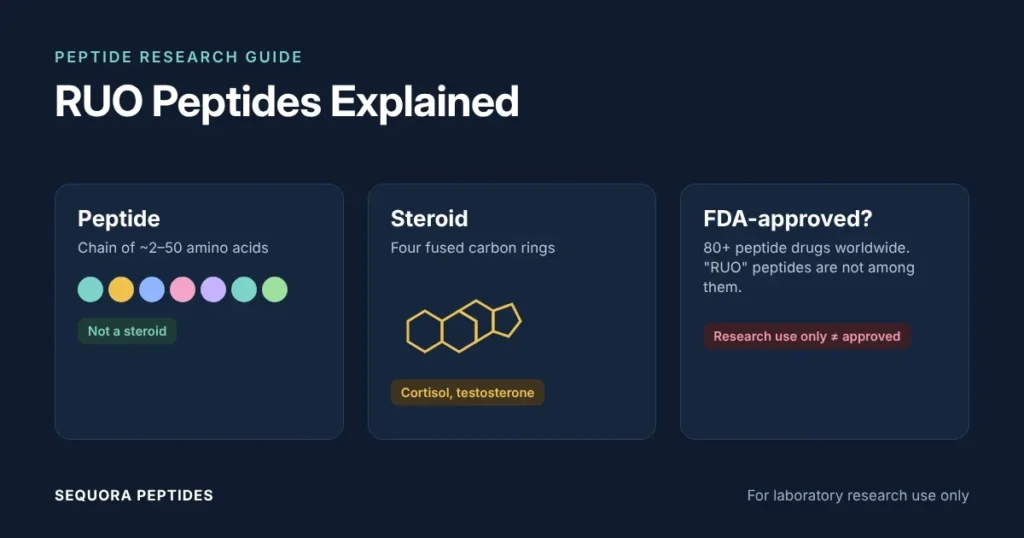
Peptides, including RUO peptides, are not steroids: a peptide is a short chain of amino acids, while a steroid is a molecule built on four fused carbon rings [R1][R2]. More than 80 peptide drugs have reached the market worldwide [R3], but the many peptides sold online as “research use only” (RUO) are not among them. This guide answers the questions people are searching for this week, with a source for every claim.
What Is a Peptide?
A peptide is a short chain of amino acids joined by peptide bonds. The U.S. National Human Genome Research Institute describes peptides as chains of roughly 2 to 50 amino acids; longer chains are polypeptides, and proteins are made of one or more polypeptides [R1]. The cutoff is a convention, not a rule: some authorities place the line between peptide and protein closer to 100 amino acids [R4].
What Do Peptides Do?
In the body, many peptides act as signaling molecules. Insulin is the best-known example: a peptide hormone, and in 1982 the recombinant human version, Humulin, became the first recombinant-DNA protein drug approved for human use [R5]. In research, synthetic peptides are used to study how these signals bind receptors and change cell behavior.
Are Peptides Steroids?
No. The two belong to different chemical classes. A steroid has a core of 17 carbon atoms arranged in four rings; cholesterol, cortisol, and androgens are examples [R2]. Anabolic steroids are synthetic versions of testosterone [R6]. A peptide’s backbone is a chain of amino acids (some peptides are cyclized), not a four-ring carbon skeleton [R1].
| Peptide | Steroid | |
|---|---|---|
| Building blocks | Amino acids linked by peptide bonds | Four fused carbon rings (17-carbon core) |
| Shape | Chain of amino acids (linear or cyclic) | Compact ring system |
| Examples | Insulin, semaglutide, octreotide | Cholesterol, cortisol, testosterone |
What Peptides Are FDA-Approved?
More than 80 peptide drugs have been approved worldwide since insulin, and over 170 more are in clinical development [R3][R7]. These are some of the best-known U.S. approvals:
| Peptide (brand) | FDA approval | Approved use |
|---|---|---|
| Human insulin (Humulin) | October 1982 [R5] | Diabetes |
| Octreotide (Sandostatin) | October 1988 [R8] | Acromegaly; symptoms of certain neuroendocrine tumors |
| Liraglutide (Victoza / Saxenda) | January 2010 / December 2014 [R9][R10] | Type 2 diabetes / weight management |
| Tesamorelin (Egrifta) | November 2010 [R11] | Excess abdominal fat in HIV-associated lipodystrophy |
| Semaglutide (Ozempic / Wegovy) | December 2017 / June 2021 [R12][R13] | Type 2 diabetes / weight management |
| Tirzepatide (Mounjaro / Zepbound) | May 2022 / November 2023 [R14][R15] | Type 2 diabetes / weight management |
Which Peptides Are FDA-Approved for Weight Management?
Of the drugs above, three are approved specifically for chronic weight management: liraglutide (Saxenda, 2014), semaglutide (Wegovy, 2021), and tirzepatide (Zepbound, 2023) [R10][R13][R15]. These are prescription medicines made under FDA oversight, which is different from research-grade material sold online.
Is Retatrutide FDA-Approved?
No. Retatrutide (LY3437943) is an investigational compound. Its developer has reported phase 3 results and plans to submit a Biologics License Application to the FDA in the first quarter of 2027, and states that retatrutide cannot legally be sold for human use [R16]. In March 2025, FDA told state medical boards that compounded retatrutide does not qualify for the legal exemptions that allow compounding [R17].
Is CJC-1295 FDA-Approved?
No. CJC-1295 is a long-acting analog of growth hormone-releasing hormone that was tested in two small placebo-controlled studies in healthy adults in 2006 [R18]. It has never been approved as a drug. In December 2024, FDA’s compounding advisory committee voted against adding any form of CJC-1295 to the list of substances pharmacies may compound from [R19]. FDA’s safety-risk list, where CJC-1295 appeared before its nomination was withdrawn, cites immunogenicity, impurity characterization, and serious adverse events including increased heart rate [R20].
What Does “Research Use Only” (RUO) Mean?
“Research Use Only” is a formal FDA label for in vitro diagnostic products in the laboratory research phase; the required wording is “For Research Use Only. Not for use in diagnostic procedures” [R21]. FDA’s guidance says the label alone does not settle a product’s status; the agency looks at the totality of circumstances [R21].
FDA applies the same logic to peptides. In 2026 warning letters, it treated peptides labeled “research use only” as unapproved drugs where a seller’s website showed they were intended for people, citing disclaimers that did not match how the products were marketed [R22][R23]. RUO peptides are meant for laboratory research by qualified researchers, not for human use.
Are There “Licensed,” “Certified,” or “Verified” Research Peptides?
Not in a regulatory sense. FDA approves drugs, not research chemicals, and registering a facility or listing a product does not mean FDA approval [R24]. Laboratory accreditation such as ISO/IEC 17025 shows a testing lab is competent; it does not certify the product being tested [R25]. What a buyer of research material can check is evidence: a batch-specific certificate of analysis with HPLC purity and mass-spectrometry identity. See our guide on how to read a peptide COA.
Frequently Asked Questions
Are peptides steroids?
No. Peptides are chains of amino acids; steroids are four-ring molecules such as cortisol and testosterone [R1][R2].
What peptides are FDA-approved?
More than 80 peptide drugs are approved worldwide (not all in the U.S.), including insulin, octreotide, liraglutide, semaglutide, and tirzepatide [R3].
What are RUO peptides?
Peptides sold labeled “research use only,” intended for laboratory research. The label does not make a product FDA-approved, and FDA judges intended use from how a product is marketed [R22].
Is retatrutide approved?
No. It is investigational, with an FDA submission planned for early 2027 [R16].
Related research guides
How to read a peptide certificate of analysis · Epitalon vs Epithalon vs Epithalamin
References
How we select and verify sources: Research Sources & Editorial Standards
- National Human Genome Research Institute. Peptide. Talking Glossary of Genomic and Genetic Terms. genome.gov
- Encyclopaedia Britannica. Steroid. britannica.com
- Muttenthaler M, King GF, Adams DJ, Alewood PF. Trends in peptide drug discovery. Nat Rev Drug Discov. 2021;20(4):309–325. doi:10.1038/s41573-020-00135-8. PMID 33536635.
- Encyclopaedia Britannica. Peptide. britannica.com
- Riggs AD. Making, cloning, and the expression of human insulin genes in bacteria: the path to Humulin. Endocr Rev. 2021;42(3):374–380. doi:10.1210/endrev/bnaa029. PMID 33340315.
- MedlinePlus, U.S. National Library of Medicine. Anabolic steroids. medlineplus.gov
- Wang L, Wang N, Zhang W, et al. Therapeutic peptides: current applications and future directions. Signal Transduct Target Ther. 2022;7:48. doi:10.1038/s41392-022-00904-4. PMID 35165272.
- U.S. FDA. Drugs@FDA: Sandostatin (octreotide), NDA 019667. accessdata.fda.gov
- U.S. FDA. Drugs@FDA: Victoza (liraglutide), NDA 022341. accessdata.fda.gov
- U.S. FDA. Drugs@FDA: Saxenda (liraglutide), NDA 206321. accessdata.fda.gov
- U.S. FDA. Drugs@FDA: Egrifta (tesamorelin), BLA 022505. accessdata.fda.gov
- U.S. FDA. Drugs@FDA: Ozempic (semaglutide), NDA 209637. accessdata.fda.gov
- U.S. FDA. FDA approves new drug treatment for chronic weight management, first since 2014 (Wegovy). June 4, 2021. Reprinted at biospace.com
- U.S. FDA. FDA approves novel, dual-targeted treatment for type 2 diabetes (Mounjaro). May 13, 2022. Reprinted at biospace.com
- U.S. FDA. FDA approves new medication for chronic weight management (Zepbound). November 8, 2023. fda.gov
- Retatrutide developer. Triple agonist retatrutide: TRIUMPH-2 topline results. Press release, September 29, 2026. Press release
- Gozun E, U.S. FDA CDER. Letter to the Federation of State Medical Boards on retatrutide. March 31, 2025. PDF
- Teichman SL, Neale A, Lawrence B, Gagnon C, Castaigne JP, Frohman LA. Prolonged stimulation of growth hormone (GH) and insulin-like growth factor I secretion by CJC-1295, a long-acting analog of GH-releasing hormone, in healthy adults. J Clin Endocrinol Metab. 2006;91(3):799–805. doi:10.1210/jc.2005-1536. PMID 16352683.
- U.S. FDA. Pharmacy Compounding Advisory Committee, December 4, 2024: final summary minutes. fda.gov
- U.S. FDA. Certain bulk drug substances for use in compounding that may present significant safety risks. fda.gov
- U.S. FDA. Distribution of in vitro diagnostic products labeled for research use only or investigational use only. Guidance, November 25, 2013. PDF
- U.S. FDA. Warning letter: Gram Peptides, MARCS-CMS 721806. March 31, 2026. fda.gov
- U.S. FDA. Warning letter: TXP Innovations LLC dba Tex Peptides, MARCS-CMS 735067. August 24, 2026. fda.gov
- U.S. FDA. Is it really “FDA approved”? Consumer update. fda.gov
- National Institute of Standards and Technology. About NVLAP. nist.gov
This article summarizes published research and public regulatory documents for educational purposes. Sequora Peptides supplies research chemicals for laboratory use only; nothing here describes use in humans or animals. Sequora Peptides is not affiliated with any drug manufacturer.
For laboratory research use only. Not for human or veterinary use.