
Institutional accounts only · Pricing and quotes released after verified laboratory registration
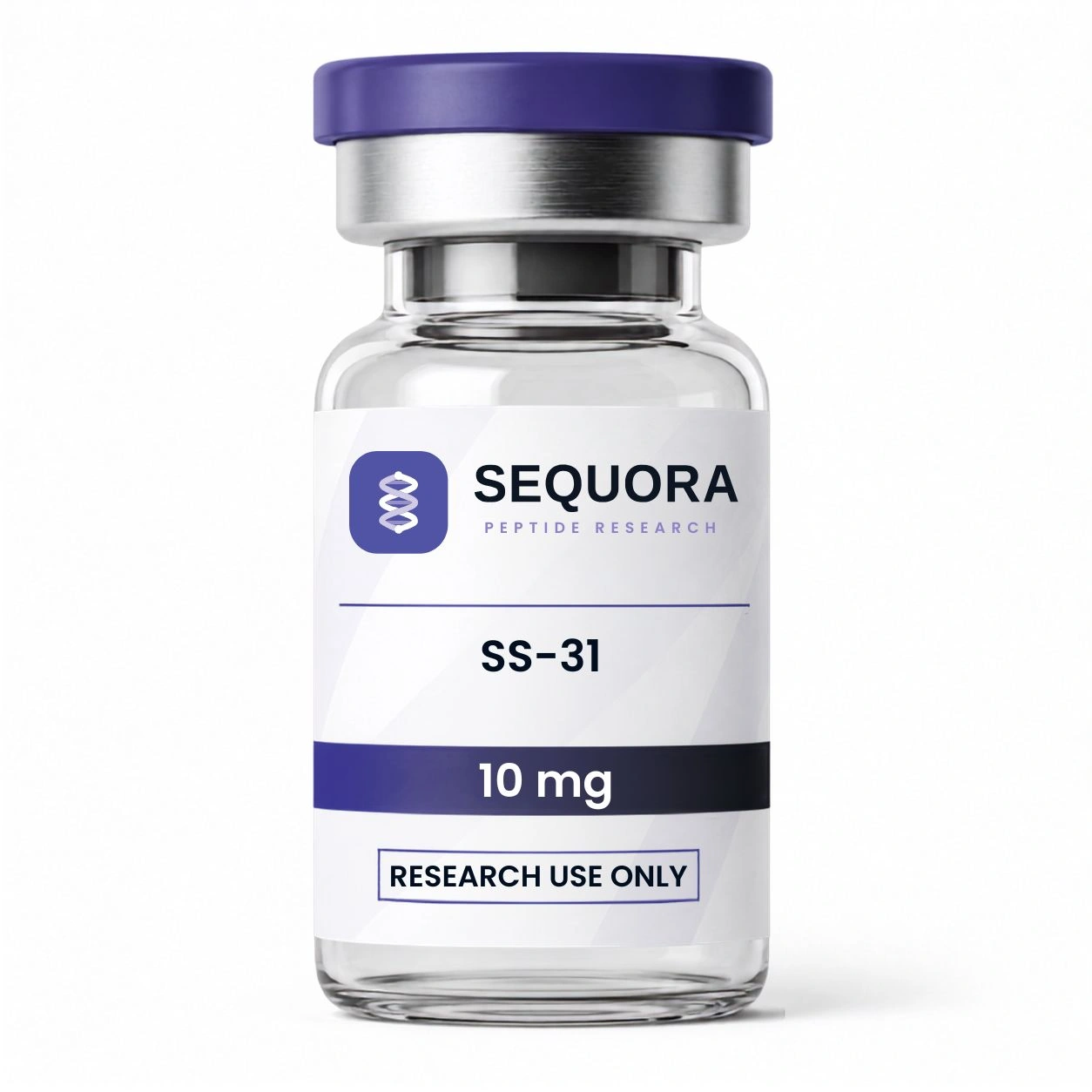
SS-31 10mg, also known as Elamipretide, is a mitochondria-targeting tetrapeptide studied for its interaction with cardiolipin and mitochondrial membranes. It is commonly researched for mitochondrial bioenergetics, ATP production, and oxidative stress pathways.
| Molecular Formula | C32H49N9O5 |
|---|---|
| Molecular Mass | 639.8 g/mol |
| Monoisotopic Mass | 639.375118 g/mol |
| Polar Area | 227 Ų |
| Complexity | 961 |
| XLogP | -1.8 |
| Heavy Atom Count | 46 |
| Hydrogen Bond Donor Count | 9 |
| Hydrogen Bond Acceptor Count | 7 |
| Rotatable Bond Count | 14 |
Every batch is verified for identity and purity by an independent lab before release.
Scan your batch code to pull the full certificate — chromatogram included.
Material compromised in transit is replaced against the original procurement record.
SS-31 10mg is a synthetic tetrapeptide designed to target mitochondria. Its amino acid sequence is D-Arg-Dmt-Lys-Phe-NH₂, where Dmt refers to 2′,6′-dimethyl-L-tyrosine.
SS-31 has been widely studied for its interaction with the inner mitochondrial membrane and its selective association with cardiolipin, a phospholipid that plays an important role in mitochondrial structure and function. Researchers investigate SS-31 in areas such as mitochondrial bioenergetics, ATP production, oxidative stress, reactive oxygen species, and cellular metabolism.
Unlike many peptides that primarily act through cell-surface receptors, SS-31 is studied for its ability to cross cellular membranes and interact directly with mitochondrial components. This makes it a useful research peptide for investigating mitochondrial function, membrane stability, and energy-related cellular pathways.
According to Szeto, British Journal of Pharmacology, SS-31 is a tetrapeptide targeted to mitochondria with selective binding to cardiolipin in the inner mitochondrial membrane. The experimental studies of SS-31 have been performed in order to investigate its role in the preservation of mitochondrial bioenergetics and the improvement of electron transport efficiency and cellular energy metabolism.
Research studies using SS-31 have been developed in many different areas of science, such as mitochondrial biology, oxidative stress studies, cardiovascular physiology, skeletal muscle biology, neurobiology, renal physiology, and cell aging.
As stated by Birk et al., experimental studies have been conducted on the effect of SS-31 on mitochondrial structure, the production of reactive oxygen species, ATP production, and bioenergetics. However, scientists indicate that further studies are needed in order to gain a full understanding of biological mechanisms and consequences of the peptide usage.
Despite some positive results that have been found in experimental studies, SS-31 is still an investigational research peptide. Research studies are still being carried out on its biological features. SS-31 10 mg, manufactured by research peptide companies, is meant for Research Use Only (RUO).
| Specification | Details |
| Product Name | SS-31 10 mg |
| Product Type | Research Peptide |
| Peptide Sequence | D-Arg-dimethylTyr-Lys-Phe-NH₂ |
| Peptide Type | Synthetic mitochondria-targeting tetrapeptide |
| Molecular Formula | C₃₂H₄₉N₉O₅ |
| Molecular Weight | 639.8 g/mol |
| CAS Number | 736992-21-5 |
| Peptide Length | 4 amino acids |
| Appearance | White to off-white lyophilized powder |
| Purity | Research-grade quality |
| Solubility | Sterile water or bacteriostatic water for laboratory research |
| Storage | 2–8°C before and after reconstitution |
| Research Use | Research Use Only (RUO) |
The synthesis of SS-31 was motivated by various scientific endeavors geared towards comprehending more about mitochondrial dysfunction and its significance in cell physiology. Scientists have known for some time that mitochondria are the ones that are accountable for ATP generation, regulation of oxidative phosphorylation, calcium homeostasis, and apoptosis. It has therefore become significant to maintain the structural integrity of the mitochondria in many biomedical research areas.
According to Szeto et al., SS-31 is one of a series of mitochondria-targeting aromatic-cationic peptides that have been synthesized to be able to penetrate the membranes of cells and localize to the mitochondria. Many other mitochondria-targeting compounds require membrane potential to be able to enter cells, but SS-31, on the other hand, has been explored in terms of its ability to interact with cardiolipin, which is an inner membrane mitochondrial phospholipid.
Interest in SS-31 in the scientific community was raised after experiments revealed interaction of the peptide with the mitochondrial membrane. As it was proposed by Birk et al., based on laboratory experiments, SS-31 could have stabilized cardiolipin and provided the stability of mitochondrial cristae formation in experimental settings. These findings were followed by further investigations of mitochondrial respiration, oxidative stress pathways, ATP synthesis, and bioenergetics in general.
Moreover, experimental studies of SS-31 were performed using several laboratory models such as those related to cardiovascular biology, skeletal muscle physiology, renal research, neurobiology, and age-related mitochondrial dysfunction. While these investigations have generated important knowledge in regard to mitochondrial biology, the molecular mechanisms of the action of SS-31 are still not fully revealed, and further preclinical and clinical investigation is required to make definite conclusions.
The exact way through which SS-31 exerts its biological effect is not fully understood. Our current scientific knowledge is informed by scientific research studies carried out in the laboratory and clinically that focus on its relationship with the mitochondrial membranes, cardiolipin, oxidative stress pathways, and cell bioenergetics. According to Birk et al., SS-31 has received a lot of attention as a mitochondrial-targeting peptide, and its ability to selectively target the inner mitochondrial membranes is well known.
One of the key aspects studied in the context of SS-31 research is the binding of this peptide to cardiolipin, a phospholipid found in the inner mitochondrial membrane that plays an important role in the maintenance of mitochondrial structure and the electron transport chain functioning. As was shown by Birk et al. in the British Journal of Pharmacology, in laboratory experiments, it was discovered that SS-31 specifically interacts with cardiolipin and might help in maintaining mitochondrial membrane integrity.
It is being actively researched how this interaction affects the mitochondrial structure.
The mitochondria generate most of the ATP that the cell requires to perform efficiently. According to Szeto, studies that have been performed have examined the influence of SS-31 on the mitochondria’s respiration and generation of ATP using the creation of respiratory chain complexes. Studies have been performed to examine the influence of SS-31 on the mitochondria’s energy metabolism.
Though these studies have yielded encouraging results, further studies are necessary to know how they may be applicable to other biological systems.
Other areas that SS-31 has been used to investigate include oxidative stress. According to Zhao et al., several experimental studies have been done on the association of the peptide with the formation of reactive oxygen species within the mitochondria. It has been noted that under certain lab conditions, there has been an observed reduction in the level of oxidative stress after exposure to SS-31.
Various research works have been carried out on SS-31 based on models of cellular metabolism and mitochondrial physiology. According to Szeto et al., preservation of the integrity of mitochondria might be essential for normal cellular bioenergetics and metabolic balance in experimental settings. The effects of mitochondrial membrane stabilization on cellular metabolism, stress response, and mitochondrial biogenesis are still being studied. Nonetheless, the exact molecular pathways are not yet fully understood.
The vast majority of research conducted on SS-31 has involved laboratory studies, animal experimentation, and some early clinical trials on humans. Most scientific studies have been conducted in the following areas: mitochondrial biology, oxidative stress, cardiovascular physiology, skeletal muscle physiology, renal physiology, neurobiology, and aging biology.
According to Birk et al., many studies performed under laboratory conditions have tested SS-31 in experiments created to explore the stability of the mitochondrial membrane, the relationship between cardiolipins and mitochondria, and mitochondrial respiration. These studies have been important in gaining knowledge regarding mitochondrial peptides.
The use of SS-31 has been studied in animal cardiovascular experiments to gain insight into mitochondrial function in cardiac tissue. As reported by Dai et al., experiments have explored mitochondrial bioenergetics, oxidative stress, and the structure of mitochondria in cardiac tissue after treatment with SS-31.
Experimental research has also been conducted on SS-31 in relation to muscle physiology and age-dependent mitochondrial dysfunction. According to Siegel et al., experimental research included studies on mitochondrial energetics, muscle function, and cellular metabolism in an aged model. Even though the studies were positive, there is still a need for more research to find out the significance of the results in biology.
Further research has been conducted on the effects of SS-31 in animals in relation to renal physiology and neurology. The studies have investigated the effects of oxidative stress and energy metabolism in the organs of the kidney and the brain. Although these studies have added to science’s understanding of mitochondria, they are still preclinical.
Overall, the studies done so far have helped in learning a lot about mitochondrial peptides. However, there is not enough evidence yet to be able to conclude.
Studies in human subjects using SS-31 are still not well documented when compared to other approved drugs that have been subjected to numerous clinical trials. Though there have been a few early-stage clinical trials studying SS-31 within certain scientific settings, most of the published work still comes from lab and animal studies. From published scientific literature, more randomized clinical trials should be conducted in order to assess its biological properties and effects on humans.
The SS-31 peptide is being studied for several peptide and mitochondrial research areas, which include:
Further research is being conducted in all of these fields to help understand mitochondrial biology and the biological nature of mitochondria-targeting peptides.
At present, SS-31 has not been approved by the U.S. Food and Drug Administration (FDA), the European Medicines Agency (EMA), or other major international regulatory agencies as a prescription medication.
According to currently available scientific literature and regulatory information, SS-31 remains an investigational research peptide undergoing continued laboratory and clinical investigation. SS-31 10 mg supplied by research peptide manufacturers is intended exclusively for Research Use Only (RUO) and is not intended for human consumption, veterinary use, diagnosis, treatment, mitigation, cure, or prevention of any disease.
SS-31 10 mg is recommended to be kept as per the laboratory guidelines on how to handle peptides for optimal stability during scientific investigations.
SS-31 10 mg is a synthetic mitochondria-targeting tetrapeptide for experimental use. The interaction of this peptide with the mitochondria, mitochondrial membrane, cardiolipin, oxidative stress pathway, and cellular energetics is studied.
The use of this compound is restricted to scientific research only in the fields of mitochondrial biology, oxidative stress, cellular energetics, cardiovascular physiology, skeletal muscle biology, renal physiology, neurobiology, and mitochondrial aging research.
According to existing scientific knowledge of the drug, this peptide specifically targets mitochondria and binds to cardiolipin in the inner mitochondrial membrane. Nevertheless, more research on its impact on mitochondrial bioenergetics and oxidative stress pathways is being performed.
Not really; SS-31 is not FDA-approved by any other regulatory body anywhere in the world.
SS-31 10 mg should be stored in a refrigerated laboratory condition at 2°C to 8°C. It should also be protected from heat, moisture, and light. After preparation of the solution, it should be frozen just once.
No, SS-31 10 mg is produced strictly for Research Use Only (RUO).
All the products available on Sequora Peptides are strictly for research purposes only.
COA ✓

COA ✓
TB-500 10mg is a synthetic peptide studied in cell migration, tissue repair pathways, and actin-related biological research. Supplied by Sequora Peptides strictly for laboratory research use only.
COA ✓
This site supplies chemicals strictly for laboratory research. You must confirm both statements below to enter.
Products are supplied for laboratory research use only and are not for human or veterinary use.