
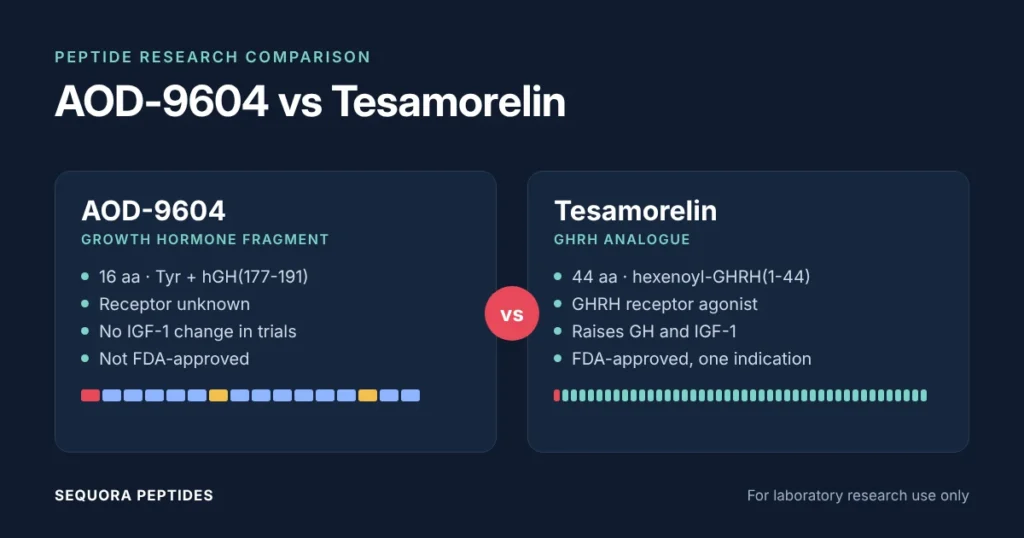
AOD-9604 and tesamorelin are both linked to growth hormone, but in opposite ways. AOD-9604 is a 16-residue piece of the growth hormone molecule itself, with no known receptor; tesamorelin is a 44-residue analogue of growth hormone–releasing hormone (GHRH) that acts on the pituitary GHRH receptor to raise growth hormone release [R1][R2]. Their clinical records also diverge: tesamorelin is an FDA-approved drug for one narrow use, while AOD-9604’s development program ended after a phase 2b trial missed its primary endpoint [R2][R1].
By Sequora Research Team · For laboratory research use only.
AOD-9604 vs Tesamorelin at a Glance
| AOD-9604 | Tesamorelin | |
|---|---|---|
| Class | Growth hormone C-terminal fragment | GHRH analogue |
| Structure | Tyr + hGH(177-191), YLRIVQCRSVEGSCGF, disulfide Cys7–Cys14 | Human GHRH(1-44) amide with an N-terminal trans-3-hexenoyl group |
| Length | 16 aa | 44 aa |
| Formula / MW | C78H123N23O23S2 · 1815.1 g/mol | C221H366N72O67S · 5135.78 g/mol (KEGG; label: 5135.9 Da free base) |
| CAS | 221231-10-3 | 218949-48-5 |
| Receptor | Unknown | GHRH receptor (GHRHR) |
| Effect on IGF-1 in trials | No change vs placebo | +81% in a 26-week trial |
| Largest trial | Phase 2b, 502 randomized, 24 weeks, primary endpoint not met | Phase 3, 412 randomized, 26 weeks, primary endpoint met |
| FDA status | Not approved; PCAC voted 12–0 against 503A listing (2024) | Approved 2010 for one indication (see below) |
| WADA 2026 | Prohibited (S2.2.3, GH fragments) | Prohibited (S2.2.4, GHRH analogues) |
Sources: [R1][R2][R3][R4][R5][R6][R7].
Structure: A Hormone Fragment vs a Releasing-Hormone Analogue
AOD-9604 is taken from the end of growth hormone. It is hGH residues 177–191 with a tyrosine added at the N-terminus, 16 residues in total, held in a loop by one disulfide bond [R1]. It is closely related to “HGH fragment 176-191,” which differs only in its first residue; the growth hormone fragments guide covers that comparison in detail.
Tesamorelin is built on a different hormone. It contains the full 44-amino-acid sequence of human GHRH, the hypothalamic hormone that signals the pituitary to release growth hormone, with a trans-3-hexenoic acid group attached to the N-terminal tyrosine [R2][R3]. Its molecular weight, 5135.78 g/mol, is nearly three times that of AOD-9604 [R3].
Mechanism Studied
The two peptides sit at different points on the growth hormone axis. Tesamorelin binds and stimulates human GHRH receptors with potency similar to native GHRH [R2]. That raises pituitary growth hormone output, and downstream IGF-1: in its 26-week phase 3 trial, IGF-1 rose 81% [R5].
AOD-9604 does not act through that axis as far as is known. Its receptor has not been identified [R1]. In obese mice its effects on fat tissue were not directly mediated by the β3-adrenergic receptor [R8], and across six human trials it did not change serum IGF-1 [R4]. In obese Zucker rats, 19 days of oral AOD-9604 increased lipolytic activity in fat tissue without the loss of insulin sensitivity seen with long-term intact hGH [R9].
Clinical Development
AOD-9604: six trials, development ended
The developer ran six randomized, placebo-controlled trials with 893 participants in total [R4]. The two largest were oral phase 2b trials in adults with obesity:
- 12-week trial (300 participants). Five oral dose levels vs placebo. Reported only as a meeting abstract; per FDA’s summary, weight loss was greater than placebo in all groups with a non-linear dose response, and the largest effect (lowest-dose group: −0.22 kg/week vs −0.07 kg/week on placebo) was significant only in women [R1].
- 24-week trial (502 randomized). Three oral dose levels vs placebo, with a dietitian-supervised diet and exercise program. Weight loss versus placebo at 12 and 24 weeks was too low to reach statistical significance, and the developer terminated development for this use in 2007 [R1].
Pooled safety data showed adverse-event rates similar to placebo, no change in IGF-1 or glucose tolerance, and no antibodies against the peptide in the subjects tested [R4]. FDA’s 2024 review concluded there was “a lack of evidence to support the effectiveness” of AOD-9604 for weight reduction and found no human pharmacokinetic studies [R1]. After the drug program ended, the developer announced a self-affirmed, conditional GRAS (food ingredient) conclusion in 2012; this was the company’s own determination, and we found no FDA GRAS notice or response for AOD-9604 [R10][R1].
Tesamorelin: phase 3 and approval
In a 26-week phase 3 trial, 412 HIV-infected patients with abdominal fat accumulation were randomized to daily tesamorelin or placebo. Visceral adipose tissue measured by CT fell 15.2% with tesamorelin and rose 5.0% with placebo; triglyceride and cholesterol measures also improved, and glycemic measures did not differ between groups [R5]. More patients withdrew because of adverse events in the tesamorelin group [R5].
FDA approved tesamorelin in 2010 for reducing excess abdominal fat in HIV-infected adults with lipodystrophy. Its label states that it is not indicated for weight-loss management, because it has a weight-neutral effect, and that long-term cardiovascular safety has not been established [R2].
Key Differences for Researchers
- Axis position. Tesamorelin works upstream, at the pituitary GHRH receptor; AOD-9604 is a piece of growth hormone with no defined receptor [R2][R1].
- IGF-1 as a readout. Tesamorelin raises IGF-1; AOD-9604 did not in human trials [R5][R4].
- Evidence base. Tesamorelin has peer-reviewed phase 3 data; AOD-9604’s larger phase 2b trial was never published in a journal [R5][R1].
- Analytical identity. The expected masses (about 1815 Da vs about 5136 Da) are far apart, so mass spectrometry separates them easily. See how to read a peptide COA.
Regulatory Status
Tesamorelin is an FDA-approved drug for one indication [R2]. Research-labeled tesamorelin is not that approved product and is not for human use. AOD-9604 is not approved for any use; its 503A compounding nomination was withdrawn in September 2024, and FDA’s advisory committee voted 12–0 against adding it to the 503A bulks list on December 4, 2024 [R11][R6]. FDA has also issued warning letters treating “research use only” peptides marketed for human use as unapproved drugs [R12]. Both peptides are prohibited at all times under the World Anti-Doping Agency’s 2026 list [R7]. See RUO peptides explained.
Frequently Asked Questions
What is the difference between AOD-9604 and tesamorelin?
AOD-9604 is a 16-residue fragment of growth hormone with no known receptor. Tesamorelin is a 44-residue GHRH analogue that stimulates the pituitary GHRH receptor and raises growth hormone and IGF-1 [R1][R2].
Is AOD-9604 a growth hormone secretagogue?
No. It is a fragment of growth hormone itself, not a releasing-hormone analogue, and it did not change IGF-1 in human trials [R1][R4].
Which one is FDA-approved?
Only tesamorelin, approved in 2010 for excess abdominal fat in HIV-infected adults with lipodystrophy [R2]. AOD-9604 is not approved.
What did each peptide’s main trial find?
Tesamorelin’s phase 3 trial met its endpoint: visceral fat fell 15.2% vs a 5.0% rise on placebo [R5]. AOD-9604’s 24-week phase 2b trial did not reach statistical significance versus placebo [R1].
Are AOD-9604 and tesamorelin banned in sport?
Yes. Both are on the World Anti-Doping Agency’s 2026 Prohibited List [R7].
Reference compounds
- AOD-9604 10mg — Tyr-hGH(177-191), CAS 221231-10-3, with batch COA.
- Tesamorelin 10mg — GHRH(1-44) analogue, CAS 218949-48-5, with batch COA.
- Category: Growth Hormone Fragments · Guide: HGH fragment 176-191 and AOD-9604
For laboratory research use only.
References
How we select and verify sources: Research Sources & Editorial Standards
- U.S. Food and Drug Administration. FDA Briefing Document: AOD-9604-related bulk drug substances. Pharmacy Compounding Advisory Committee meeting, December 4, 2024 (memo dated 11/5/2024). fda.gov/media/183584/download
- U.S. Food and Drug Administration. Tesamorelin prescribing information (NDA 022505, label revision 2025). accessdata.fda.gov (PDF)
- KEGG DRUG. Tesamorelin, D06655. kegg.jp/entry/D06655
- Stier H, Vos E, Kenley D. Safety and tolerability of the hexadecapeptide AOD9604 in humans. J Endocrinol Metab. 2013;3(1-2):7–15. doi:10.4021/jem.v3i1-2.157.
- Falutz J, Allas S, Blot K, et al. Metabolic effects of a growth hormone–releasing factor in patients with HIV. N Engl J Med. 2007;357(23):2359–2370. doi:10.1056/NEJMoa072375. PMID 18057338.
- U.S. Food and Drug Administration. Final summary minutes of the Pharmacy Compounding Advisory Committee meeting, December 4, 2024. fda.gov/media/185642/download
- World Anti-Doping Agency. Prohibited List 2026, sections S2.2.3 and S2.2.4 (published in Tractatenblad 2026, nr. 25). officielebekendmakingen.nl
- Heffernan M, Summers RJ, Thorburn A, et al. The effects of human GH and its lipolytic fragment (AOD9604) on lipid metabolism following chronic treatment in obese mice and β3-AR knock-out mice. Endocrinology. 2001;142(12):5182–5189. doi:10.1210/endo.142.12.8522. PMID 11713213.
- Ng FM, Sun J, Sharma LK, Libinaka R, Jiang WJ, Gianello R. Metabolic studies of a synthetic lipolytic domain (AOD9604) of human growth hormone. Horm Res. 2000;53(6):274–278. doi:10.1159/000053183. PMID 11146367.
- Developer announcement to the Australian Securities Exchange: conditional GRAS determination for AOD9604, June 25, 2012. asx.com.au (PDF)
- Reed Smith LLP. FDA removes certain peptide bulk drug substances from Category 2 and schedules PCAC review. Client Alert 2024-208, October 2024. reedsmith.com
- U.S. Food and Drug Administration. Warning letter, March 31, 2026 (research-use-only peptides). fda.gov
This article summarizes published research for educational purposes. Sequora Peptides supplies research chemicals for laboratory use only; nothing here describes use in humans or animals.
For laboratory research use only. Not for human or veterinary use.