
Institutional accounts only · Pricing and quotes released after verified laboratory registration
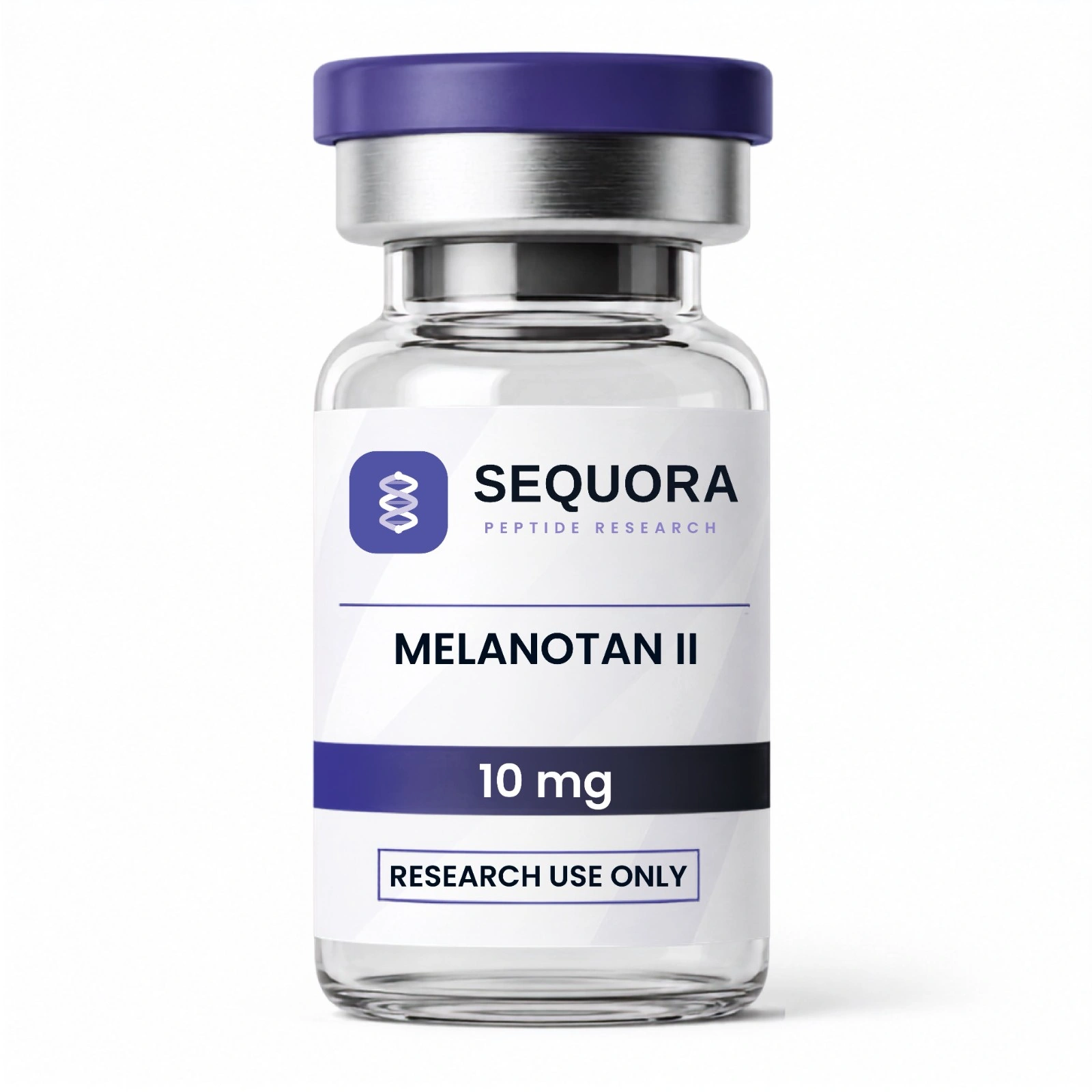
Melanotan II (MT-II) 10mg is a synthetic peptide that has been studied for its activity at melanocortin receptors. Research has explored MT-II in areas including melanogenesis and melanocortin signaling. Available from Sequora Peptides for laboratory and scientific research.
Every batch is verified for identity and purity by an independent lab before release.
Scan your batch code to pull the full certificate — chromatogram included.
Material compromised in transit is replaced against the original procurement record.
Melanotan II (MT-II) is a synthetic cyclic heptapeptide analogue of the alpha-melanocyte-stimulating hormone (α-MSH) to increase peptide stability and biological activity. As a non-selective melanocortin receptor agonist, Melanotan II interacts with multiple melanocortin receptor subtypes, including MC1R, MC3R, MC4R, and MC5R. Its broad receptor profile has made it an important research tool for investigating melanogenesis, pigmentation biology, melanocortin receptor signaling, energy homeostasis, appetite regulation, and neuroendocrine function.
In this study, “The melanocortin-1 receptor and human pigmentation”, published in Pigment Cell Research, the researchers found that activation of the melanocortin-1 receptor (MC1R) stimulates the production of eumelanin, the darker form of melanin that is responsible for skin pigmentation and provides natural protection against ultraviolet (UV) radiation. According to this study, “Evaluation of melanotan-II, a superpotent cyclic melanotropic peptide in a pilot phase-I clinical study“, scientists utilize Melanotan II as a research tool to investigate melanocortin receptor pharmacology, pigmentation biology, and the physiological functions of multiple melanocortin receptor subtypes by inducing skin pigmentation under controlled clinical research conditions.
Beyond studying the effects of MT-II on increasing melanin production, scientists are also researching the effects of this substance on melanocortin receptors in the context of studying the mechanisms that control body weight, diet, and brain function. As it was stated in the article, “Melanocortin receptor agonist melanotan-II microinjected in the nucleus accumbens decreases feeding behaviour”, the center of the brain involved in reward is one of the regions where the distribution of MT-II affects a person’s eating patterns. The activation of these particular receptors strongly decreases active eating and the intake of food in general. On the other hand, as it was mentioned in this article, “Activation of the central melanocortin system chronically decreases body mass without the necessity of long-term caloric restriction”. Preclinical studies have investigated effects on appetite and energy balance, but these findings should not be interpreted as evidence of effectiveness in humans.
Nevertheless, it is important to note that scientists have not approved the use of this substance by the Food and Drug Administration or other regulatory agencies. Therefore, it is not allowed to use Melanotan II for human consumption or clinical purposes.
Buy Melanotan II at Sequora Peptides. Research-grade peptide with third-party testing, COA availability, and fast shipping for laboratory research.
| Characteristics | Specification |
| Product Name | Melanotan II (MT-II) |
| CAS Number | 121062-08-6 |
| Molecular Formula | C₅₀H₆₉N₁₅O₉ |
| Molecular Weight | 1024.18 g/mol |
| Peptide Sequence | Ac-Nle-cyclo[Asp-His-D-Phe-Arg-Trp-Lys]-NH2 |
| Structure | Cyclic lactam-bridged heptapeptide |
| Physical Appearance | White, sterile-filtered lyophilized powder |
| Supplier Name | Sequora Peptide |
Melanotan II (MT-II) is an artificial cyclic analog of α-melanocyte-stimulating hormone (α-MSH), which was synthesized to increase the stability and biological activity of the natural hormone. The synthesis of Melanotan II included the introduction of structural changes into the polypeptide chain, which allowed increasing the resistance to enzymatic destruction and biological activity of this product.
Melanotan II was created as a result of research dedicated to the study of the physiological role of α-MSH and melanocortin receptors. Unlike the natural α-MSH, which has a short time of action in vivo due to rapid enzymatic degradation, Melanotan II contains the substitution of norleucine (Nle) and D-phenylalanine (D-Phe) amino acids along with the presence of the cyclic structure of the polypeptide chain.
As per The melanocortin-1 receptor and human pigmentation, published in Pigment Cell Research, melanocortin receptors control various physiological processes like melanogenesis, pigmentation, energy balance, and neuroendocrine signaling. As Melanotan II acts on several subtypes of melanocortin receptors (MC1R, MC3R, MC4R, and MC5R), it has emerged as an excellent model compound to study the coordination of diverse biological functions by these receptors.
For the last two decades, Melanotan II has found wide use as a laboratory research compound to study:
Such research efforts have made significant contributions to the scientific knowledge about the melanocortin system and the biological role of its receptor subtypes. Many observations are still experimental and warrant further studies.
While it is true that Melanotan II has shown various biological actions in preclinical studies as well as limited studies in human beings, the fact remains that it is still a drug under investigation. It is different from Afamelanotide (Melanotan I) because while Afamelanotide is a drug that has been approved by a regulatory body for a particular clinical application, Melanotan II has yet to be approved by the FDA or any other regulatory body.
Melanotan II is a biomimetic pan-agonist that acts on endogenous neural and cutaneous circuits. Due to the non-selective nature of MT-II, the mechanism of action depends on the target tissue.
In the context of cutaneous biology, MT-II functions as a direct activator of cellular tanning mechanisms, effectively bypassing the need for systemic stimulation from ultraviolet light exposure.
In regard to neuroendocrine research, the use of MT-II acts to target relevant neurological centers regulating hunger and satiety.
Further, the melanocortin 3 and 4 receptor agonist can be considered to cause long-term changes to energy expenditure regulation.
Beyond the established capacity of Melanotan II (MT-II) to demonstrate its pharmacological properties on the epidermis, preclinical investigations often report on the peptide’s expanded biochemical range regarding its metabolic and neuronal effects:
Unlike its linear counterpart, Melanotan I (Afamelanotide), which was eventually approved for clinical use in patients with particular photodermatitis, Melanotan II failed a phase III trial because of its nonselective receptor engagement. In parallel, the early-stage clinical investigation in humans identified several pharmacological properties of the compound:
Modern laboratory research is using MT-II to study receptor crosstalk and the possibility of obtaining an orally available version of this peptide.
As stated in the study, “Novel approaches to the design of bioavailable melanotropins,” MT-II’s cyclized analogs are considered crucial for analyzing the ability of a molecule to penetrate the blood-brain barrier.
This way, researchers are trying to create modern MT agonists with improved tissue selectivity by studying their constrained conformations and overcoming the systemic side effects of pan-agonistic neuropeptides.
Melanotan II (MT-II) is extensively used in preclinical laboratory settings to determine the receptor structure and downstream signaling networks of G-protein coupled receptors. The current research applications make use of the peptide as a reference control in several key areas:
Unlike Afamelanotide (Melanotan I), which has been approved by the FDA as Scenesse® for the treatment of erythropoietic protoporphyria, Melanotan II has not been approved by the FDA or other global regulatory agencies for therapeutic use or as a treatment for any medical condition.
As of now, Melanotan II is an investigational research peptide, and the published scientific literature refers to MT-II as an experimental pharmaceutical agent undergoing research and development.
Melanotan II (MT-II) 10mg from Sequora Peptide is provided for Research Use Only (RUO). This product is for laboratory research and should not be used for human consumption, therapeutic use, diagnostic use, or self-administration.
Proper storage of MT-II 10mg is essential to ensure the stability, purity, and integrity of this peptide during lab experimentation. The following guidelines should be followed to guarantee proper MT-II storage and prevent peptide instability:
When working with MT-II, the following guidelines should be followed:
By adhering to the above recommendations, researchers can ensure the integrity of their peptides while also maximizing their chances of obtaining reliable lab results.
Melanotan II (MT-II) 10mg is a cyclic analogue of alpha-melanocyte stimulating hormone or α-MSH that has been developed as a non-selective melanocortin receptor agonist. MT-II is often used in scientific research to study the function of the melanocortin system and its impact on various physiological processes, including pigmentation, energy metabolism, feeding behavior, and neuroendocrine function.
Melanotan II works by binding to various types of melanocortin receptors (MC1R, MC3R, MC4R, and MC5R) and activating their signaling cascades, leading to increased production of melanin, regulation of receptor pharmacology, control of energy homeostasis, and other related physiological effects. Scientists are studying Melanotan II to gain a better understanding of the melanocortin system and its implications for health and disease.
Melanotan II is used in research settings to study the functions related to:
These are just a few examples of the many ways that scientists might use Melanotan II in their research.
Melanotan II is not approved by the Food and Drug Administration or any other regulatory agency for human use or treatment of any medical condition. It is a research peptide that is only intended for use in laboratory experiments by qualified personnel.
No, Melanotan II is different than Melanotan I (also called Afamelanotide or Scenesse). Both peptides were developed from alpha-MSH, but they have different amino acid sequences and target different sets of melanocortin receptors. While Melanotan I is an FDA-approved therapy for patients with EPP, Melanotan II is an investigational peptide that has not been approved by any regulatory authority.
No, the product provided by Sequora Peptide is for Research Use Only (RUO). It is strictly for laboratory investigations and should not be used for human consumption, clinical trials, diagnostic assays, veterinary applications, or personal experimentation.
Melanotan II (MT-II) 10mg from Sequora Peptide is for research purposes only. The peptide is not intended for human consumption, therapy, diagnosis, veterinary purposes, or self-experimentation.
Melanotan II is an investigative drug that has not received approval from the US FDA or other global regulatory agencies for human use or the treatment of any disease. Do not interpret any of the statements contained in this document as a claim related to disease diagnosis, treatment, cure, mitigation, or prevention.
The information provided on this page is solely for educational purposes and provides only a summary of research findings in scientific literature. Any mention in this document of preclinical findings, initial clinical studies, or receptor-level research details is provided for educational and scientific publishing purposes and does not support or suggest that these products are safe or effective for human use.
Researchers are responsible for ensuring this product’s purchase, storage, preparation, and use are consistent with all applicable federal, state, local, and institutional laws and regulations.
Melanotan II should only be purchased, stored, prepared, and used in a qualified laboratory by trained personnel under appropriate laboratory conditions and safety procedures.
COA ✓
Semax 10mg is a synthetic research peptide studied for its activity in neurological, cognitive, and neuroprotective research models. Each vial is intended strictly for laboratory research use only and is not for human use.
COA ✓
COA ✓
This site supplies chemicals strictly for laboratory research. You must confirm both statements below to enter.
Products are supplied for laboratory research use only and are not for human or veterinary use.