
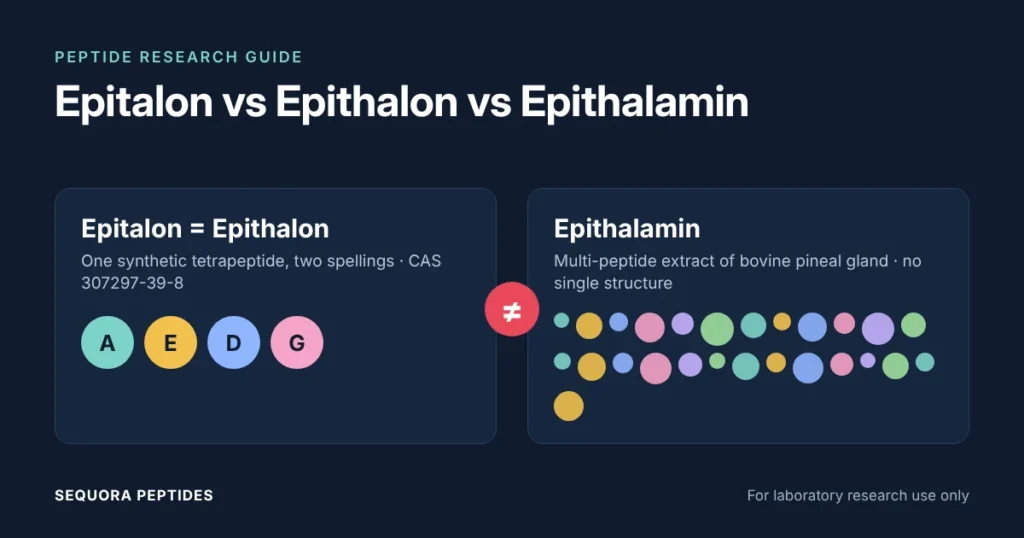
Epitalon and Epithalon are two spellings of the same synthetic peptide, the four-amino-acid sequence Ala-Glu-Asp-Gly. Epithalamin is a different substance: the extract from the pineal gland that epitalon was modeled on [R2]. Confusing the two is the most common error in online sources, and it matters, because much of the human research was done with epithalamin, not epitalon [R5].
Is Epitalon the Same as Epithalon?
Yes. Both names refer to the tetrapeptide H-Ala-Glu-Asp-Gly-OH, also called the AEDG peptide, CAS 307297-39-8 [R1]. The scientific literature uses both spellings for the same compound. A 2003 telomerase study used “Epithalon” in its title [R3], while a mouse aging study published the same year used “Epitalon” [R4]. When you search the literature, search both.
What Is Epithalamin?
Epithalamin is a polypeptide extract isolated from the pineal glands of cattle. It is a mixture of peptides rather than one defined molecule. Researchers at the St. Petersburg Institute of Bioregulation and Gerontology designed epitalon from the amino-acid composition of epithalamin and proposed it as one of the extract’s active components [R2].
Epitalon vs Epithalamin at a Glance
| Epitalon / Epithalon | Epithalamin | |
|---|---|---|
| What it is | Synthetic tetrapeptide, Ala-Glu-Asp-Gly | Polypeptide extract of bovine pineal gland |
| Defined structure | Yes: C14H22N4O9, 390.35 g/mol, CAS 307297-39-8 | No single structure |
| Origin | Designed from epithalamin’s amino-acid composition | Isolated from animal tissue |
| Human data | Few small studies, not adequately blinded | More numerous, but not transferable to epitalon |
Why the Difference Matters
A 2026 narrative review of both compounds warns that evidence from epithalamin should not be used to support claims about epitalon. The extract contains many peptides, so an effect seen with epithalamin cannot be attributed to the AEDG sequence alone [R5]. When a source cites “decades of human research” on epitalon, check which compound the studies actually used.
What the Research on Epitalon Shows
Cell studies
In cultured human fetal fibroblasts, epitalon increased expression of the telomerase catalytic subunit, telomerase activity, and telomere length [R3]. An independent 2025 study reported telomere elongation in normal human cell lines through telomerase, but in breast-cancer cell lines through the telomerase-independent ALT pathway [R6]. That paper was later corrected.
A 2022 study from a separate group found that epitalon added to culture medium at 0.1 mM reduced reactive oxygen species and spindle defects in aging mouse oocytes in vitro [R7].
Animal studies
Results are mixed. In female SHR mice, epitalon did not change mean lifespan or total tumor incidence [R4].
What is still missing
No pharmacokinetic study exists in any species, there is no toxicity or carcinogenicity package, and no adequately powered randomized human trial has been published. Most studies come from a single research group [R2][R5]. The 2026 review summarizes epitalon as biologically active but clinically unproven [R5].
Regulatory Status
Epitalon is not approved by the FDA for any use. In July 2026, an FDA advisory committee narrowly voted to recommend it for the 503A bulk-substances list used in compounding. The vote is non-binding, and FDA had not changed the list as of October 2026 [R8][R9].
Frequently Asked Questions
Is epitalon the same as epithalon?
Yes. They are two spellings of the same synthetic tetrapeptide, Ala-Glu-Asp-Gly [R1].
Is epithalamin the same as epitalon?
No. Epithalamin is a multi-peptide extract of the pineal gland. Epitalon is a single synthetic peptide designed from it [R2].
What is epitalon peptide?
Epitalon is a synthetic four-amino-acid peptide, CAS 307297-39-8, studied in laboratory models of telomere biology, gene expression, and pineal function [R1][R2].
Is epitalon FDA-approved?
No. It is not an approved drug, and the July 2026 advisory committee vote on compounding has not changed its status [R8].
Reference compound
Epitalon 10mg (Epithalon) — synthetic Ala-Glu-Asp-Gly, CAS 307297-39-8, with batch COA. For laboratory research use only.
References
How we select and verify sources: Research Sources & Editorial Standards
- PubChem. Epitalon, CID 219042. National Center for Biotechnology Information. pubchem.ncbi.nlm.nih.gov/compound/219042
- Araj SK, Brzezik J, Mądra-Gackowska K, Szeleszczuk Ł. Overview of Epitalon—highly bioactive pineal tetrapeptide with promising properties. Int J Mol Sci. 2025;26(6):2691. doi:10.3390/ijms26062691. PMID 40141333.
- Khavinson VKh, Bondarev IE, Butyugov AA. Epithalon peptide induces telomerase activity and telomere elongation in human somatic cells. Bull Exp Biol Med. 2003;135(6):590–592. doi:10.1023/A:1025493705728. PMID 12937682.
- Anisimov VN, Khavinson VKh, Popovich IG, et al. Effect of Epitalon on biomarkers of aging, life span and spontaneous tumor incidence in female Swiss-derived SHR mice. Biogerontology. 2003;4(4):193–202. doi:10.1023/A:1025114230714. PMID 14501183.
- Jain A, Gallacher DM, Issa MA, et al. Epitalon and epithalamin: a narrative review of mechanistic, preclinical, and clinical evidence. Int J Mol Sci. 2026;27(19):8922. doi:10.3390/ijms27198922.
- Al-Dulaimi S, Thomas RS, Matta S, Roberts T. Epitalon increases telomere length in human cell lines through telomerase upregulation or ALT activity. Biogerontology. 2025;26(5):178. doi:10.1007/s10522-025-10315-x. PMID 40908429.
- Yue X, Liu SL, Guo JN, et al. Epitalon protects against post-ovulatory aging-related damage of mouse oocytes in vitro. Aging (Albany NY). 2022;14(7):3191–3202. doi:10.18632/aging.204007. PMID 35413689.
- U.S. Food and Drug Administration. Bulk drug substances used in compounding under section 503A of the FD&C Act. fda.gov
- McDermott Will & Schulte. Bulk list bound? PCAC backs majority of peptides in two-day public meeting. July 2026. mcdermottlaw.com
This article summarizes published research for educational purposes. Sequora Peptides supplies research chemicals for laboratory use only; nothing here describes use in humans or animals.