
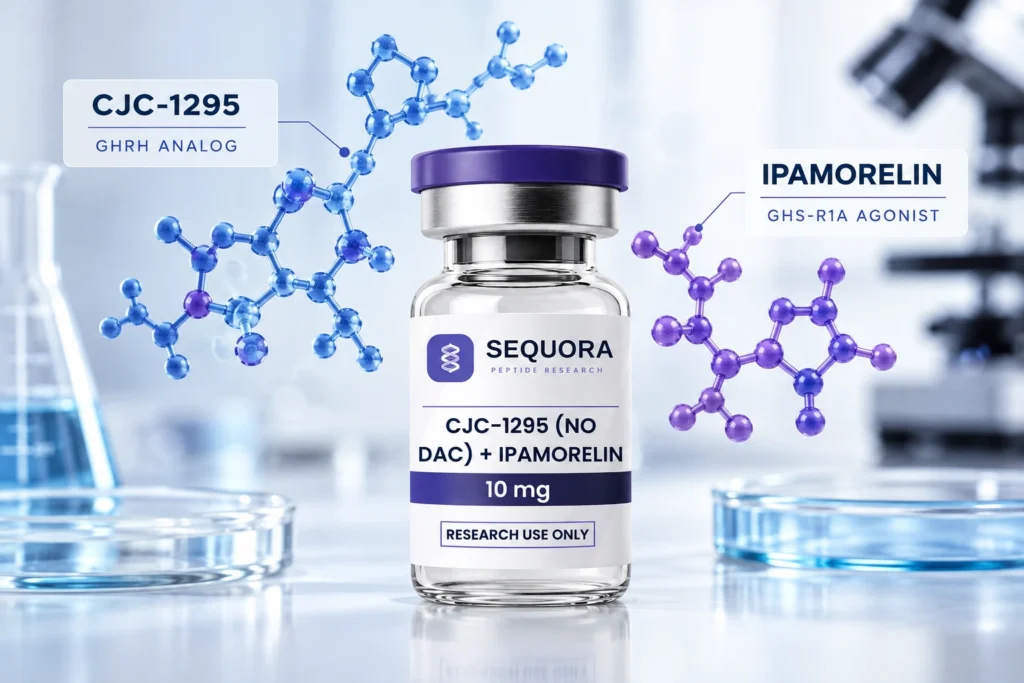
CJC-1295 and Ipamorelin are two synthetic peptides studied for their interactions with the growth hormone (GH) signaling system. Although both are associated with growth hormone secretion, they differ in molecular structure, receptor binding, and biological activity.
CJC-1295 is a modified analog of growth hormone-releasing hormone (GHRH). Ipamorelin belongs to a separate class of compounds called growth hormone secretagogues (GHS). It interacts primarily with the growth hormone secretagogue receptor, GHS-R1a.
These differences explain why researchers are interested in examining the two compounds together.
A CJC-1295 and Ipamorelin blend combines both peptides in a single research preparation. However, published findings involving the individual compounds should not be treated as direct evidence for the combined formulation.
This guide examines the composition, molecular mechanisms, laboratory applications, and analytical considerations associated with CJC-1295 and Ipamorelin research.
What Is CJC-1295?
CJC-1295 is a synthetic peptide developed from the structure of endogenous GHRH, a hormone involved in regulating growth hormone secretion.
Natural GHRH interacts with receptors located on somatotroph cells in the anterior pituitary gland. This interaction activates intracellular signaling pathways that influence GH synthesis and release.
CJC-1295 was developed to investigate how modifications to the GHRH structure could affect receptor activity and the duration of biological responses.
Molecular Characteristics of CJC-1295
CJC-1295 is commonly discussed in two forms:
- CJC-1295 with DAC: A long-acting analog containing a drug-affinity complex designed to facilitate binding to circulating albumin.
- CJC-1295 without DAC: A shorter-acting modified GHRH analog frequently associated with the name Modified GRF (1-29).
The distinction matters because these forms do not have identical pharmacokinetic properties.
The original CJC-1295 clinical investigations primarily involved the DAC-containing compound.
In a 2006 study published in the Journal of Clinical Endocrinology & Metabolism, researchers investigated the pharmacokinetic and pharmacodynamic characteristics of CJC-1295 in healthy adult volunteers.
The study reported prolonged changes in circulating GH and IGF-I concentrations following administration of the investigated compound.
These findings relate to the specific CJC-1295 formulation studied and cannot automatically be extended to CJC-1295 No DAC or commercial peptide blends.
Research reference: Teichman et al., 2006 — PubMed
What Is Ipamorelin?
Ipamorelin is a synthetic pentapeptide belonging to the growth hormone secretagogue family.
Unlike CJC-1295, which acts through the GHRH receptor, Ipamorelin interacts with GHS-R1a, a receptor associated with ghrelin signaling.
This receptor belongs to the G-protein-coupled receptor family.
Ipamorelin has been investigated for its ability to influence growth hormone secretion through receptor-mediated pathways.
Molecular Characteristics of Ipamorelin
Ipamorelin contains five amino acid residues and has a molecular formula of C₃₈H₄₉N₉O₅ in its free-base form.
Its molecular weight is approximately 711.85 g/mol.
The peptide’s structure differs substantially from that of CJC-1295, reflecting its separate receptor-binding mechanism.
Early experimental research investigated Ipamorelin’s selectivity within the growth hormone secretagogue family.
The findings helped establish Ipamorelin as a useful compound for studying the relationship between GHS receptor activation and pituitary hormone release.
However, selectivity observed in experimental models does not establish the long-term safety or effectiveness of Ipamorelin in clinical settings.
What Is a CJC-1295 and Ipamorelin Blend?
A CJC-1295 and Ipamorelin blend is a research formulation containing both synthetic peptides.
The combination brings together two compounds that interact with different receptor systems involved in growth hormone regulation.
In laboratory research, this pairing is of interest because GHRH receptor signaling and GHS receptor signaling are biologically distinct but related.
A blended preparation may be used to investigate these pathways within a controlled experimental design.
However, combining two peptides does not automatically produce a stronger or more predictable biological response.
Any interaction between the compounds must be evaluated experimentally rather than assumed from their individual mechanisms.
Understanding Blend Composition
Research peptide blends are generally identified by their total peptide content and the quantity of each component.
For example, a hypothetical 10 mg blend containing equal quantities of CJC-1295 and Ipamorelin would consist of:
- CJC-1295: 5 mg
- Ipamorelin: 5 mg
- Total peptide content: 10 mg
This example illustrates how blend quantities may be described. It does not establish the composition of every commercially available 10 mg formulation.
Different products may contain different ratios.
Researchers should examine the product specifications and supporting analytical documentation to determine the declared composition.
How Do CJC-1295 and Ipamorelin Work?
Although CJC-1295 and Ipamorelin are associated with the same endocrine system, their receptor interactions are different.
Understanding these differences is essential when examining the scientific rationale behind the combination.
CJC-1295 and GHRH Receptor Signaling
CJC-1295 acts as an analog of GHRH.
GHRH receptors are primarily associated with somatotroph cells in the anterior pituitary gland.
When a GHRH-type ligand activates its receptor, it stimulates intracellular signaling involving cyclic adenosine monophosphate (cAMP).
This signaling pathway contributes to the regulation of growth hormone synthesis and secretion.
Experimental research involving CJC-1295 has examined how structural modifications influence the duration and characteristics of these responses.
The DAC-containing version has been investigated for its prolonged biological activity.
Ipamorelin and GHS-R1a Signaling
Ipamorelin interacts with the growth hormone secretagogue receptor, GHS-R1a.
This receptor is associated with ghrelin-mediated signaling and is expressed in several tissues, including regions involved in endocrine regulation.
GHS-R1a activation involves intracellular pathways that differ from the primary cAMP signaling associated with GHRH receptors.
These pathways can influence intracellular calcium signaling and downstream hormone-release mechanisms.
Ipamorelin therefore provides a separate experimental approach for examining growth hormone secretagogue activity.
Why Are These Peptides Studied Together?
The scientific interest in CJC-1295 and Ipamorelin arises from their different receptor targets.
CJC-1295 is associated with GHRH receptor activation, while Ipamorelin acts through GHS-R1a.
Researchers studying endocrine signaling may examine whether activating these pathways together changes the characteristics of a measured response.
Potential experimental questions include:
- How do the two receptor pathways interact?
- Does combined receptor activation alter downstream signaling?
- Are changes in growth hormone secretion different from those observed with either compound alone?
- Does the timing of receptor activation influence experimental measurements?
These are research questions, not established outcomes for the commercial blend.
Importantly, evidence from separate studies of the two peptides does not demonstrate synergy or effectiveness for their combination.
CJC-1295 vs Ipamorelin: Key Differences
CJC-1295 and Ipamorelin differ in several important ways.
| Characteristic | CJC-1295 | Ipamorelin |
|---|---|---|
| Compound type | Synthetic GHRH analog | Synthetic pentapeptide |
| Primary receptor | GHRH receptor | GHS-R1a |
| Research category | GHRH signaling | Growth hormone secretagogue signaling |
| Primary signaling | cAMP-associated pathways | GHS-R1a-associated pathways |
| Molecular structure | Modified GHRH peptide | Five-amino-acid peptide |
| Research interest | GHRH receptor activity and GH regulation | GHS receptor activity and GH regulation |
| Formulation distinction | DAC and No DAC variants | Different salt and preparation forms |
These differences are central to understanding the experimental rationale behind the CJC-1295 and Ipamorelin blend.
The two compounds should not be described as interchangeable, even though both are associated with growth hormone regulation.
CJC-1295 With DAC vs No DAC in Research Blends
One of the most important considerations when studying CJC-1295 and Ipamorelin is identifying the exact CJC-1295 variant.
The terms CJC-1295 with DAC and CJC-1295 without DAC refer to structurally and pharmacokinetically different preparations.
CJC-1295 With DAC
DAC stands for Drug Affinity Complex.
The DAC modification was developed to facilitate albumin binding and extend the compound’s circulating exposure.
This property was a major focus of the original CJC-1295 investigations.
A 2006 clinical study reported an estimated elimination half-life of approximately 5.8–8.1 days for the investigated long-acting CJC-1295 compound.
These results should not be applied to formulations lacking DAC.
CJC-1295 Without DAC
CJC-1295 No DAC is commonly used as a commercial name for a modified GHRH (1-29) analog.
Unlike the DAC-containing version, it does not incorporate the same albumin-binding modification.
Consequently, it should not be assumed to have the prolonged exposure characteristics reported in DAC studies.
The naming of CJC-1295 variants has also been inconsistent across commercial and research sources.
For this reason, the exact chemical identity should be established through product documentation rather than the product name alone.
Research reference: FDA — CJC-1295 Scientific Review
Research Applications of CJC-1295 and Ipamorelin
The combination is relevant to several areas of experimental endocrine research.
1. Growth Hormone Signaling Research
CJC-1295 and Ipamorelin provide two different approaches to studying receptor systems involved in growth hormone secretion.
Researchers may examine receptor activation, intracellular signaling, and downstream biochemical responses.
Such studies can help clarify how separate regulatory pathways contribute to growth hormone signaling.
2. Receptor Interaction Studies
Because CJC-1295 and Ipamorelin target different receptors, the compounds may be useful in experimental designs investigating receptor interactions.
Studies may compare responses following exposure to individual compounds with responses observed under combined experimental conditions.
These comparisons require appropriate controls and validated analytical methods.
3. Peptide Structure and Activity Research
The structural differences between CJC-1295 and Ipamorelin provide opportunities to investigate relationships between peptide structure and biological activity.
Researchers can examine how amino acid sequences, chemical modifications, and receptor-binding characteristics influence experimental observations.
4. Peptide Stability and Analytical Research
Blended peptide preparations can also be examined from an analytical chemistry perspective.
Relevant research questions include whether each component remains chemically stable within a shared formulation and whether the compounds can be reliably identified and quantified.
These studies are important because the analytical behavior of a mixture may differ from that of its individual components.
What Does Published Research Say About CJC-1295 and Ipamorelin?
The available scientific literature provides useful information about the individual peptides, but direct evidence for the combined formulation remains limited.
Research on CJC-1295
Teichman and colleagues investigated long-acting CJC-1295 in randomized, placebo-controlled studies involving healthy adults.
The researchers observed changes in circulating growth hormone and IGF-I concentrations.
Another study examined whether growth hormone pulsatility persisted during prolonged stimulation with CJC-1295.
These investigations contributed to the understanding of long-acting GHRH analogs.
However, the studies primarily involved CJC-1295 with DAC and did not establish the behavior of a CJC-1295 No DAC and Ipamorelin blend.
Research on Ipamorelin
Ipamorelin has been studied separately for its growth hormone secretagogue activity.
Experimental investigations have examined receptor selectivity, pharmacokinetic behavior, and endocrine responses.
These findings support its classification as a growth hormone secretagogue.
However, they do not establish how Ipamorelin behaves when combined with CJC-1295 in a commercial research formulation.
Limitations of the Combined Evidence
A critical distinction must be made between evidence for individual compounds and evidence for the blend.
Published studies of CJC-1295 or Ipamorelin alone cannot confirm that their combination produces additive, synergistic, or otherwise predictable effects.
The available literature does not establish the clinical effectiveness or long-term safety of the combined preparation.
Further controlled research would be needed to characterize the formulation directly.
Analytical Testing of CJC-1295 and Ipamorelin Blends
Accurate characterization is important when working with multi-component peptide preparations.
A label identifying a blend’s total peptide content does not independently verify its composition.
Researchers should distinguish between declared product specifications and analytically confirmed findings.
High-Performance Liquid Chromatography (HPLC)
HPLC is commonly used to examine peptide purity and detect chromatographically separated components or impurities.
For a blend, an appropriate analytical method must distinguish the two intended peptides from relevant degradation products and contaminants.
A single overall purity percentage may not provide enough information about the identity or quantity of each component.
Mass Spectrometry
Mass spectrometry can support molecular identification by measuring mass-to-charge characteristics.
When combined with suitable chromatographic separation, it can help distinguish individual peptide components.
The analytical method must account for relevant chemical forms, including salts and modified structures.
Certificate of Analysis (COA)
A Certificate of Analysis provides information about the testing performed on a particular material or batch.
For a CJC-1295 and Ipamorelin blend, useful documentation may include:
- Batch or lot identification
- Identity testing for both peptides
- Component-specific assay results
- Purity and impurity information
- Analytical methods used
- Testing date and laboratory information
A COA should be evaluated according to the actual tests performed. It should not be interpreted as proof of safety or suitability for administration.
Stability and Storage Considerations
Peptide stability depends on several factors, including temperature, moisture, light exposure, formulation, and chemical composition.
These factors can influence the integrity of peptide preparations over time.
Temperature
Elevated temperatures may accelerate certain chemical degradation processes.
However, the stability characteristics of one peptide cannot automatically be applied to another.
A blended preparation may require separate stability evaluation.
Moisture Exposure
Moisture can influence the stability of some peptide materials.
Lyophilized preparations are designed to reduce water content, but their stability still depends on the formulation and storage conditions.
Chemical Degradation
Peptides may undergo degradation reactions such as oxidation, hydrolysis, or deamidation, depending on their amino acid sequences and environmental conditions.
Validated stability-indicating methods are necessary to determine whether meaningful changes occur over time.
Why Blend-Specific Stability Testing Matters
CJC-1295 and Ipamorelin have different molecular structures.
Their behavior in a combined formulation should therefore be evaluated rather than inferred from separate stability studies.
Researchers should follow documented storage specifications and assess the supporting stability data for the exact material being investigated.
Frequently Asked Questions
What is CJC-1295 and Ipamorelin?
CJC-1295 and Ipamorelin are synthetic peptides associated with growth hormone signaling research. CJC-1295 acts through the GHRH receptor, while Ipamorelin interacts with the growth hormone secretagogue receptor GHS-R1a.
What is a CJC-1295 and Ipamorelin blend?
It is a preparation containing both peptides. The compounds are combined because they interact with different receptor pathways associated with growth hormone regulation. The exact composition depends on the formulation.
Is CJC-1295 the same as Ipamorelin?
No. CJC-1295 is a modified GHRH analog, while Ipamorelin is a five-amino-acid growth hormone secretagogue. They differ in molecular structure and receptor activity.
What is the difference between CJC-1295 with DAC and No DAC?
CJC-1295 with DAC contains an albumin-binding modification associated with prolonged circulating exposure. The No DAC variant lacks that modification. Findings from DAC studies should not automatically be applied to No DAC preparations.
Does CJC-1295 and Ipamorelin work together?
The compounds interact with different receptor systems, providing a scientific reason to investigate them together. However, the available research does not establish the effectiveness or safety of the combined formulation.
What does a 10mg CJC-1295 and Ipamorelin blend contain?
A 10 mg label generally refers to the declared total peptide content. For example, an equal-ratio formulation may contain 5 mg of each peptide. Actual composition must be confirmed through the specific product documentation.
Are CJC-1295 and Ipamorelin FDA-approved?
Neither CJC-1295 nor Ipamorelin is an FDA-approved drug. Research findings involving these compounds should not be interpreted as authorization for therapeutic use.
Why is a Certificate of Analysis important for peptide blends?
A COA provides batch-specific analytical information. Appropriate testing can help establish identity, purity, and component quantities, although a COA alone does not demonstrate biological safety.
Final Thoughts
CJC-1295 and Ipamorelin represent two different approaches to investigating growth hormone-related signaling pathways.
CJC-1295 is associated with GHRH receptor activation, while Ipamorelin acts through the growth hormone secretagogue receptor.
Their distinct molecular mechanisms explain the scientific interest in examining these compounds together.
However, the existing literature primarily concerns the individual peptides. The combined formulation requires its own experimental evaluation, particularly regarding receptor interactions, chemical stability, and biological responses.
For laboratory researchers, understanding the exact CJC-1295 variant, blend composition, and analytical documentation is essential when interpreting experimental findings.
Research References
- Teichman SL, et al. (2006). Prolonged stimulation of growth hormone (GH) and insulin-like growth factor I secretion by CJC-1295, a long-acting analog of GH-releasing hormone, in healthy adults. Journal of Clinical Endocrinology & Metabolism. PubMed
- Ionescu M, Frohman LA. (2006). Pulsatile secretion of growth hormone persists during continuous stimulation by CJC-1295, a long-acting growth hormone-releasing hormone analog. Journal of Clinical Endocrinology & Metabolism. PubMed
- Sackmann-Sala L, et al. (2009). Activation of the GH/IGF-1 axis by CJC-1295, a long-acting GHRH analog, results in serum protein profile changes in normal adult subjects. Growth Hormone & IGF Research. PubMed
- U.S. Food and Drug Administration. (2024). Scientific review of CJC-1295-related bulk drug substances. FDA Document
Research Use Disclaimer: CJC-1295 and Ipamorelin are discussed here for scientific and educational purposes. These compounds are not FDA-approved drugs. Research-grade materials are not intended for human or veterinary administration, diagnosis, treatment, or prevention of disease.