
Institutional accounts only · Pricing and quotes released after verified laboratory registration
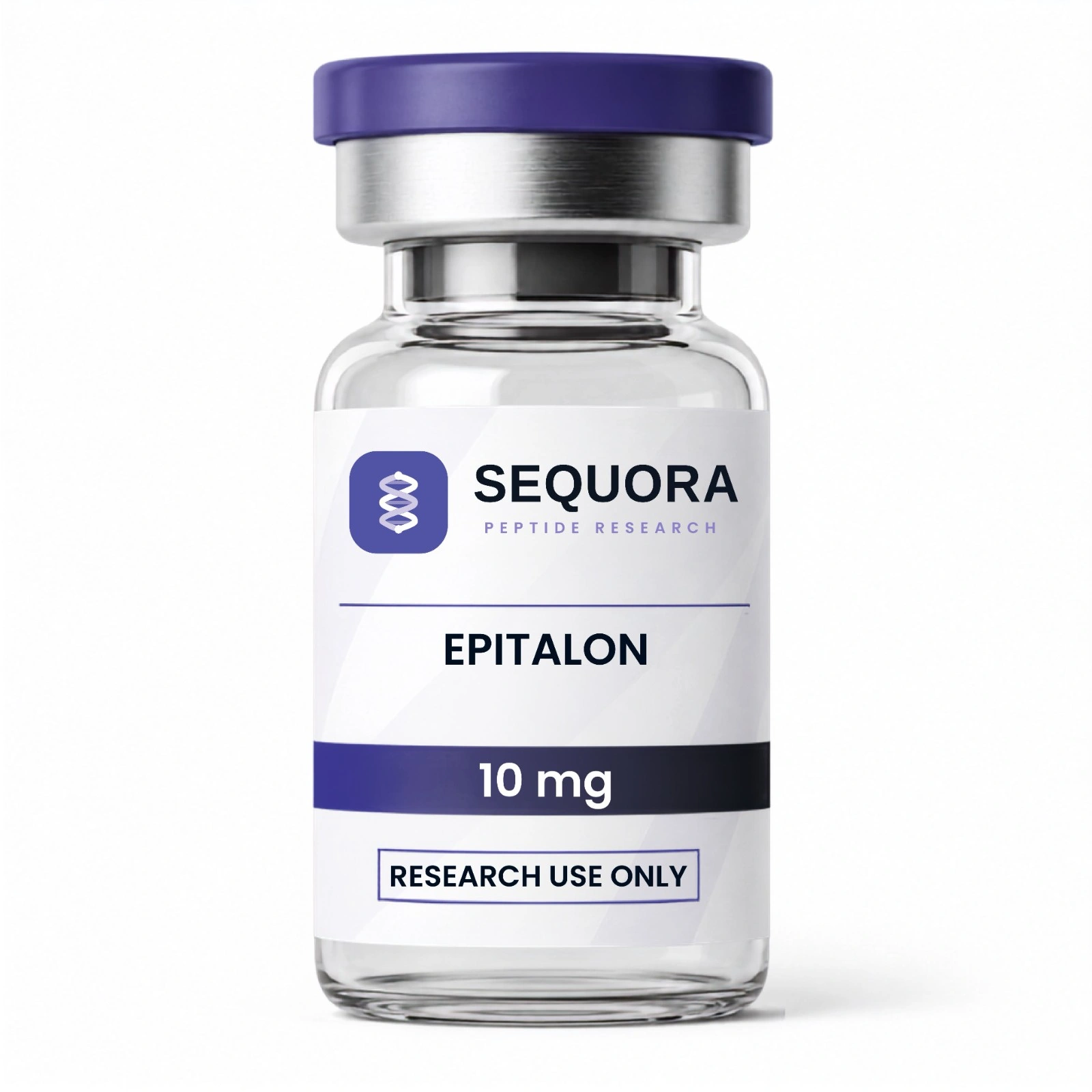
Epitalon is a synthetic tetrapeptide studied for its potential role in cellular aging, telomere biology, and related laboratory research. It is supplied strictly for research use only and is not approved for human use.
| Molecular Formula | C14H22N4O9 |
|---|---|
| Molecular Mass | 390.35 g/mol |
| Monoisotopic Mass | 390.138679 g/mol |
| Polar Area | 171 Ų |
| Complexity | 538 |
| XLogP | -4.1 |
| Heavy Atom Count | 27 |
| Hydrogen Bond Donor Count | 7 |
| Hydrogen Bond Acceptor Count | 10 |
| Rotatable Bond Count | 11 |
Every batch is verified for identity and purity by an independent lab before release.
Scan your batch code to pull the full certificate — chromatogram included.
Material compromised in transit is replaced against the original procurement record.
Epitalon, sometimes referred to as Epithalon or Ala-Glu-Asp-Gly, is a synthetically produced tetrapeptide extracted from Epithalamin, which is a naturally occurring peptide complex extracted from the pineal gland. Epitalon has been studied widely since its discovery by scientists at the Saint Petersburg Institute of Bioregulation and Gerontology, due to its possible effects on telomere biology, cellular aging, oxidative stress, and the physiology of aging.
The scientific community became more interested in Epitalon after studies indicated that Epitalon may have a role in the regulation of telomerase activity, an enzyme responsible for the maintenance of telomere length in cell divisions. This was supported by the results obtained in Epithalon Peptide Induces Telomerase Activity and Telomere Elongation in Human Somatic Cells, published in the Bulletin of Experimental Biology and Medicine. According to this study, Epitalon activated telomerase and stimulated telomere elongation in cultured human somatic cells.
In the last two decades, there have been various studies conducted on Epitalon in labs and through clinical trials regarding its effects on healthy aging, circadian rhythms, immunity, and oxidation. Even though the results of these published studies appear promising, there is a need for more clinical studies in order to assess its safety and efficacy.
If you are searching for 10mg Epitalon or for high-quality research-grade Epitalon, Sequora Peptide offers pure Epitalon, which is third-party tested and manufactured only for research purposes.
| Characteristics | Details |
| Product Name | Epitalon 10 mg |
| Peptide Sequence | Ala-Glu-Asp-Gly |
| Molecular Formula | C14H22N4O9 |
| Molecular Weight | 390.35 g/mol |
| Synonyms | Epithalon |
| PubChem CID | 219042 |
| CAS Number | 307297-39-8 |
| Peptide Lenght | 4 amino acids ( tetrapeptide) |
| Appearence | White lyophilized powder |
| Purity | ( HPLC Tested) |
| Solubility | Sterile water or bacteriostatic water for laboratory research |
| Storage | Medium-Term (Up to 1 Year): Refrigerated (2°C to 8°C). |
| Research Use | ROU (research use only) |
Epitalon has been studied for more than three decades as part of scientific research in the field of cellular aging and peptide bioregulation. This peptide has been derived from Epithalamin, which is a natural complex of peptides isolated from the pineal gland. Scientists were trying to study the biological mechanism behind the aging process, telomere regulation, and cellular homeostasis.
The peptide Epitalon was invented by Professor Vladimir Khavinson along with his colleagues at the Saint Petersburg Institute of Bioregulation and Gerontology. It is a combination of four amino acids (Ala-Glu-Asp-Gly), which has been designed as a synthetic analog of naturally occurring pineal peptides for laboratory conditions investigation.
One of the breakthroughs in Epitalon research relates to its effects on telomerase, which is an enzyme that maintains the length of telomeres while dividing cells. According to the article “Epithalon Peptide Induces Telomerase Activity and Telomere Elongation in Human Somatic Cells“, published in the Bulletin of Experimental Biology and Medicine, Epitalon stimulates telomerase activity and causes telomere elongation in cultured human cells.
At present, Epitalon is being studied in various fields of aging and regenerative science, including:
While encouraging results from experimental and preliminary clinical trials have been reported, more large-scale and rigorously controlled studies in humans will be necessary to determine the safety and efficacy of Epitalon.
Numerous studies have focused on the potential ability of Epitalon to affect telomere biology, gene regulation, oxidative stress, and cellular homeostasis. Despite the fact that the full extent of Epitalon’s mechanism of action remains unknown, scientific articles have suggested that this peptide affects some biological pathways related to aging.
The most popular characteristic of Epitalon is its ability to affect telomerase – the enzyme that controls the length of telomeres during mitosis. According to an article, Epithalon Peptide Induces Telomerase Activity and Telomere Elongation in Human Somatic Cells, in the Bulletin of Experimental Biology and Medicine, Epitalon activates telomerase and induces the elongation of telomeres in cultured human cells.
It has been hypothesized that Epitalon can affect the expression of genes responsible for the process of repairing, synthesis of proteins, and stress reaction. In accordance with an article, Peptide Regulation of Gene Expression: A Systematic Review, short peptides, including Epitalon, can regulate gene activity.
Oxidative stress is known to be one of the significant factors contributing to cellular aging. Pre-clinical research has been conducted on whether Epitalon can affect the antioxidant defense system and decrease oxidative stress. Although the preliminary results look promising, the scientific community is actively studying these effects in laboratory and clinical settings.
Since Epitalon was originally derived from peptides found in the pineal gland, there have been studies concerning the connection between Epitalon and circadian rhythm and age-related melatonin regulation as well. These issues are still actively researched in the sphere of aging despite not yet fully understood mechanisms.
Despite the fact that these suggested mechanisms have been proven in laboratory and some clinical settings, there should be more large-scale studies among humans.
Studies have been conducted on Epitalon using lab testing, animal models, and some human subjects. Research that has been written up has mainly focused on telomere science, healthful aging, oxidative stress, the immune system, and pineal activity. Although many results are positive, further research is required in the form of larger-scale randomized clinical studies.
As stated in Epithalon Peptide Induces Telomerase Activity and Telomere Elongation in Human Somatic Cells in the Bulletin of Experimental Biology and Medicine, Epithalon stimulated telomerase activity and induced telomere extension in cultured human cells in laboratory settings. This has contributed to a burgeoning interest in Epitalon in cellular aging research.
Studies on Epitalon have examined the peptide’s potential effects on age-related physiological changes. As mentioned above, in the publication Peptide Bioregulation of Aging: Results and Prospects (Biochemistry (Moscow)), pineal peptides, including Epitalon, demonstrated biological activity related to cellular homeostasis and healthy aging in experimental models. The authors pointed out that more human studies were necessary.
Experiments have been conducted to explore the potential ability of the peptide to protect cells from oxidative stress. Further studies of the influence of Epitalon on antioxidant defense mechanisms are still under investigation; however, these results are still preclinical.
Only a few human studies have been conducted on Epitalon for the use of the peptide in aging-related research, in particular, the influence of the peptide on physiological processes and overall health status of older people. Though there were several reports about promising results, clinical data are not sufficiently numerous yet.
Some of the research areas where Epitalon has been studied include:
While Epitalon has received a lot of attention in studies on longevity, there are still some important questions that need to be answered by science. Most of the publications come from a few scientific groups, and a majority of these studies include laboratory investigations or animals. Therefore, scientists are still investigating the following questions:
Answering these scientific questions might increase our knowledge about the biological activity of Epitalon and its future applications.
Epitalon is currently being evaluated as an experimental research peptide with respect to cellular aging, telomere science, oxidative stress, and peptide bioregulation. While laboratory and preliminary clinical trials have yielded promising results, Epitalon has yet to receive FDA and EMA approval as a prescription drug for treatment, prevention, or cure of any disease.
Epitalon is continuing to be studied in relation to its biological effect via preclinical trials and limited clinical trials. Based on information available at ClinicalTrials.gov, research trials involving Epitalon as well as peptide bioregulators in general appear limited compared to that of approved peptide drugs.
Epitalon 10mg by Sequora Peptide is produced for research purposes only (RUO). This product is strictly meant for research only and has not received any approval for human consumption or therapeutic purposes.
The proper storage of Epitalon 10mg will ensure its stability and integrity during laboratory studies.
Proper storage and handling help preserve peptide quality and support reliable, reproducible research outcomes.
Epitalon (also called Epithalon) is a synthetic tetrapeptide (Ala-Glu-Asp-Gly), which was designed as an analogue of peptides that can be extracted from the pineal gland. The biological functions of Epitalon were studied in connection with their relation to telomeres, healthy aging, oxidation, and cellular homeostasis.
Scientists study Epitalon in the process of conducting experiments related to telomere homeostasis, telomerase activity, healthy aging, oxidation, circadian regulation, and peptide bioregulation. While there are many positive results of experimental research on Epitalon, more studies are necessary for its complete evaluation.
Not at all. Epitalon is not approved as a drug for treating, preventing, or curing diseases by the U.S. Food and Drug Administration and other governmental organizations.
Lyophilized peptide should be stored between 2°C and 8°C (36°F to 46°F) in a dry environment that is free from exposure to light and moisture. Following the reconstitution process, the solution should be stored in the refrigerator, avoiding repetitive freeze-thaw cycles and using appropriate laboratory procedures for peptide stability.
No. The Epitalon 10mg peptide product provided by Sequora Peptide is designed and produced for research purposes only (RUO).
Epitalon 10 mg from Sequora Peptide is exclusively produced for research use only (RUO). The product is to be used only in scientific research by qualified individuals and is not meant for internal consumption or therapy.
Sequora Peptide makes no claims about the use of this product in the diagnosis, treatment, cure, or prevention of any ailment. Researchers are fully responsible for compliance with all relevant laws and regulations related to the purchase, handling, and usage of this product.
The product should be used only under controlled laboratory conditions by trained scientists.
COA ✓

COA ✓
TB-500 10mg is a synthetic peptide studied in cell migration, tissue repair pathways, and actin-related biological research. Supplied by Sequora Peptides strictly for laboratory research use only.

COA ✓
This site supplies chemicals strictly for laboratory research. You must confirm both statements below to enter.
Products are supplied for laboratory research use only and are not for human or veterinary use.