
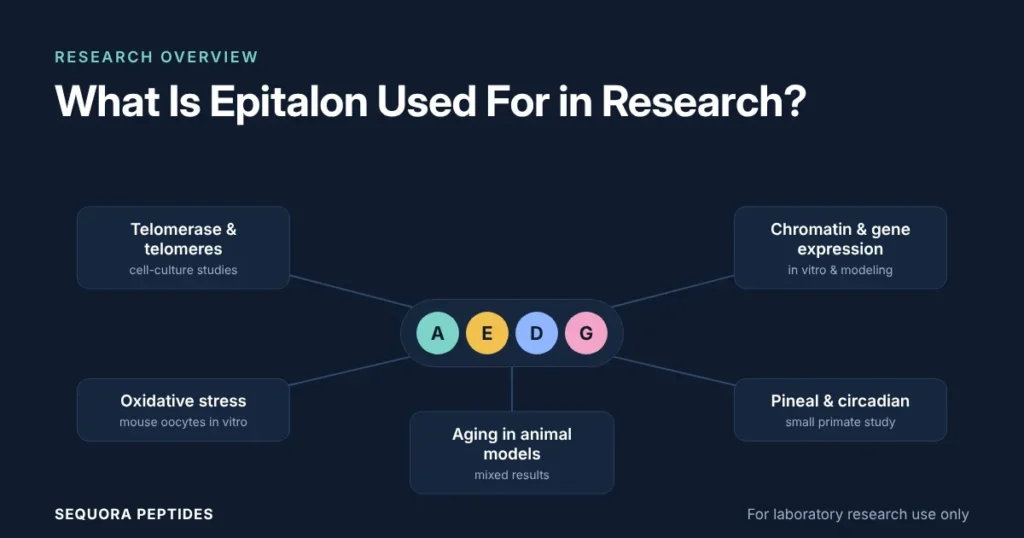
What is epitalon used for? Researchers use this synthetic peptide, Ala-Glu-Asp-Gly, to study five areas: telomerase and telomeres, chromatin and gene expression, oxidative stress, pineal and circadian function, and aging in animal models [R1]. Each area has published findings, but almost all of them come from cell cultures or animals, and most come from one research group [R2]. Below is what each line of research has reported, and what it has not.
Where Epitalon Came From
Epitalon was developed at the St. Petersburg Institute of Bioregulation and Gerontology as part of a decades-long program by Vladimir Khavinson and colleagues on short regulatory peptides [R3]. It was designed from the amino-acid composition of epithalamin, a multi-peptide extract of the bovine pineal gland [R1]. For how the two differ, see our guide to epitalon vs epithalon vs epithalamin.
1. Telomerase and Telomeres
Telomerase is the enzyme that rebuilds telomeres, the protective caps on chromosome ends that shorten as cells divide. In a 2003 study, epitalon increased expression of the telomerase catalytic subunit, telomerase activity, and telomere length in cultured human fetal fibroblasts [R4].
An independent 2025 study tested epitalon in several human cell lines. Normal cells showed telomere elongation with increased telomerase activity. Breast-cancer cell lines also showed longer telomeres, but through the ALT pathway, a telomerase-independent mechanism, rather than through telomerase [R5]. That paper was later corrected.
2. Chromatin and Gene Expression
A second line of research asks whether a four-amino-acid peptide can act on DNA and gene activity directly.
- Chromatin in aged cells. In cultured lymphocytes from donors aged 76–80, epitalon was associated with decondensation of heterochromatin and activation of ribosomal genes [R6].
- DNA binding. Computer docking models predicted that AEDG binds specific short DNA sequences, and spectrophotometry showed changes in DNA melting behavior in its presence; the authors note the predicted binding sites still need experimental confirmation [R7].
- Neuronal markers. In human gingival mesenchymal stem cells, epitalon increased mRNA of the neurogenesis markers Nestin, GAP43, β-Tubulin III, and Doublecortin by 1.6–1.8-fold; proposed binding to histone proteins was modeled computationally, not measured [R8].
- Scope. A 2021 systematic review by the same group lists AEDG among short peptides reported to regulate gene expression, with 98 genes attributed to it, largely from in-vitro and modeling studies [R9].
3. Oxidative Stress
Oxidative stress, damage from reactive oxygen species (ROS), is a common focus in aging research. The clearest primary study here comes from a group outside St. Petersburg. In mouse oocytes aging in culture, epitalon at 0.1 mM reduced intracellular ROS, lowered spindle and cortical-granule defects at 12 and 24 hours, raised mitochondrial membrane potential and mtDNA copy number, and reduced apoptosis [R10]. Earlier work from the Khavinson group examined antioxidant enzymes with pineal peptides including epitalon [R11].
4. Pineal Gland and Circadian Rhythm
Because epitalon was modeled on a pineal extract, researchers have studied its relationship to melatonin and daily rhythms. In a small study of senescent rhesus monkeys, three animals per group, epitalon was associated with higher evening melatonin; young animals showed no effect [R12]. The 2021 review also reports effects on the circadian genes Clock, Csnk1e, and Cry2 in human blood cells [R9]. Results are not uniform: the 2025 Araj review notes a study in which epitalon did not affect melatonin release from rat pineal glands [R1].
5. Aging in Animal Models
Animal results depend heavily on conditions. In female SHR mice, epitalon did not change mean lifespan or total tumor incidence [R13]. In female rats, effects on lifespan appeared under some light regimes and were absent under a standard light/dark cycle [R14].
Has Epitalon Been Studied in Humans?
Only in a few small studies, and many of the human reports in this field used epithalamin, the extract, rather than epitalon. No adequately powered randomized controlled trial of epitalon has been published, no pharmacokinetic data exist in any species, and there is no dedicated human safety study [R2].
Open Questions Researchers Are Still Asking
- Can the cell-culture telomerase findings be replicated by independent laboratories across cell types [R5]?
- What are the long-term consequences of telomerase or ALT activation, given that cancer cells use both [R5]?
- Does a four-residue peptide reach cell nuclei and bind DNA under physiological conditions, as models predict [R7]?
- How is epitalon absorbed, distributed, and cleared? No pharmacokinetic study has answered this [R2].
Regulatory Status
Epitalon is not approved by the FDA or the European Medicines Agency for any use. A July 2026 FDA advisory committee vote recommending it for the compounding bulks list was non-binding, and the list was unchanged as of October 2026 [R15].
In short: what is epitalon used for? It is a research tool for studying telomere biology, gene regulation, oxidative stress, pineal function, and aging in cells and animals. It is not an approved treatment for any condition.
Frequently Asked Questions
What is epitalon used for?
In research, epitalon is used to study telomerase and telomere maintenance, chromatin and gene expression, oxidative stress, pineal and circadian function, and aging in animal models [R1]. It is not an approved treatment for any condition.
What does epitalon do at the cellular level?
In cultured cells, studies report increased telomerase activity, chromatin decondensation, and changes in gene expression and ROS levels [R4][R6][R10]. How these effects arise is not established.
Who discovered epitalon?
Vladimir Khavinson and colleagues at the St. Petersburg Institute of Bioregulation and Gerontology [R3].
Has epitalon been tested in clinical trials?
Not in adequately powered randomized trials. Human data are limited and often involve epithalamin rather than epitalon [R2].
Reference compound
Epitalon 10mg (Epithalon) — synthetic Ala-Glu-Asp-Gly, CAS 307297-39-8, with batch COA. For laboratory research use only.
References
How we select and verify sources: Research Sources & Editorial Standards
- Araj SK, Brzezik J, Mądra-Gackowska K, Szeleszczuk Ł. Overview of Epitalon—highly bioactive pineal tetrapeptide with promising properties. Int J Mol Sci. 2025;26(6):2691. doi:10.3390/ijms26062691. PMID 40141333.
- Jain A, Gallacher DM, Issa MA, et al. Epitalon and epithalamin: a narrative review of mechanistic, preclinical, and clinical evidence. Int J Mol Sci. 2026;27(19):8922. doi:10.3390/ijms27198922.
- Anisimov VN, Khavinson VKh. Peptide bioregulation of aging: results and prospects. Biogerontology. 2010;11(2):139–149. doi:10.1007/s10522-009-9249-8. PMID 19830585.
- Khavinson VKh, Bondarev IE, Butyugov AA. Epithalon peptide induces telomerase activity and telomere elongation in human somatic cells. Bull Exp Biol Med. 2003;135(6):590–592. doi:10.1023/A:1025493705728. PMID 12937682.
- Al-Dulaimi S, Thomas RS, Matta S, Roberts T. Epitalon increases telomere length in human cell lines through telomerase upregulation or ALT activity. Biogerontology. 2025;26(5):178. doi:10.1007/s10522-025-10315-x. PMID 40908429.
- Khavinson VKh, Lezhava TA, Monaselidze JR, et al. Peptide Epitalon activates chromatin at the old age. Neuro Endocrinol Lett. 2003;24(5):329–333. PMID 14647006.
- Khavinson VKh, Linkova NS, Tarnovskaya SI. Short peptides regulate gene expression. Bull Exp Biol Med. 2016;162(2):288–292. doi:10.1007/s10517-016-3596-7. PMID 27909961.
- Khavinson V, Diomede F, Mironova E, et al. AEDG peptide (Epitalon) stimulates gene expression and protein synthesis during neurogenesis: possible epigenetic mechanism. Molecules. 2020;25(3):609. doi:10.3390/molecules25030609. PMID 32019204.
- Khavinson VKh, Popovich IG, Linkova NS, et al. Peptide regulation of gene expression: a systematic review. Molecules. 2021;26(22):7053. doi:10.3390/molecules26227053. PMID 34834147.
- Yue X, Liu SL, Guo JN, et al. Epitalon protects against post-ovulatory aging-related damage of mouse oocytes in vitro. Aging (Albany NY). 2022;14(7):3191–3202. doi:10.18632/aging.204007. PMID 35413689.
- Kozina LS, Arutjunyan AV, Khavinson VKh. Antioxidant properties of geroprotective peptides of the pineal gland. Arch Gerontol Geriatr. 2007;44(Suppl 1):213–216. doi:10.1016/j.archger.2007.01.029. PMID 17317455.
- Khavinson V, Goncharova N, Lapin B. Synthetic tetrapeptide epitalon restores disturbed neuroendocrine regulation in senescent monkeys. Neuroendocrinol Lett. 2001;22(4):251–254. Full text (PDF).
- Anisimov VN, Khavinson VKh, Popovich IG, et al. Effect of Epitalon on biomarkers of aging, life span and spontaneous tumor incidence in female Swiss-derived SHR mice. Biogerontology. 2003;4(4):193–202. doi:10.1023/A:1025114230714. PMID 14501183.
- Vinogradova IA, Bukalev AV, Zabezhinski MA, et al. Effect of Ala-Glu-Asp-Gly peptide on life span and development of spontaneous tumors in female rats exposed to different illumination regimes. Bull Exp Biol Med. 2007;144(6):825–830. doi:10.1007/s10517-007-0441-z. PMID 18856211.
- U.S. Food and Drug Administration. Bulk drug substances used in compounding under section 503A of the FD&C Act. fda.gov
This article summarizes published research for educational purposes. Sequora Peptides supplies research chemicals for laboratory use only; nothing here describes use in humans or animals.