
Institutional accounts only · Pricing and quotes released after verified laboratory registration
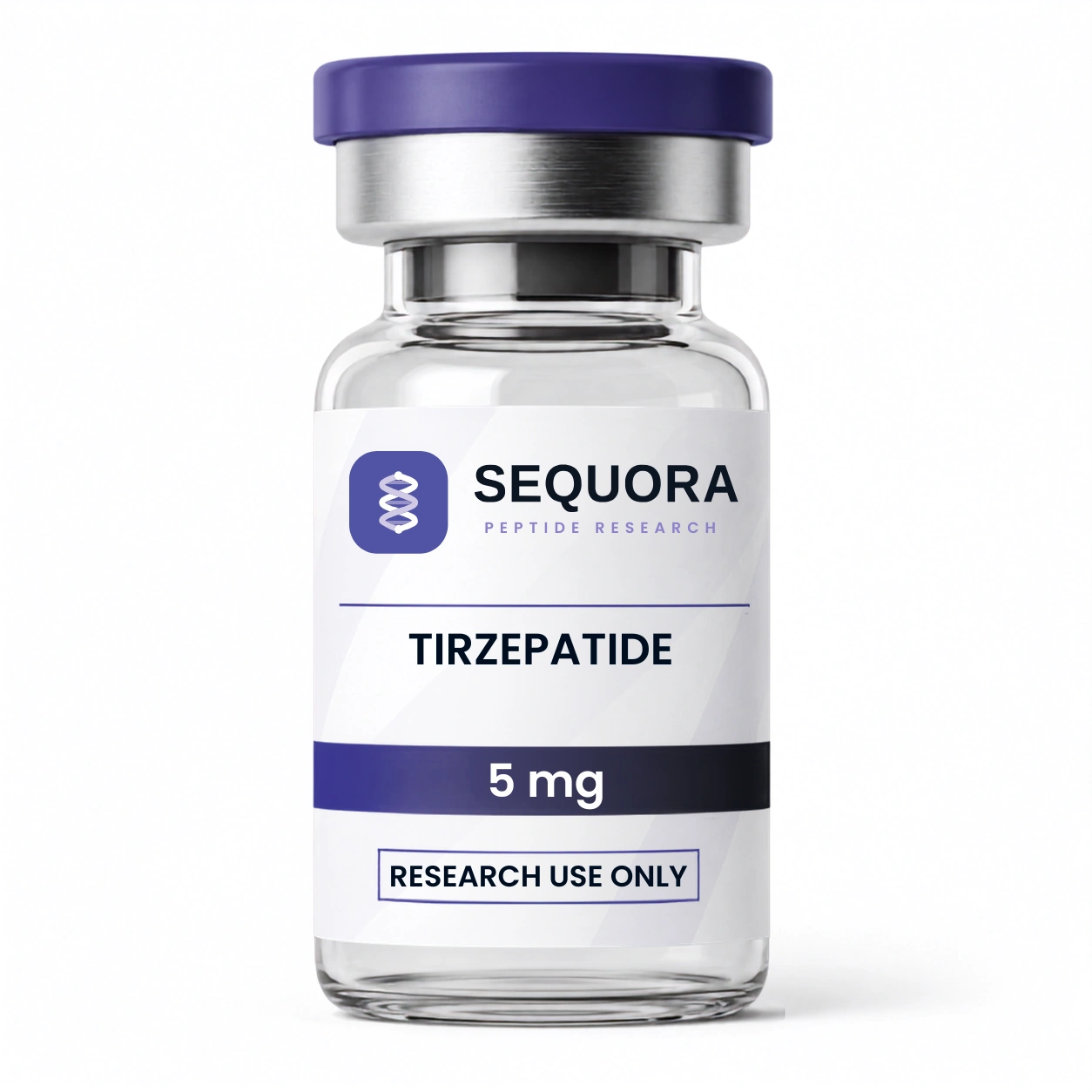
Tirzepatide 5mg is a research-grade compound studied for its activity at GIP and GLP-1 receptors. Researchers investigate tirzepatide to better understand its properties and potential applications in controlled research.
| Molecular Formula | C225H348N48O68 |
|---|---|
| Molecular Mass | 4813.5 g/mol |
| Monoisotopic Mass | 4810.526270 g/mol |
| Polar Area | 2380 Ų |
| Complexity | 13500 |
| XLogP | -42.8 |
| Heavy Atom Count | 341 |
| Hydrogen Bond Donor Count | 76 |
| Hydrogen Bond Acceptor Count | 90 |
| Rotatable Bond Count | 189 |
Every batch is verified for identity and purity by an independent lab before release.
Scan your batch code to pull the full certificate — chromatogram included.
Material compromised in transit is replaced against the original procurement record.
Tirzepatide is a synthetic 39-amino acid peptide created by Eli Lilly and Company that is a dual GIP/ GLP-1 receptor agonist. Extensive studies of the dual-incretin mechanism of action have been conducted due to its impact on body weight, glucose metabolism, insulin sensitivity, and metabolic health.
There has been a significant scientific interest in Tirzepatide since the publication of several Phase 3 clinical trials. In accordance with the results of the article Tirzepatide Once Weekly for the Treatment of Obesity, published in the New England Journal of Medicine, subjects who received the highest doses of Tirzepatide had an average weight loss of 20.9 % during 72 weeks, and Tirzepatide became one of the most studied peptides in obesity research.
In addition to obesity research, Tirzepatide is currently studied in the treatment of type 2 diabetes, metabolic dysfunction-associated steatotic liver disease (MASLD), cardiovascular risk factors, and other obesity-related diseases. As mentioned in the article Tirzepatide versus Semaglutide Once Weekly in Patients with Type 2 Diabetes, published in the New England Journal of Medicine, Tirzepatide provided greater decreases in HbA1c and body weight than semaglutide.
Tirzepatide is among the most widely researched incretin peptides to date. Sequora Peptides offers Tirzepatide 5mg as a highly pure, 3rd party tested research peptide intended for research lab use only.
Tirzepatide is the first-in-class experimental peptide that is known to target the activation of the GIP and GLP-1 receptors at the same time. The researchers were working on this dual-incretin drug for years based on the knowledge that these naturally produced hormones have complementary effects in the processes of glucose regulation, signaling of food intake, and energy balance.
This drug was developed by Eli Lilly and Company, where researchers aimed to test if the dual-incretin drug can provide more beneficial effects than monotherapy. The special molecule of this drug consists of a 39-amino acid peptide and a fatty diacid moiety with C20, which leads to an increase in the biological half-life and makes it possible to administer it only once per week.
The scientific world showed more interest in the new drug after some global Phase 3 clinical trials. In the study “Tirzepatide Once Weekly for the Treatment of Obesity” published in the New England Journal of Medicine, the authors reported the loss of body weight from 15.0% to 20.9% over 72 weeks.
Tirzepatide vs. Semaglutide Once Weekly in Type 2 Diabetes from the New England Journal of Medicine shows that this drug is more effective in reducing HbA1c levels and body mass in comparison to semaglutide, which provides grounds for further studies into dual GIP/GLP-1 receptor agonism.
At present, Tirzepatide is being studied in various fields of metabolic research that include:
Though there have been some favorable outcomes in various Phase 3 clinical trials, there are still studies underway for assessing the efficacy and safety profile of Tirzepatide.
Tirzepatide is the first peptide synthesized that acts on the GIP and GLP-1 receptors. It is hypothesized that this dual-incretin effect plays an important role in its effects on glucose homeostasis, appetite, energy expenditure, and body weight loss. While traditional GLP-1 receptor agonists target only one pathway, Tirzepatide acts through the two complementary hormonal pathways.
Tirzepatide interacts with GIP and GLP-1 receptors, resulting in combined metabolic effects. As explained in A Dual GIP and GLP-1 Receptor Agonist for the Treatment of Type 2 Diabetes, from the Journal of Medicinal Chemistry, the peptide is specifically designed for the activation of both incretin pathways and sustained biological activity via albumin binding.
Studies show that GLP-1 receptors play an important role in appetite regulation, and GIP receptor agonists can provide complementary effects in metabolism. In the article “Tirzepatide Once Weekly for the Treatment of Obesity” from the New England Journal of Medicine, subjects using Tirzepatide lost considerable amounts of weight, thus providing grounds for further studies into the effects on energy intake.
A wide variety of studies were conducted regarding the effects of Tirzepatide on glucose regulation. As shown in the article “Tirzepatide versus Semaglutide Once Weekly in Patients with Type 2 Diabetes” from the New England Journal of Medicine, Tirzepatide had more significant effects on lowering HbA1c than semaglutide among the tested population.
Tirzepatide possesses a C20 fatty diacid side chain, which enhances reversible binding to albumin, leading to decreased clearance from the body. The increased half-life has thus been one of the key characteristics of this peptide.
Despite the evidence gained from preclinical and clinical studies, researchers are still interested in learning about the effect of simultaneous activation of both GIP and GLP-1 receptors on the metabolism of the drug.
Extensive preclinical research and Phase 3 clinical trials have been conducted for Tirzepatide. Scientific literature describes effects of this medication on body weight, glycemic control, insulin resistance, and cardiometabolic health. The following is a list of some of the results reported by researchers.
According to Tirzepatide Once Weekly for the Treatment of Obesity, Tirzepatide led to 15.0%-20.9% weight loss in adults over 72 weeks, depending on the dose.
According to Tirzepatide versus Semaglutide Once Weekly in Patients with Type 2 Diabetes, Tirzepatide demonstrated higher HbA1c and body weight reduction compared to semaglutide in patients with type 2 diabetes over the course of 40 weeks of therapy.
The effects of Tirzepatide on cardiometabolic risk factors were investigated as well. According to Effects of Tirzepatide versus Insulin Glargine on Kidney Outcomes in Type 2 Diabetes in the SURPASS-4 Trial, published in The Lancet Diabetes & Endocrinology, Tirzepatide had a positive effect on several cardiometabolic factors and decreased risk of progression of kidney disease compared to insulin glargine.
In addition to clinical studies related to the effectiveness of Tirzepatide, ongoing research is being conducted in many clinical trials concerning obesity, type 2 diabetes, metabolic dysfunction-associated steatotic liver disease (MASLD), obstructive sleep apnea, heart failure, and chronic kidney disease. While current results look promising, the researchers are still working on determining the long-term effects of this medication in various patients.
The FDA has already approved Mounjaro® for the treatment of type 2 diabetes and Zepbound® for chronic weight management for qualified adults. The drug is also approved in some other countries for specified medical indications.
According to FDA Approves Lilly’s Zepbound (tirzepatide) for Chronic Weight Management, the FDA approved Zepbound in November 2023 for adults with obesity or overweight, accompanied by at least one weight-related medical condition. In December 2024, the agency also approved Zepbound as the first medication for adults with moderate-to-severe obstructive sleep apnea (OSA) and obesity.
Tirzepatide 5mg from Sequora Peptides is designed for research purposes only (RUO). The compound is meant for experimental and scientific research only and is not to be taken internally by humans under any circumstances.
The correct storage conditions will be helpful in maintaining the stability and integrity of Tirzepatide during laboratory research.
Following these instructions helps preserve peptide quality and support consistent, reproducible research outcomes.
Tirzepatide is an artificial 39-amino acid dual agonist of GIP and GLP-1 receptors produced by Eli Lilly and Company. This substance has undergone numerous clinical trials in order to test its impact on body weight, glucose metabolism, insulin resistance, and metabolic state.
Scientists explore Tirzepatide in research studies dedicated to obesity, type 2 diabetes, insulin resistance, metabolic dysfunction-associated steatotic liver disease (MASLD), cardiometabolic health, and other metabolic diseases. The ongoing research seeks to examine the safety and efficacy of this compound over the long term.
The active substance tirzepatide has been approved by the FDA in the forms of Mounjaro® (type 2 diabetes) and Zepbound® (chronic weight management and some adults with obstructive sleep apnea). Nevertheless, Tirzepatide 5 mg from Sequora Peptides is intended solely for research purposes and is not an FDA-approved drug.
Lyophilized powder should be kept under refrigerated conditions of 2°C to 8°C (36°F to 46°F) in a cool, dry place away from light and moisture. Once the powder has been dissolved into a solution, it must be stored in the refrigerator and protected against repetitive freezing and thawing.
No. The current product is developed solely for research purposes (RUO).
All products sold by Sequora Peptides are intended strictly for research purposes only. They are not intended for human or veterinary use, consumption, diagnosis, treatment, or any other clinical application.
1. Jastreboff AM, Aronne LJ, Ahmad NN, et al. Tirzepatide Once Weekly for the Treatment of Obesity. New England Journal of Medicine. 2022;387(3):205-216.
https://www.nejm.org/doi/full/10.1056/NEJMoa2206038
2. Frias JP, Davies MJ, Rosenstock J, et al. Tirzepatide versus Semaglutide Once Weekly in Patients with Type 2 Diabetes. New England Journal of Medicine. 2021;385(6):503-515.
https://www.nejm.org/doi/full/10.1056/NEJMoa2107519
3. [Tirzepatide (Mounjaro®) : a GIP/GLP-1 receptor dual agonist for the treatment of type 2 diabetes]

COA ✓

COA ✓
Tesamorelin 10mg is a synthetic GHRH analog studied for growth hormone signaling, endocrine function, and metabolic research. Supplied by Sequora Peptides strictly for laboratory research use only.
COA ✓
This site supplies chemicals strictly for laboratory research. You must confirm both statements below to enter.
Products are supplied for laboratory research use only and are not for human or veterinary use.