
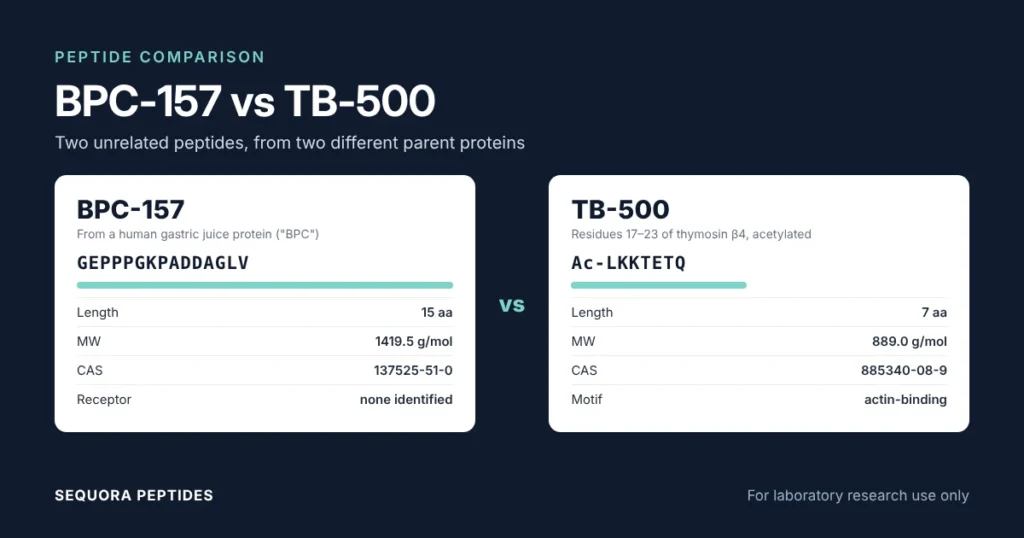
BPC-157 and TB-500 are unrelated molecules. BPC-157 is a 15-amino-acid peptide taken from a gastric juice protein; TB-500 is a 7-amino-acid, N-terminally acetylated fragment (Ac-LKKTETQ) of thymosin β4, an actin-binding protein [R1][R2]. They are often discussed together because both have been studied in animal models of tissue injury, both lack meaningful human data, and both were reviewed by an FDA advisory committee on the same day in July 2026 [R3]. This article compares their structure, origin, studied pathways, evidence and regulatory status.
BPC-157 vs TB-500 at a Glance
| BPC-157 | TB-500 | |
|---|---|---|
| Parent protein | Human gastric juice protein “BPC” (body protection compound) | Thymosin β4 (43 aa), residues 17–23 |
| Sequence | GEPPPGKPADDAGLV | Ac-LKKTETQ (N-acetyl-Leu-Lys-Lys-Thr-Glu-Thr-Gln) |
| Length | 15 aa | 7 aa |
| CAS | 137525-51-0 | 885340-08-9 |
| FDA UNII / PubChem CID | 8ED8NXK95P / 9941957 | QHK6Z47GTG / 62707662 |
| Formula / MW | C62H98N16O22 / 1419.5 g/mol | C38H68N10O14 / 889.01 g/mol |
| Known receptor | None identified | None; contains the actin-binding motif of thymosin β4 |
| Human data | 3 small uncontrolled reports, 30 people | None identified by FDA |
| PCAC vote, Jul 23 2026 | 8–6–1, recommended (advisory) | 8–6–1, recommended (advisory) |
Sources: [R1][R2][R3][R4][R5][R24][R6][R7]. MW is the average molecular weight of the free peptide.
What Is BPC-157?
BPC-157 is a synthetic linear peptide of 15 amino acids. Its developers, a group at the University of Zagreb, describe it as a partial sequence of a human gastric juice protein they called BPC [R8][R9], usually expanded as “body protection compound” [R25]. It has no identified receptor. Rodent and cell studies have measured changes in nitric-oxide signaling, VEGFR2–Akt–eNOS signaling and FAK–paxillin signaling [R10][R11]. In rats and dogs, the intact peptide had an elimination half-life under 30 minutes [R12]. For a full background, read What is BPC-157? A research guide.
What Is TB-500?
FDA defines TB-500 as a synthetic seven-amino-acid fragment of thymosin β4: residues 17–23 with an acetyl group on the N-terminal leucine, Ac-Leu-Lys-Lys-Thr-Glu-Thr-Gln-OH (Ac-LKKTETQ). Its formula is C38H68N10O14 and its molecular weight is 889.01 g/mol, CAS 885340-08-9, UNII QHK6Z47GTG [R24][R2]. A 2012 doping-control study identified this fragment in a product sold as TB-500 and synthesized it as a reference standard [R13].
The parent protein, thymosin β4, has 43 amino acids [R24]. Inside cells, β-thymosins bind monomeric (G-) actin and act as a major actin-sequestering factor; outside cells, studies have reported paracrine activity in models of angiogenesis and wound repair [R15]. LKKTETQ is the actin-binding stretch. In a 2003 mouse study, the synthetic LKKTETQ peptide gave wound-model results comparable to the full protein [R16].
TB-500 is not thymosin β4. FDA’s July 2026 briefing document states plainly that “thymosin beta-4 and TB-500 are not the same substance.” It adds that data on the non-acetylated LKKTETQ peptide cannot be directly extrapolated to acetylated TB-500 [R24]. FDA also notes that several websites use the two names interchangeably [R24]. Full-length thymosin β4 is C212H350N56O78S, about 4963 g/mol [R17]. The two differ more than five-fold in mass, so the mass-spectrometry line on a COA shows which one is in the vial. See How to read a peptide COA, and for the full comparison, TB-500 vs thymosin β4.
Key Differences
Origin and structure
BPC-157 comes from gastric juice research; TB-500 comes from an intracellular actin-binding protein. BPC-157 has free ends and four prolines, including a Pro-Pro-Pro run. TB-500 carries an N-terminal acetyl group and is rich in lysine and threonine [R1][R2].
Pathways studied
BPC-157 work focuses on nitric-oxide and VEGF-related signaling and cell migration [R10][R11]. TB-500 work traces back to the actin-binding function of thymosin β4 [R15][R16]. Much of the thymosin β4 literature used the full protein, so results cannot be assumed to apply to the 7-residue fragment.
Who did the research
A 2025 critical commentary found that most BPC-157 studies “originate from a single research center” and that independent laboratories have added only a handful [R18]. The thymosin β4 literature is spread across more groups, but very little of it tests TB-500 itself. A 2026 scoping review included 80 studies on thymosin β4 and TB-500; most evaluated the full protein, and direct TB-500 evidence was limited to a single study [R23].
Limits of the Evidence
Neither peptide has adequate human data. A 2026 systematic review of BPC-157 found three human studies with 30 participants in total, none controlled, and rated the certainty of evidence very low [R6]. For TB-500, FDA states it “has not identified any human exposure data” [R7]. A 2026 review for sports-medicine physicians reached the same view: BPC-157 findings are mostly unvalidated in human trials, and human data on TB-500 are lacking [R19].
The one head-to-head study
Only one published study has compared the two directly. In a 2026 rat Achilles tendon repair model, 32 rats were split into four groups of eight: control, BPC-157, TB-500, and both together. Load to failure was higher than control in all treated groups but reached statistical significance only with TB-500. Total histology scores were significantly lower (less degeneration) than control with TB-500 on two scales and with the combination on one scale; the BPC-157-alone group did not reach significance on either. The combination gave no additional effect over either peptide alone [R22]. The authors call the study exploratory and preliminary. It is one small study in one model, and it has not been replicated.
The premixed vial we sell is a convenience format for laboratories; its TB-500 component is the Ac-LKKTETQ fragment as defined by FDA, which the batch COA should confirm by mass. It is not a combination with any shown interaction.
Regulatory Status
Neither BPC-157 nor TB-500 is FDA-approved for any use. In April 2026, FDA said it would remove both, along with 10 other peptides, from “Category 2” of its 503A compounding list; that removal did not make them eligible for compounding [R20]. On July 23, 2026, FDA’s Pharmacy Compounding Advisory Committee voted 8–6, with 1 abstention, to recommend each one for the 503A bulks list. The votes are advisory, and FDA must complete rulemaking before anything changes [R3].
Both appear on the 2026 World Anti-Doping Agency Prohibited List: BPC-157 under S0 (non-approved substances) and “thymosin-β4 and its derivatives, e.g. TB-500” under S2.3 [R21].
Frequently Asked Questions
What is the difference between BPC-157 and TB-500?
BPC-157 is a 15-amino-acid peptide from a gastric juice protein. TB-500 is an acetylated 7-amino-acid fragment of thymosin β4. They share no sequence [R1][R2].
Is TB-500 the same as thymosin β4?
No. FDA defines TB-500 as acetylated residues 17–23 of thymosin β4 (Ac-LKKTETQ, 889.01 g/mol) and states the two are not the same substance. Full thymosin β4 has 43 residues [R24][R14]. More detail: TB-500 vs thymosin β4.
Which has more research?
BPC-157 has more published studies, but most come from one center [R18]. TB-500 itself has very few studies; most work used full thymosin β4.
Have BPC-157 and TB-500 been studied together?
Once, in a 2026 rat tendon model with eight animals per group. The combination showed no additional effect over either peptide alone [R22].
Are BPC-157 and TB-500 FDA-approved?
No. The July 2026 advisory votes concerned compounding, were non-binding, and did not approve either as a drug [R3].
Reference compounds
BPC-157 (5 mg, 10 mg) — GEPPPGKPADDAGLV, CAS 137525-51-0. Category: Gastric Pentadecapeptides.
TB-500 (5 mg, 10 mg) — Ac-LKKTETQ, acetylated thymosin β4 residues 17–23, CAS 885340-08-9. Not full-length thymosin β4; see TB-500 vs thymosin β4. Category: Thymosin Peptides.
BPC-157 (10 mg) and TB-500 (10 mg) Blend — both peptides in one vial. All with batch COA. For laboratory research use only.
References
How we select and verify sources: Research Sources & Editorial Standards
- U.S. Food and Drug Administration. Global Substance Registration System: BPC-157, UNII 8ED8NXK95P. precision.fda.gov
- U.S. Food and Drug Administration. Global Substance Registration System: TB-500, UNII QHK6Z47GTG. precision.fda.gov
- McDermott Will & Schulte. Bulk-list bound? PCAC backs majority of peptides in two-day public meeting. July 27, 2026. mcdermottlaw.com
- PubChem. BPC-157, CID 9941957. pubchem.ncbi.nlm.nih.gov/compound/9941957
- PubChem. UNII-QHK6Z47GTG (TB-500), CID 62707662. pubchem.ncbi.nlm.nih.gov/compound/62707662
- Poolton JT, Minett J, Kazmi A. Human evidence for BPC-157 in orthopaedic and regenerative medicine: a systematic review of efficacy and safety. Acta Orthop Belg. 2026;92(3). doi:10.52628/92.3.15837. PMID 42885452.
- U.S. Food and Drug Administration. Certain bulk drug substances for use in compounding that may present significant safety risks. fda.gov
- Knezevic M, Gojkovic S, Krezic I, et al. Occlusion of the superior mesenteric artery in rats reversed by collateral pathways activation: gastric pentadecapeptide BPC 157 therapy counteracts multiple organ dysfunction syndrome; intracranial, portal, and caval hypertension; and aortal hypotension. Biomedicines. 2021;9(6):609. doi:10.3390/biomedicines9060609. PMID 34073625.
- Sikirić P, Petek M, Ručman R, et al. A new gastric juice peptide, BPC. An overview of the stomach-stress-organoprotection hypothesis and beneficial effects of BPC. J Physiol Paris. 1993;87(5):313–327. doi:10.1016/0928-4257(93)90038-U. PMID 8298609.
- Demirtaş H. BPC 157 in rodent ischemia–reperfusion injury: a critical review of preclinical evidence. Int J Mol Sci. 2026;27(18):8344. doi:10.3390/ijms27188344. PMID 42794771.
- Chang CH, Tsai WC, Lin MS, Hsu YH, Pang JHS. The promoting effect of pentadecapeptide BPC 157 on tendon healing involves tendon outgrowth, cell survival, and cell migration. J Appl Physiol. 2011;110(3):774–780. doi:10.1152/japplphysiol.00945.2010. PMID 21030672.
- He L, Feng D, Guo H, et al. Pharmacokinetics, distribution, metabolism, and excretion of body-protective compound 157, a potential drug for treating various wounds, in rats and dogs. Front Pharmacol. 2022;13:1026182. doi:10.3389/fphar.2022.1026182. PMID 36588717.
- Esposito S, Deventer K, Goeman J, Van der Eycken J, Van Eenoo P. Synthesis and characterization of the N-terminal acetylated 17–23 fragment of thymosin beta 4 identified in TB-500, a product suspected to possess doping potential. Drug Test Anal. 2012;4(9):733–738. doi:10.1002/dta.1402. PMID 22962027.
- U.S. Food and Drug Administration. Global Substance Registration System: Thymosin β-4, UNII 549LM7U24W. precision.fda.gov
- Mannherz HG, Hannappel E. The β-thymosins: intracellular and extracellular activities of a versatile actin binding protein family. Cell Motil Cytoskeleton. 2009;66(10):839–851. doi:10.1002/cm.20371. PMID 19405116.
- Philp D, Badamchian M, Scheremeta B, Nguyen M, Goldstein AL, Kleinman HK. Thymosin β4 and a synthetic peptide containing its actin-binding domain promote dermal wound repair in db/db diabetic mice and in aged mice. Wound Repair Regen. 2003;11(1):19–24. doi:10.1046/j.1524-475X.2003.11105.x. PMID 12581423.
- PubChem. Timbetasin (thymosin β4), CID 16132341. pubchem.ncbi.nlm.nih.gov/compound/16132341
- Józwiak M, Bauer M, Kamysz W, Kleczkowska P. Reply to Sikiric et al. BPC 157 therapy: targeting angiogenesis and nitric oxide’s cytotoxic and damaging actions, but maintaining, promoting, or recovering their essential protective functions. Pharmaceuticals. 2025;18(10):1451. doi:10.3390/ph18101451. PMID 41155566.
- Mayfield CK, Bolia IK, Feingold CL, et al. Injectable peptide therapy: a primer for orthopaedic and sports medicine physicians. Am J Sports Med. 2026;54(1):223–229. doi:10.1177/03635465251357593. PMID 41476424.
- Frier Levitt. FDA peptides “do not compound” list update 2026. April 2026. frierlevitt.com
- Finnish Center for Integrity in Sports (SUEK). Doping agent classes and substances 2026 (WADA Prohibited List). kamu.suek.fi
- Biçer O, Adanır O, Güleryüz Y, et al. Effects of BPC-157 and TB-500 on Achilles tendon healing in rats: a histopathological and biomechanical study. Jt Dis Relat Surg. 2026;37(3):822–837. doi:10.52312/jdrs.2026.2951. PMID 42542926.
- McGuire F, Hughes ED, Maak TG, Cushman DM. Thymosin beta-4 and TB-500 in tissue healing, regeneration, and musculoskeletal repair: a scoping review. Appl Sci. 2026;16(12):6202. doi:10.3390/app16126202.
- U.S. Food and Drug Administration. FDA briefing document, Pharmacy Compounding Advisory Committee, July 23–24, 2026: Evaluation of TB-500-related bulk drug substances for inclusion on the 503A bulk drug substances list. fda.gov/media/193349/download
- Vasireddi N, Hahamyan HA, Salata MJ, et al. Emerging use of BPC-157 in orthopaedic sports medicine: a systematic review. HSS J. 2025;21(4):485–495. doi:10.1177/15563316251355551. PMID 40756949.
This article summarizes published research for educational purposes. Sequora Peptides supplies research chemicals for laboratory use only; nothing here describes use in humans or animals.
For laboratory research use only. Not for human or veterinary use.