
Institutional accounts only · Pricing and quotes released after verified laboratory registration
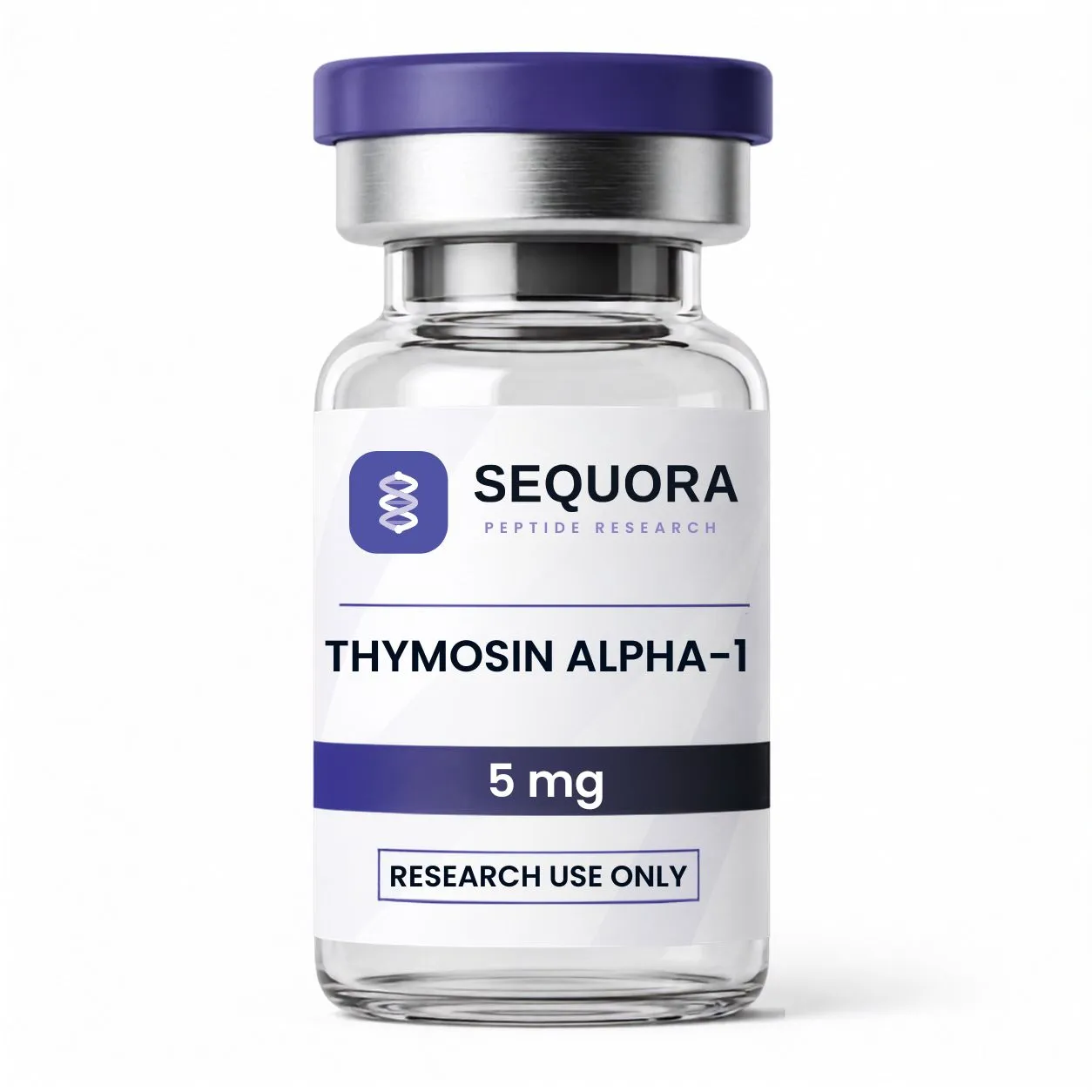
Thymosin Alpha-1 5mg is a research peptide studied for its role in immune-system signaling and T-cell activity. Researchers have investigated this peptide in areas including immune response, inflammation, and infectious disease research. Available from Sequora Peptides for research purposes.
| Molecular Formula | C129H215N33O55 |
|---|---|
| Molecular Mass | 3108.3 g/mol |
| Monoisotopic Mass | 3106.495034 g/mol |
| Polar Area | 1440 Ų |
| Complexity | 7580 |
| XLogP | -25.2 |
| Heavy Atom Count | 217 |
| Hydrogen Bond Donor Count | 50 |
| Hydrogen Bond Acceptor Count | 57 |
| Rotatable Bond Count | 112 |
Every batch is verified for identity and purity by an independent lab before release.
Scan your batch code to pull the full certificate — chromatogram included.
Material compromised in transit is replaced against the original procurement record.
Thymosin alpha-1 (Tα1) is a synthetic, N-terminally acetylated 28-amino-acid peptide originally isolated from thymosin fraction 5 of calf thymus and subsequently produced by chemical synthesis. Extensive research on Tα1 has been conducted due to its impact on immune system components. In contrast to a specific molecule being its target, Tα1 has undergone studies as a factor that influences dendritic cells, T lymphocytes, macrophages, cytokine signaling, and innate immunity. According to Goldstein et al., Tα1 is a thymic-based biological response modifier with a considerable track record of both laboratory and clinical research.
The scientific study of Tα1 commenced with research into the role played by thymic peptides in influencing immune-system function. This was followed by further research into Tα1 in infectious disease, immune deficiency, vaccine immunogenicity, cancer therapy, and inflammation. Garaci. evaluated research on the role of Tα1 in the expression of MHC class I and Toll-like receptor-mediated immune signaling.
Further studies are underway regarding Tα1 and innate immunity signal transduction, dendritic cell biology, T cell activity, cytokine regulation, viral immunity, immune response to vaccines, and host-pathogen interaction. Although Tα1 has more clinical research than most research peptides, results may differ depending on the disorder under investigation, the population involved, and the methodology used. Dominari et al. highlighted the importance of Tα1 clinical studies and the need to interpret its effects based on the clinical context.
In laboratory experiments, Thymosin Alpha-1 5 mg is used to refer to a certain amount of Tα1 that has been prepared for research use. This material should be properly characterized in terms of identity and purity.
| Specification | Details |
|---|---|
| Product Name | Thymosin Alpha-1 5 mg |
| Peptide Name | Thymosin Alpha-1 (Tα1) |
| Peptide Type | Synthetic thymic-derived immunomodulatory peptide |
| Peptide Length | 28 amino acids |
| Sequence | Ac-SDAAVDTSSEITTKDLKEKKEVVEEAEN |
| Molecular Formula | C₁₂₉H₂₁₅N₃₃O₅₅ |
| Molecular Weight | 3108.3 g/mol |
| CAS Number | 62304-98-7 |
| Appearance | White to off-white lyophilized powder |
| Purity | Research-grade quality |
| Storage | According to validated manufacturer specifications |
| Research Use | Research Use Only (RUO) |
Development of Tα1 started with the identification of peptides with biological activity in the thymus tissue. Scientists later characterized Tα1 as the defined peptide and studied the possible effects of Tα1 on immune functions. In the beginning, research was conducted in regard to immune restoration; however, further research included infectious diseases, oncology, vaccines, and immune disorders. The progression of Tα1 from the initial experiments with peptides to large-scale clinical trials with a synthesized peptide was described by Tuthill et al.
In order to better understand the activity of the peptide Tα1, the interaction of Tα1 with dendritic cells, macrophages, T-lymphocytes, and other cells of the immune system was studied. This research contributes to defining Tα1 as an immunomodulator instead of merely an unspecific stimulator of the immune system. Experimental data about the activity of Tα1 in innate immune cells were reviewed by Serafino et al.
The regulation of innate and adaptive immune responses has been a subject of investigation in research involving Tα1. Experiments conducted have studied the effect of Tα1 on dendritic cells, monocytes, macrophages, T cells, cytokine secretion, and antigen presentation. Serafino et al. identified Tα1 as a peptide that could regulate multiple activities of innate immune cells and their associated pathways.
Another topic of interest in the research of Tα1 has been the activities of dendritic cells. In experimental studies, Tα1 was found to influence dendritic cell maturation and signaling by Toll-like receptor-associated pathways. Romani et al. reported that Tα1 regulated the activity of dendritic cells by TLR9-associated signaling.
Current laboratory and clinical research involving Tα1 includes:
The diversity of these research areas reflects the multiple immune pathways associated with Tα1. At the same time, results obtained from one experimental approach cannot be considered applicable to all diseases. Dominari et al. reviewed the rich literature related to Tα1 and its investigations in different contexts.
The precise mechanism of action of Tα1 remains to be determined. Existing data point to the fact that Tα1 can affect different elements of innate and adaptive immunity and does not appear to depend on a single well-defined molecular pathway. Studies have focused on the role of Tα1 in Toll-like receptor-mediated signaling, dendritic cell activation, cytokine regulation, antigen presentation, and T cell responses. Garaci reviewed evidence that Tα1 has been associated with modulation of MHC class I expression and Toll-like receptor-mediated immune response.
Innate immunity is characterized by toll-like receptors that are responsible for recognition of microbial components and intracellular signaling pathways. Tα1 has been well studied in connection with TLR9-related signaling and dendritic cell functions. According to Romani et al., Tα1 was able to prime dendritic cells due to the TLR9-dependent signaling pathway.
In addition to effects on dendritic cells, Tα1 has been examined in relation to monocytes, macrophages, dendritic cells, and other populations of cells of the innate immune system. Cells of the innate immune system function in pathogen recognition and cytokine production, leading to adaptive immune response activation. According to Serafino et al. Tα1 can influence several functions of innate immune cells.
There have been studies conducted on Tα1 concerning T cell function and the relationship between innate immunity and adaptive immunity. Research shows that the immunomodulatory properties of Tα1 may depend on the immune context in which it exists rather than representing a nonspecific enhancement of immune function. According to Goldstein et al., there is evidence suggesting the capacity of Tα1 to modulate several functions of adaptive immunity.
Thymosin alpha-1 has been extensively studied in both preclinical and clinical trials, especially concerning its applications in infectious diseases, immune disorders, cancer, vaccination, and sepsis. Compared with many research peptides, Tα1 has an extensive history of preclinical and clinical investigation, although findings have varied across indications, study populations, and trial designs. However, results have differed depending on the disease studied, patient populations, and designs of the research. Goldstein et al. discussed how Tα1 was discovered through research and development into a promising immunomodulating peptide.
In research on infectious diseases, thymosin alpha-1 has been researched for its ability to modulate the host’s immune system without being an antimicrobial. In studies, it has been looked at in its effects on innate immunity cells, antigen presentation, and adaptive immunity. Dominari et al. looked at the preclinical and clinical research done on Tα1.
Tα1 has also been studied in the context of sepsis, where scientists have looked at the possible impact of modulating the body’s immune system in specific patient groups. Other research has involved exploring the use of Tα1 in vaccinations and immunology in relation to cancer. While this research demonstrates the need for further study, results from each study cannot be applied to all diseases.
History of human research on Tα1 is more elaborate than that of some research peptides. The uses of this peptide have been explored in clinical research in infectious diseases, immune disorders, cancer research, sepsis, and vaccines. However, clinical research does not mean that the efficacy of every use suggested has been proven.
Approval or use of Tα1 is indicated for certain conditions in some nations, while its regulatory approval varies from one country to another. Thymosin Alpha-1 has been granted orphan drug designations for some indications in the US; nevertheless, the orphan drug designations do not mean FDA approval. FDA records show that the respective orphan indications of thymalfasin are not FDA approved.
The current research concerning Thymosin Alpha-1 covers:
The ongoing study is concerned with various immune pathways affected by Tα1 and possible differences depending on the biological and/or disease context. Dominari et al. stated that Tα1 was an extensively studied immunomodulatory peptide with effects on several elements of host immunity.
The regulatory status of Thymosin Alpha-1 depends on the country, formulation, indication, and purpose of its use. In the US, thymalfasin has been designated as an orphan drug for certain investigational indications, but orphan drug designation does not mean that a drug is approved by the FDA. Accordingly, Thymosin Alpha-1 5 mg for research use cannot be considered an FDA-approved drug.
The storage guidelines must be in line with the validated guidelines for the specific grade of research formulation since the stability of peptides is formulation- and storage condition-specific.
For the Tα1 free base FDA briefing documents, storage conditions of the dry peptide include storing the compound in a desiccated state below −18°C. Following reconstitution, the FDA briefing materials report stability for 2–7 days at 4°C, with longer-term storage below −18°C. Such conditions refer only to the material tested by the FDA and do not necessarily apply to all research-grade formulations.
Thymosin Alpha-1 5 mg refers to a defined amount of the synthetic 28-amino acid peptide thymosin Tα1. The peptide has been studied for its association with innate and adaptive immunity, dendritic cells, T-cell function, and host immunity.
Research applications of the compound include immunomodulation, infectious diseases, antiviral response, vaccine response, dendritic cell biology, T cell functions, sepsis, cancer immunology, and host-pathogen interaction.
Experimental studies suggest that Tα1 may affect different immune responses such as toll-like receptor signaling, dendritic cell functions, cytokine regulation, antigen presentation, and T cell response. Romani et al. reported on Tα1-induced effects mediated through TLR9 signaling in dendritic cells.
The use or approval of Tα1 for particular indications is country-specific; however, the regulatory status varies from one country to another. Thymosin Alpha-1 has been awarded orphan drug status for some of its investigational uses in the US; however, orphan drug status is not approval by the FDA.
Storage should adhere to the specifications as verified for the specific research-grade formulation. The peptide must be kept safe from excessive heat, moisture, light, and unnecessary variations in temperature.
When marketed as a Research Use Only (RUO) product, Thymosin Alpha-1 5 mg is used for research only and is not to be presented as a product that can be used for human consumption and treatment of diseases.
Thymosin Alpha-1 5 mg as a research-grade material is meant for Research Use Only (RUO).
The chemical is meant for laboratory testing for qualified researchers.
It should not be offered as a pharmaceutical product or as a product for human consumption and treatment of diseases.

COA ✓
TB-500 10mg is a synthetic peptide studied in cell migration, tissue repair pathways, and actin-related biological research. Supplied by Sequora Peptides strictly for laboratory research use only.
COA ✓

COA ✓
This site supplies chemicals strictly for laboratory research. You must confirm both statements below to enter.
Products are supplied for laboratory research use only and are not for human or veterinary use.