
Institutional accounts only · Pricing and quotes released after verified laboratory registration
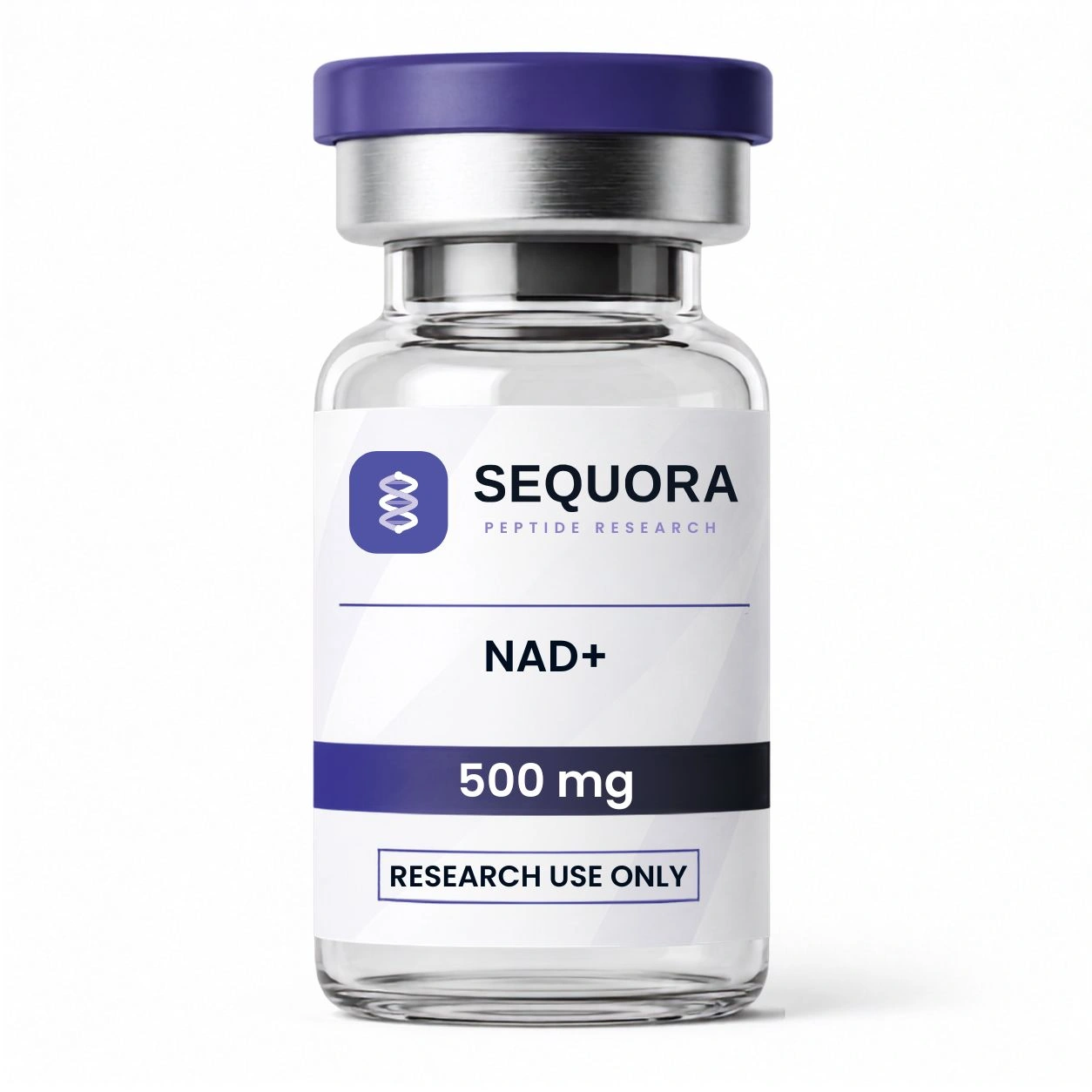
NAD+ is a naturally occurring coenzyme widely studied in cellular energy metabolism, mitochondrial function, and redox biology. Supplied strictly for laboratory research use only and not approved for human use.
| Molecular Formula | C21H27N7O14P2 |
|---|---|
| Molecular Mass | 663.4 g/mol |
| Monoisotopic Mass | 663.109121 g/mol |
| Polar Area | 322 Ų |
| Complexity | 1160 |
| XLogP | -4.8 |
| Heavy Atom Count | 44 |
| Hydrogen Bond Donor Count | 8 |
| Hydrogen Bond Acceptor Count | 17 |
| Rotatable Bond Count | 10 |
Every batch is verified for identity and purity by an independent lab before release.
Scan your batch code to pull the full certificate — chromatogram included.
Material compromised in transit is replaced against the original procurement record.
Nicotinamide Adenine Dinucleotide (NAD+) is an essential coenzyme found in nearly every living cell. It plays a central role in cellular energy metabolism, redox reactions, mitochondrial function, DNA repair, and cell signaling. Because of these wide-ranging biological functions, NAD+ has become an important research compound in the fields of metabolism, molecular biology, neuroscience, mitochondrial research, and aging-related studies.
Researchers can buy NAD+ 500mg for laboratory research to investigate how NAD+-dependent pathways influence cellular metabolism and biochemical regulation. Unlike peptides that typically interact with specific receptors, NAD+ functions as a universal coenzyme involved in numerous enzyme-driven reactions throughout the cell.
Scientific interest in NAD+ dates back to the early twentieth century, when researchers studying cellular respiration identified molecules involved in transferring electrons during metabolic reactions. Modern research has since shown that NAD+ serves as a critical cofactor for many enzymes associated with energy production, mitochondrial activity, genome maintenance, and cellular stress responses.
NAD+ is also closely associated with the activity of important enzyme families such as sirtuins and poly(ADP-ribose) polymerases (PARPs). These enzymes are widely studied for their roles in DNA repair, gene regulation, metabolic signaling, and cellular homeostasis. Researchers continue to examine how changes in intracellular NAD+ concentrations may affect mitochondrial function, oxidative stress, enzyme regulation, and overall cellular physiology. (Canto et al., 2015; Verdin, 2015; Covarrubias et al., 2021)
Today, NAD+ research spans biochemistry, molecular biology, neuroscience, metabolism, and aging science. Its fundamental role in cellular energy transfer and enzyme regulation continues to make NAD+ 500mg a valuable material for controlled laboratory investigation and biochemical research.
Research Use Only: At Sequora Peptides, NAD+ 500mg is intended strictly for laboratory and research purposes. It is not approved for human or veterinary use.
| Specification | Details |
|---|---|
| Compound Name | Nicotinamide Adenine Dinucleotide (NAD+) |
| Compound Type | Pyridine nucleotide coenzyme |
| Chemical Formula | C₂₁H₂₇N₇O₁₄P₂ |
| Molecular Weight | 663.43 g/mol |
| CAS Number | 53-84-9 |
| PubChem CID | 5892 |
| Appearance | White to off-white lyophilized powder |
| Vial Size | 10 mL sterile glass vial |
| Contents | Lyophilized Nicotinamide Adenine Dinucleotide (NAD+) |
| Purity | High purity |
| Research Use | Intended exclusively for laboratory research. Not intended for human or veterinary use. |
Scientific interest in NAD+ (Nicotinamide Adenine Dinucleotide) dates back more than a century. Early biochemists studying cellular respiration and oxidation were trying to understand how cells convert nutrients into usable energy. These investigations helped establish NAD+ as an essential coenzyme, rather than an enzyme, involved in many metabolic reactions. (Ying 2008; Canto et al., 2015; Pollak et al., 2007)
Researchers later found that NAD+ plays a central role in oxidation-reduction reactions, where it helps transfer electrons during cellular metabolism. This function is especially important in pathways involved in nutrient metabolism, ATP production, and mitochondrial energy processing. (Ying 2008; Canto et al., 2015; Pollak et al., 2007)
As molecular biology advanced, scientists discovered that NAD+ has functions beyond energy metabolism. It also serves as a substrate for NAD+-dependent enzymes, including sirtuins and poly(ADP-ribose) polymerases (PARPs). These enzymes are involved in processes such as DNA repair, gene regulation, cellular signaling, stress responses, and maintenance of cellular homeostasis. (Verdin 2015; Covarrubias et al., 2021; Canto et al., 2015)
Because of these broad biological roles, NAD+ remains an important subject of laboratory research. Scientists continue to study its involvement in mitochondrial function, metabolic regulation, oxidative stress, cellular aging, DNA maintenance, and enzyme activity to better understand how NAD+ homeostasis affects normal cellular physiology.
Ever since its discovery, numerous laboratory experiments have been carried out regarding NAD+, involving disciplines ranging from biochemistry and molecular biology to metabolism, neuroscience, and even aging research. Researchers continue to discover ways in which this vital coenzyme functions and keeps the body’s metabolism balanced. (Ying 2008; Verdin 2015; Covarrubias et al., 2021)
Biochemical studies of NAD+ date back to the 1900s when investigations into cellular respiration yielded a mysterious coenzyme that was a part of oxidation-reduction reactions. The studies resulted in the identification of the importance of NAD+ for metabolism when carbohydrates, lipids, and proteins are transformed into energy. (Ying 2008; Pollak et al., 2007)
It has been discovered through biochemical research that NAD+ plays the role of an electron carrier in glycolysis, the TCA cycle, and oxidative phosphorylation. (Ying 2008; Canto et al., 2015; Pollak et al., 2007)
The emergence of molecular biology revealed the importance of NAD+ not only in producing energy but also in other biological activities. Studies conducted in the lab indicated that NAD+ was used as a substrate by enzymes responsible for DNA repair, chromatin modification, and cellular signaling. (Verdin 2015; Covarrubias et al., 2021; Canto et al., 2015)
Contemporary studies keep examining the biological roles of NAD+ in various areas of science, such as:
All of these studies help increase knowledge about the roles of NAD+ in normal physiology and provide information for future studies on metabolic and molecular biology. (Verdin 2015; Covarrubias et al., 2021; Rajman et al., 2018)
In the current times, NAD+ is one of the most widely studied cofactors in biology. Scientists keep studying its role in various physiological processes within cells that are critical to maintaining regular cellular function. Currently, there is active research being done in the following areas, among others:
Despite the years of studies dedicated to proving the role of NAD+ as a necessary cofactor in cellular metabolism, scientists still study the impact of its changes on cellular physiology and molecular signaling pathways.
In contrast to receptor-binding peptides, NAD+ acts as a coenzyme that plays a role in several enzymatic reactions within the cell. It works as an electron carrier and plays a vital role in numerous biochemical reactions. (Ying 2008; Canto et al., 2015; Pollak et al., 2007)
Firstly, the main biological function of NAD+ is as an electron carrier. The role of NAD+ is the transfer of electrons during oxidation-reduction reactions. NAD+ works as an electron acceptor and generates NADH that helps to produce ATP with the help of oxidative phosphorylation in mitochondria. It is one of the most researched biological functions of NAD+. (Ying 2008; Canto et al., 2015; Pollak et al., 2007)
There were many research studies carried out in connection with the biological substance NAD+ because of its significant role in glycolysis, the tricarboxylic acid cycle, and oxidative phosphorylation. All these pathways are connected with the generation of energy by means of carbohydrates, fats, and proteins. Now, research is performed in laboratories to determine the significance of NAD+ in metabolism. (Ying 2008; Canto et al., 2015)
In addition, NAD+ is the substrate of enzymes involved in DNA repair, such as poly (ADP-ribose) polymerases (PARPs). The role of NAD+-dependent enzyme activities in maintaining genome stability and dealing with DNA damage has been investigated in experimental studies. (Verdin 2015; Covarrubias et al., 2021)
The other important area of research concerns the action of the enzyme sirtuin that regulates gene expression, metabolism, and response to stress. Scientists continue their studies concerning the effect of NAD+ levels on the activity of sirtuins. (Verdin 2015; Covarrubias et al., 2021; Canto et al., 2015)
Recent experiments in the laboratory have increased scientific knowledge about NAD+ in ways other than in energy metabolism. Scientific investigation into the role of NAD+ in intracellular signaling systems, mitochondrial signaling, oxidative stress signaling, and cellular adaptation continues. (Verdin 2015; Covarrubias et al., 2021; Canto et al., 2015)
Appropriate storage is required to maintain the stability and biochemical purity of NAD+ during laboratory investigations.
The powdered form of NAD+ should be stored at temperatures ranging from 2°C to 8°C inside a refrigerator. In case of long-term storage, unopened vials can be stored below -20°C to increase stability. The vial should always remain sealed before laboratory use.
After being dissolved in an appropriate laboratory-grade diluent, the solution should be stored in a temperature range of 2°C to 8°C. Repetitive freezing and thawing should be avoided to increase the stability of the compound.
Avoid exposing NAD+ to light, heat, and moisture for storage purposes. Stable storage will go a long way in ensuring that the product quality is maintained when used in the laboratory.
The handling of NAD+ should always be carried out under sterile laboratory conditions.
NAD+ (Nicotinamide adenine dinucleotide) is a natural coenzyme found in most living organisms. It is very important in the metabolism of energy, reduction and oxidation reactions, as well as many other enzyme reactions.
A lot of studies are being conducted in relation to NAD+ because of its importance in energy production, DNA repair, redox reactions, cell communication, and so forth. Its biological significance makes it a worthy topic to study for the subjects of biochemistry and metabolism.
NAD+ is studied in the research areas of metabolism, mitochondrial physiology, aging, neuroscience, molecular biology, cell physiology, oxidative stress, and enzymology.
The unused NAD+ should be stored at 2°C-8°C for routine lab storage or -20°C for long-term storage. Upon dissolution of the powder, the solution should be stored at 2°C-8°C without freezing.
No. The NAD+ that is used in laboratory research is intended solely for research purposes.
This is not for human consumption.
FOR RESEARCH USE ONLY (RUO). NOT FOR HUMAN OR VETERINARY USE.
NAD+ 500 mg is supplied only for research purposes to be used by qualified personnel in a lab setting.
This item is not for human consumption and is not meant to diagnose, treat, cure, or prevent any disease. This item must be used by qualified laboratory personnel only using laboratory techniques.
The buyer is solely responsible for the proper purchase and storage of research items.

COA ✓
Tesamorelin 10mg is a synthetic GHRH analog studied for growth hormone signaling, endocrine function, and metabolic research. Supplied by Sequora Peptides strictly for laboratory research use only.

COA ✓

COA ✓
TB-500 10mg is a synthetic peptide studied in cell migration, tissue repair pathways, and actin-related biological research. Supplied by Sequora Peptides strictly for laboratory research use only.
This site supplies chemicals strictly for laboratory research. You must confirm both statements below to enter.
Products are supplied for laboratory research use only and are not for human or veterinary use.