
Institutional accounts only · Pricing and quotes released after verified laboratory registration
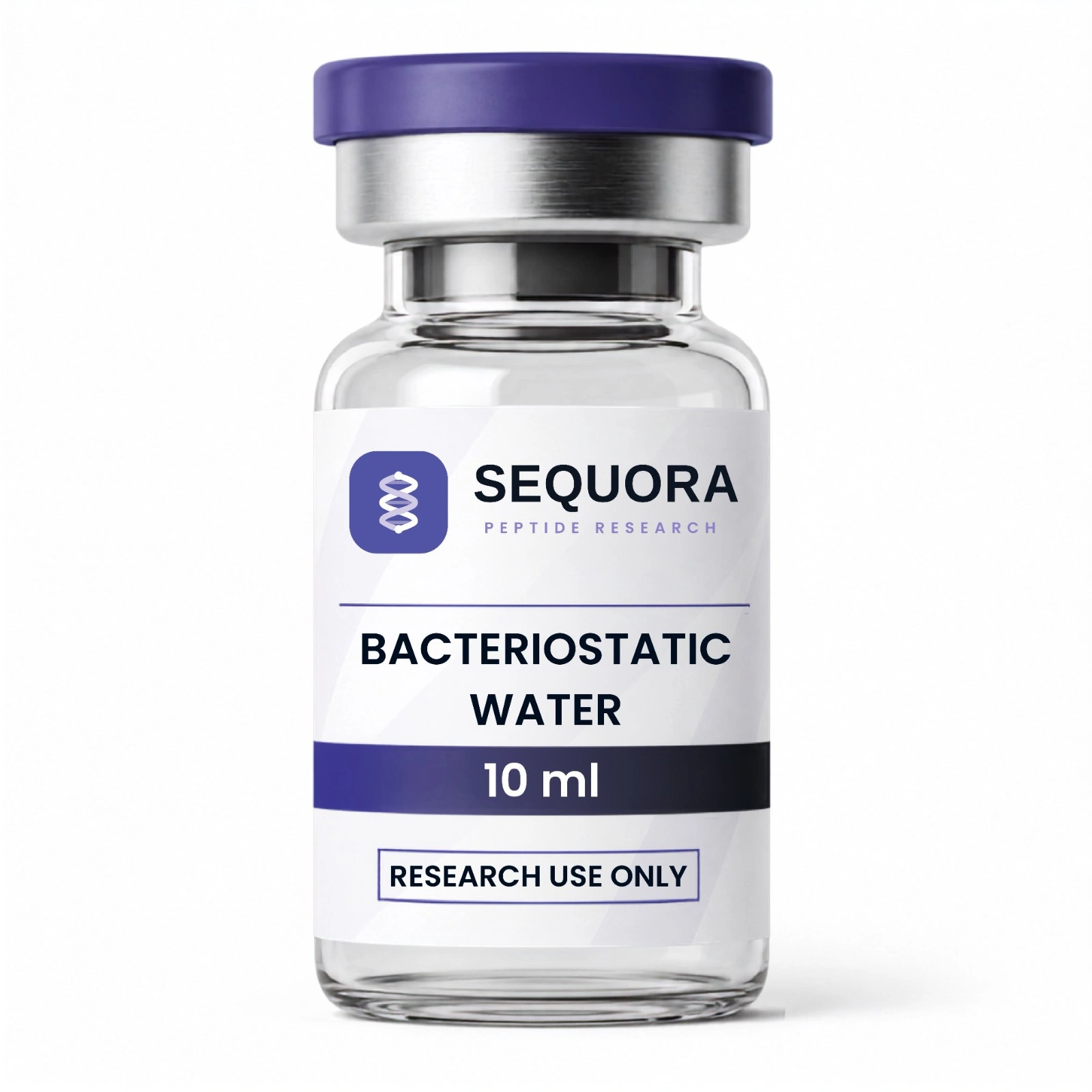
Bacteriostatic Water 10mL is a preserved sterile water product containing benzyl alcohol. It is supplied for laboratory and research applications where bacteriostatic water is required. Available at Sequora Peptides for research purposes.
| Molecular Formula | H2O (with 0.9% C7H8O) |
|---|---|
| Molecular Mass | 18.015 g/mol (Water component) |
| Monoisotopic Mass | 18.010565 g/mol |
| Polar Area | 1 Ų |
| Complexity | 0 |
| XLogP | -0.5 |
| Heavy Atom Count | 1 |
| Hydrogen Bond Donor Count | 1 |
| Hydrogen Bond Acceptor Count | 1 |
| Rotatable Bond Count | 0 |
Every batch is verified for identity and purity by an independent lab before release.
Scan your batch code to pull the full certificate — chromatogram included.
Material compromised in transit is replaced against the original procurement record.
The Bacteriostatic Water for Injection is a sterile, pyrogen-free preparation of water for injection with 0.9% benzyl alcohol as the preservative. Unlike Sterile Water for Injection, which is meant for single use only, Bacteriostatic Water is designed to allow withdrawals from the same vial as long as proper aseptic techniques are employed. This feature has made it one of the most common diluents for reconstituting lyophilized peptides, proteins, and other compounds in scientific and pharmaceutical research laboratories.
What makes the Bacteriostatic Water scientifically important does not have anything to do with any biological activity; it has to do with its function as a sterile carrier medium for the safe manipulation of multi-dose preparations in the laboratory setting. This is illustrated in the paper titled “Antimicrobial Preservative Use in Parenteral Products: Past and Present” published in the Journal of Pharmaceutical Sciences. According to this work, antimicrobial preservatives such as benzyl alcohol have been crucial in ensuring microbiological stability of multidose injectables while minimizing the possibility of microbial contamination through multiple withdrawals from a multi-dose preparation.
Research on Bacteriostatic Water is mainly centered on preservation efficiency, sterility of multi-dose vials, aseptic technique, prevention of microorganism contamination, and compatibility with sterile drug preparations. Recent research, such as the review “Antimicrobial Preservatives for Protein and Peptide Formulations: An Overview,” published in Pharmaceutics, underscores the significance of antimicrobial preservatives in ensuring microbiological quality and stability of peptide and protein multi-dose formulations and avoiding adverse interaction with drug ingredients.
Sequora Peptide offers Bacteriostatic Water 10 mL for Research Use Only (RUO) as an advanced laboratory reagent designed for scientific studies, analytical laboratories, peptide dilution, and other laboratory purposes.
| Characteristics | Details |
| Product Name | Bacteriostatic Water 10mL |
| Generic Name | Bacteriostatic Water for Injection |
| Composition | Sterile Water with 0.9% Benzyl Alcohol |
| Volume | 10ml |
| Active Preservative | Benzyl Alcohol (0.9%) |
| CAS Number (Benzyl Alcohol) | 100-51-6 |
| PubChem CID (Benzyl Alcohol) | 244 |
| Appearance | Clear, colorless sterile solution |
| Container | 10 mL sterile multidose glass vial |
| Sterility | Sterile and non-pyrogenic |
| Storage | Store at 20°C–25°C (68°F–77°F); protect from excessive heat |
| Research Use | Research Use Only (RUO) |
Bacteriostatic Water has been a crucial sterile diluent in pharmaceutical production, research laboratories, and sterile compounding for many years. As opposed to bioactive peptides or proteins, Bacteriostatic Water plays an important role as a sterile diluent and ensures the microbiological integrity of multidose products. Therefore, the scientific literature on the topic is mostly devoted to Bacteriostatic Water in terms of the preservative properties, contamination, sterile manufacturing processes, and compatibility with injectable drugs.
One of the major constituents of Bacteriostatic Water is benzyl alcohol, which acts as an antimicrobial preservative. According to the review “Antimicrobial Preservative Use in Parenteral Products: Past and Present,” benzyl alcohol is considered to be one of the most common preservatives used in multidose injectable preparations since it inhibits microorganisms’ growth without losing compatibility with different pharmaceutical formulations. Choosing the preservative is one of the key stages in multidose product development, especially concerning peptide and protein formulations.
Further studies have broadened the scope of this knowledge. The review titled “Antimicrobial Preservatives for Protein and Peptide Formulations: An Overview,” which appeared in Pharmaceutics, addresses the persisting significance of antimicrobial preservatives as an element ensuring the microbiological quality of multidose biologics and peptide formulations. It is pointed out that the choice of preservatives involves not only the effective inhibition of microorganisms but also formulation, stability, and compatibility.
A separate field of research relates to the contamination that arises in the context of repeated puncturing of vials. The article “Multidose Medication Vial Sterility: An In-use Study and a Review of the Literature” has examined the microbiological safety of multidose vials during normal use and stressed the necessity of proper aseptic techniques for avoiding contamination.
Bacteriostatic Water is currently essential as a laboratory reagent for the preparation of lyophilized research compounds, peptides, proteins, and sterility of pharmaceutical products. Scientific research that is currently ongoing is continuously improving the methods of asepsis, preservation techniques, multidose vials, and sterile compounding processes.
In contrast to peptides and other medicinal agents, Bacteriostatic Water is neither biologically active nor does it have any pharmacological activity in terms of its impact on the cell or tissue systems. Rather, it is a laboratory diluent that has been prepared under sterile conditions, which can be used to prepare injectable reagents for use in scientific research. For these reasons, biological activity has not been of significant importance in the scientific study of the agent.
One of the unique features of Bacteriostatic Water is the presence of 0.9% benzyl alcohol used as an antimicrobial preservative. As stated in the literature review, “Antimicrobial Preservative Use in Parenteral Products: Past and Present,” which was featured in the Journal of Pharmaceutical Sciences, benzyl alcohol has been used in multidose injectable products to reduce microorganism growth from repetitive withdrawals, while maintaining product integrity over the expected duration of use. It should be noted that effective preservatives depend greatly on proper product formulation and cannot substitute for aseptic technique.
Bacteriostatic Water has found extensive usage in the laboratory reconstitution of lyophilized peptides, proteins, and other substances for further studies. In the article titled “Antimicrobial Preservatives for Protein and Peptide Formulations: An Overview,” it is stated that multi-dosing involves the use of antimicrobial preservatives for maintaining microbiological integrity without affecting the integrity and compatibility of the formulation. This is because the use of preservatives is still an important aspect for peptides and proteins, as both sterility and the formulation need to be maintained.
Repetitive handling of multidose vials raises the risk of contamination if the laboratory protocols are not adhered to. The research paper “Multidose Medication Vial Sterility: An In-use Study and a Review of the Literature” assessed the safety of multidose vials during normal usage and determined that contamination still did not occur frequently as long as proper techniques were adhered to. This has kept intact the present laboratory guidelines advocating the use of sterilized needles, cleaning of vials, and other such practices in multidose applications.
Another example is the study titled “Bacterial Contamination of Multiple-dose Vials: A Prevalence Study” featured in the American Journal of Infection Control. In the study, the authors assessed contamination that occurred as a result of using multidose containers during the process of clinical care and found that the contamination was mostly due to lack of aseptic technique and not necessarily any problem with multidose preparations.
Ensuring sterility is possible not only through the use of antimicrobial preservatives but also through validation of the manufacturing process and proper laboratory practices. According to “Sterility, Sterilisation and Sterility Assurance for Pharmaceuticals: Technology, Validation and Current Regulations” by Tim Sandle, the scientific basis for ensuring sterility in the manufacture of sterile pharmaceuticals includes the principles of environmental monitoring, contamination prevention, aseptic manufacturing, validation, and quality management of sterilized pharmaceutical products. This scientific basis enables the manufacture of sterile laboratory reagents such as Bacteriostatic Water and their microbiological safety when used in laboratories.
While the preservative system assists in minimizing microbial growth after multiple withdrawals, sterility depends on both a validated manufacturing process and proper aseptic handling in the laboratory.
While Bacteriostatic Water does not possess any biological activity itself, it still plays an important role as an auxiliary agent in pharmaceuticals, analytical chemistry, molecular biology, and peptide research. All literature references stress the importance of this substance as a sterilizing agent during preparation and use, rather than an agent that directly influences biological processes.
Current pharmaceutical and laboratory research involving Bacteriostatic Water includes:
The review paper titled “Antimicrobial Preservatives for Protein and Peptide Formulations: An Overview” underscores the ongoing requirement to have an effective preservative system in place, which not only maintains microbial purity but also reduces unfavorable reactions with the biological formulation. This is especially critical in the case of peptide-based research products.
Studies related to Bacteriostatic Water are constantly changing along with new developments in sterile drug production processes and multidose formulations. In place of therapeutic efficacy research, the emphasis is placed on preservation efficiency, compatibility, and reproducibility of the formulation in laboratory conditions.
Preservative systems continue to be an important field of study for pharmacological sciences because they affect the safety of multidose products. The paper “Antimicrobial Preservative Use in Parenteral Products: Past and Present” gives a review of decades of research on antimicrobial preservatives such as benzyl alcohol and explains the scientific aspects behind such trade-offs.
Safe handling of multidose containers is still being studied extensively. As indicated in the article “Multidose Medication Vial Sterility: An In-use Study and a Review of the Literature,” compliance with proper aseptic technique considerably reduces the contamination probability in the process of opening multidose containers several times.
Sterility assurance is not limited to antimicrobial preservatives. In “Sterility, Sterilisation and Sterility Assurance for Pharmaceuticals: Technology, Validation and Current Regulations” by Tim Sandle discusses scientifically proven methods of sterile pharmaceutical production that include such methods as environmental monitoring, sterilization validation, contamination control, personnel training, container integrity, and quality management systems. All these methods are collectively the science of sterility assurance in microbiological quality maintenance of sterile pharmaceutical and laboratory preparations.
Therefore, the quality of Bacteriostatic Water is not only guaranteed by benzyl alcohol but also by scientifically proven manufacturing and aseptic procedures in laboratories.
Bacteriostatic Water for Injection is made up of Sterile Water for Injection and 0.9% benzyl alcohol, which is used as an antimicrobial preservative for multidose use in laboratories. Product specifications, including its formulation, preservative content, storage conditions, and multidose vial details, are stated by the manufacturer in the product labeling. This product specification complements the scientific literature related to the effectiveness of the preservatives, sterility assurance, and protection against contamination.
Bacteriostatic Water 10 mL is manufactured by Sequora Peptide for research purposes only. This water is suitable for research purposes, analysis, and reconstitution of peptides and other scientific uses. It is not suitable for human or animal consumption.
Proper handling and storage are important aspects when trying to preserve the sterility and microbial qualities of the Bacteriostatic Water. This is because the water contains 0.9% benzyl alcohol, which is used to prevent bacterial growth after multiple withdrawals. However, the preservative cannot be used as an alternative to appropriate laboratory handling procedures.
Proper storage and aseptic handling of the product facilitate laboratory research.
Bacteriostatic Water for Injection is sterile Water for Injection containing 0.9% benzyl alcohol as an antimicrobial preservative. The Bacteriostatic Water for Injection is widely used as a laboratory diluent for the preparation of compatible research compounds.
The presence of benzyl alcohol allows this solution to be used as an antimicrobial preservative, which helps to prevent microbial growth after repeated punctures of multidose vials. According to scientific studies, preservative systems are an important component for maintenance of microbiological quality of solutions under aseptic technique.
Applications of Bacteriostatic Water include:
The intact vial should be stored at 20-25°C (68-77°F). Following the opening, follow aseptic technique and sterilize the vial stopper before each withdrawal.
No. Sequora Peptide Bacteriostatic Water 10mL is developed for Research Use Only (RUO).
This site supplies chemicals strictly for laboratory research. You must confirm both statements below to enter.
Products are supplied for laboratory research use only and are not for human or veterinary use.