
Institutional accounts only · Pricing and quotes released after verified laboratory registration
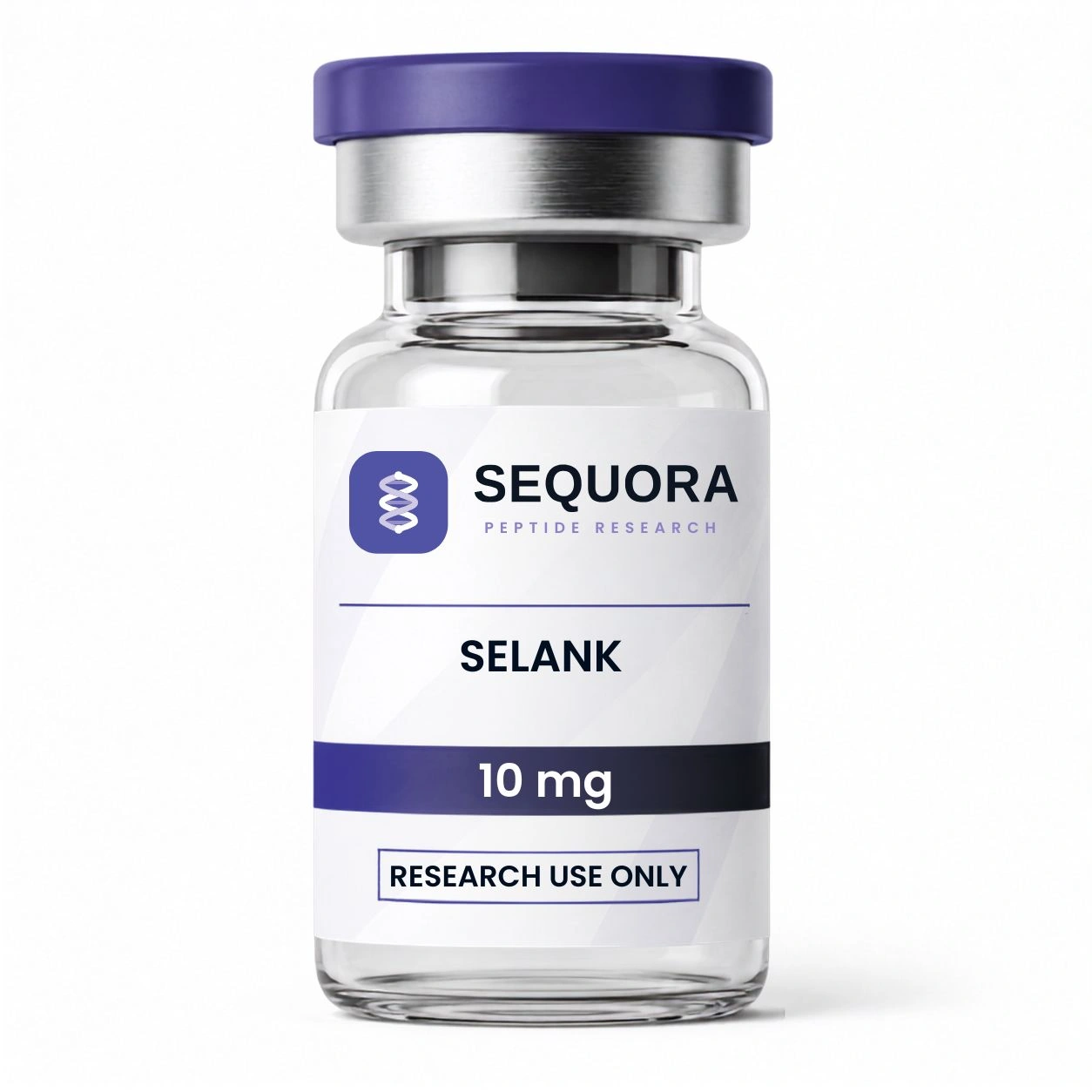
Selank 10mg is a research-grade peptide that is not FDA-approved for human use. Research on Selank has examined its anxiolytic effects, GABA-related activity, stress responses, and cognitive-related effects in laboratory and clinical research settings. Available from Sequora Peptides for research purposes.
| Molecular Formula | C33H57N11O9 |
|---|---|
| Molecular Mass | 751.9 g/mol |
| Monoisotopic Mass | 751.434074 g/mol |
| Polar Area | 307 Ų |
| Complexity | 1290 |
| XLogP | -5.4 |
| Heavy Atom Count | 53 |
| Hydrogen Bond Donor Count | 10 |
| Hydrogen Bond Acceptor Count | 11 |
| Rotatable Bond Count | 19 |
Every batch is verified for identity and purity by an independent lab before release.
Scan your batch code to pull the full certificate — chromatogram included.
Material compromised in transit is replaced against the original procurement record.
Selank is a synthetic heptapeptide with the amino acid sequence Thr-Lys-Pro-Arg-Pro-Gly-Pro. It was developed as an analog of tuftsin, a naturally occurring peptide involved in immune signaling. Selank was originally developed by researchers associated with the Institute of Molecular Genetics of the Russian Academy of Sciences.
Scientific interest in Selank has focused mainly on its potential influence on neurotransmitter signaling, stress-related pathways, cognitive processes, and neuroimmune communication. Researchers have investigated how this peptide may interact with signaling systems within the central nervous system, including pathways associated with GABAergic neurotransmission.
One study published in Frontiers in Pharmacology, titled “Selank Administration Affects the Expression of Some Genes Involved in GABAergic Neurotransmission”, reported changes in the expression of several genes associated with GABA-related signaling following experimental Selank administration. These findings contributed to further scientific interest in the peptide and its potential biological mechanisms.
Research involving Selank continues across preclinical and limited clinical settings, particularly in areas such as stress physiology, neurotransmitter regulation, cognitive neuroscience, and neuroimmune signaling. However, the available evidence remains limited, and larger, independent studies are needed to better understand its biological activity and research significance.
Researchers looking to buy Selank 10mg can obtain research-grade Selank from Sequora Peptides for laboratory and analytical research purposes. Selank products offered by Sequora Peptides are intended strictly for Research Use Only (RUO) and are not intended for human or veterinary use.
| Characteristics | Specification |
| Name of Product | Selank 10 mg |
| Selank peptide Sequence | Thr-Lys-Pro-Arg-Pro-Gly-Pro (TKPRPGP) |
| Peptide Type | Synthetic heptapeptide |
| Molecular Formula | C₃₃H₅₇N₁₁O₉ |
| Molecular Weight | 751.9 g/mol |
| CAS Number | 129954-34-3 |
| PubChem CID | 11765600 |
| Peptide Length | 7 amino acids |
| Purity | F(HPLC Tested) |
| Appearance | White lyophilized powder |
| Solubility | Sterile water or bacteriostatic water for laboratory research |
| Storage | Store at 2–8°C before and after reconstitution |
| Research Use | ROU: Research Use Only |
Over the past twenty years, Selank has been under study due to its relevance to neuropeptides research, cognitive functioning, stress responses, and immune system control. The peptide was developed as an analogue of tuftsin – a naturally existing tetrapeptide responsible for immune signaling. Scientists decided to design Selank to find out if structural changes can affect peptide stability and its functional potential within the central nervous system.
Selank is a product of research developed by scientists working at the Institute of Molecular Genetics of the Russian Academy of Sciences. It is composed of seven amino acids (Thr-Lys-Pro-Arg-Pro-Gly-Pro) and has been developed to study its impact on neurotransmitter regulation, stress adaptation, and neuroimmunity in lab and clinical studies.
One of the key milestones in Selank research is the study of the impact of this peptide on neurotransmitter systems involved in stress and cognitive functions. “Use of Selank to correct measures of integrative brain activity and biogenic amine levels in adult rats resulting from Antenatal Hypoxia” says that studies showed that Selank affected the activity of several neurotransmitter systems such as GABA, serotonin, dopamine, and norepinephrine.
At present, Selank continues to be explored by researchers in various aspects of neuroscience and peptide science, which include:
While promising results have been demonstrated from laboratory and clinical trials, the existing data remain inadequate. Further investigation of Selank is conducted by researchers using preclinical and clinical trials.
Selank has been extensively studied for its potential effects on neurotransmitters, neuroplasticity, immune responses, and stress pathways. Although the exact mechanism of Selank is not fully understood, studies indicate it affects various biological processes related to CNS function.
One of the most studied properties of Selank is its interaction with neurotransmitter systems. According to “Use of Selank to correct measures of integrative brain activity and biogenic amine levels in adult rats resulting from Antenatal Hypoxia,” published in Neuroscience and Behavioral Physiology, Selank influenced the activity of GABAergic, serotonergic, dopaminergic, and noradrenergic pathways in experimental studies. Researchers suggest that these interactions may contribute to its biological effects on stress responses and cognitive function.
Selank has also been studied for potential effects on neuroplasticity and learning. In the Bulletin of Experimental Biology and Medicine, they found that Selank altered the expression of a number of proteins and signaling cascades involved in neuronal communication and synaptic signaling in experimental conditions. This supports further research into its role in cognitive neuroscience.
Selank is derived from the endogenous peptide tuftsin. As such, researchers have examined its possible role in neuroimmune communication. Results of clinical and laboratory trials, including those published in Zhurnal Nevrologii i Psikhiatrii, have demonstrated that Selank can modulate Th1/Th2 cytokine balance and change Interleukin-6 (IL-6) levels in patients. Further studies, published in the Bulletin of Experimental Biology and Medicine, also indicate that Selank modulates cytokine expression and immune response pathways under conditions of induced environmental stress; however, these results remain under investigation in ongoing laboratory studies.
Published research has looked closely at Selank in experimental models of stress and anxiety-related behaviour. Landmark research that tracks “Effects of Selank on behavioral reactions and activities of plasma enkephalin-degrading enzymes” and studies on unpredictable chronic mild stress (UCMS) conditions have shown that the peptide helps to stabilize behavioral stress adaptation. Researchers are still investigating how its combined effects on the regulation of neurotransmitters and neuroimmune signaling protect the brain from stress.
While comparative trials against traditional anxiolytics like phenazepam show promising tolerability profiles, additional large-scale human clinical studies are required to completely map Selank’s long-term biological effects and human research applications.
Selank has been tested in laboratories, animal models, and a few human trials. Most research studies have been centered on neurotransmitter regulation, anxiety behavior, cognitive performance, neuroprotective effects, and immune response modification. Although several findings appear promising, more randomized controlled trials on the long-term safety and biological effects of Selank are required.
As stated in Selank Administration Affects the Expression of Some Genes Involved in GABAergic Neurotransmission,” published in Frontiers in Pharmacology, the drug acted on several neurotransmitter pathways, which include GABA, serotonin, dopamine, and norepinephrine, in experimental conditions. Such findings have driven more research to be done on Selank’s neurobiological effects.
Further studies have been done on Selank’s effects on gene expression for neural functions. According to published research in the Bulletin of Experimental Biology and Medicine, Selank acted on the expression of several genes that facilitate neurotransmission and synaptic activity.
Several studies done on the use of Selank as a model of anxiety-related behaviors and cognition are already documented in scientific literature. The results show that the peptide affects stress adaptation and cognitive learning, but further research is needed to confirm the results using more extensive clinical trials in humans.
Since Selank is a synthetic analogue of tuftsin, a number of studies were conducted on its ability to modulate neuroimmune pathways. The experimental data show that Selank affects immune response and cytokine regulation, but these results are still being researched.
The use of Selank as a research neuropeptide is ongoing in the scientific literature and in various research projects. To date, the published research has focused mainly on the biological activities of Selank in neuroscience and neuroimmunology, where scientists have evaluated its putative role in neurotransmitter regulation, stress physiology, cognitive processes, and immune signaling.
Research is ongoing into the various uses of Selank in several scientific disciplines such as:
While several preclinical and preliminary clinical trials have yielded promising results, more large-scale and randomized clinical trials are still required.
Currently, there is no approval from the FDA, EMA, or other international regulatory agencies for the use of Selank as a prescription drug for the treatment, prevention, or curing of any disease.
As per information available on the website ClinicalTrials.gov, the number of studies related to Selank has been far less than that of already approved peptide drugs. There is ongoing research regarding the pharmacological features of Selank, which requires more clinical trials in order to establish the safety and efficacy of Selank.
Selank 10 mg from Sequora Peptide is meant only for Research Use Only (RUO). It is meant for experimental and scientific research purposes only and should not be taken by humans.
Selank 10mg must be properly stored to aid in its stability during laboratory research studies.
Proper storage and handling help preserve peptide quality, minimize degradation, and support consistent, reproducible research outcomes.
Selank is a laboratory-made heptapeptide (Thr-Lys-Pro-Arg-Pro-Gly-Pro) analog of the native tuftsin. Scientists have studied its role in neurotransmitter regulation, neuroprotection, cognitive functions, stress physiology, and neuro-immune interactions.
In scientific studies, Selank is frequently employed in research involving anxiety-related behaviors, cognitive neuroscience, learning and memory, neurotransmitter modulation, neuroprotection, and immunomodulation. Although the published results are promising, more large-scale clinical trials are required to verify these findings.
According to current scientific data, Selank can affect such neurotransmitter systems as GABAergic, serotonergic, dopaminergic, and noradrenergic ones. Also, scientists study the effects of Selank on gene expression, neuroimmune interactions, and neurotransmission. Nonetheless, its exact mechanism of action has not been elucidated yet.
No. Currently, Selank has not been approved as a medicinal drug by the U.S. Food and Drug Administration (FDA) or other relevant international agencies.
Store the lyophilized peptide at 2°C to 8°C (36°F to 46°F) in a cool, dry place protected from light and moisture. After reconstitution, refrigerate the solution, avoid repeated freeze-thaw cycles, and follow validated laboratory handling procedures to help preserve peptide stability.
No. Selank 10mg supplied by Sequora Peptide is manufactured exclusively for Research Use Only (RUO). It is intended solely for laboratory and scientific research and is not intended for human consumption, therapeutic use, diagnostic use, or self-administration.
The Selank 10mg produced by Sequora Peptide is made for Research Use Only (RUO). The product is meant only for laboratory/ scientific research purposes performed by trained professionals and is not for human consumption, treatment, diagnosis, or self-medication.
Sequora Peptide makes no claims about the suitability of Selank for diagnosis, treatment, mitigation, cure, or prevention of any disease. It is the responsibility of the researcher to ensure that all purchases, handling, storage, and use of this product are compliant with all relevant guidelines.
This product is only meant to be used under controlled laboratory conditions by scientifically trained and experienced personnel.
COA ✓
COA ✓

COA ✓
TB-500 10mg is a synthetic peptide studied in cell migration, tissue repair pathways, and actin-related biological research. Supplied by Sequora Peptides strictly for laboratory research use only.
This site supplies chemicals strictly for laboratory research. You must confirm both statements below to enter.
Products are supplied for laboratory research use only and are not for human or veterinary use.