
Institutional accounts only · Pricing and quotes released after verified laboratory registration
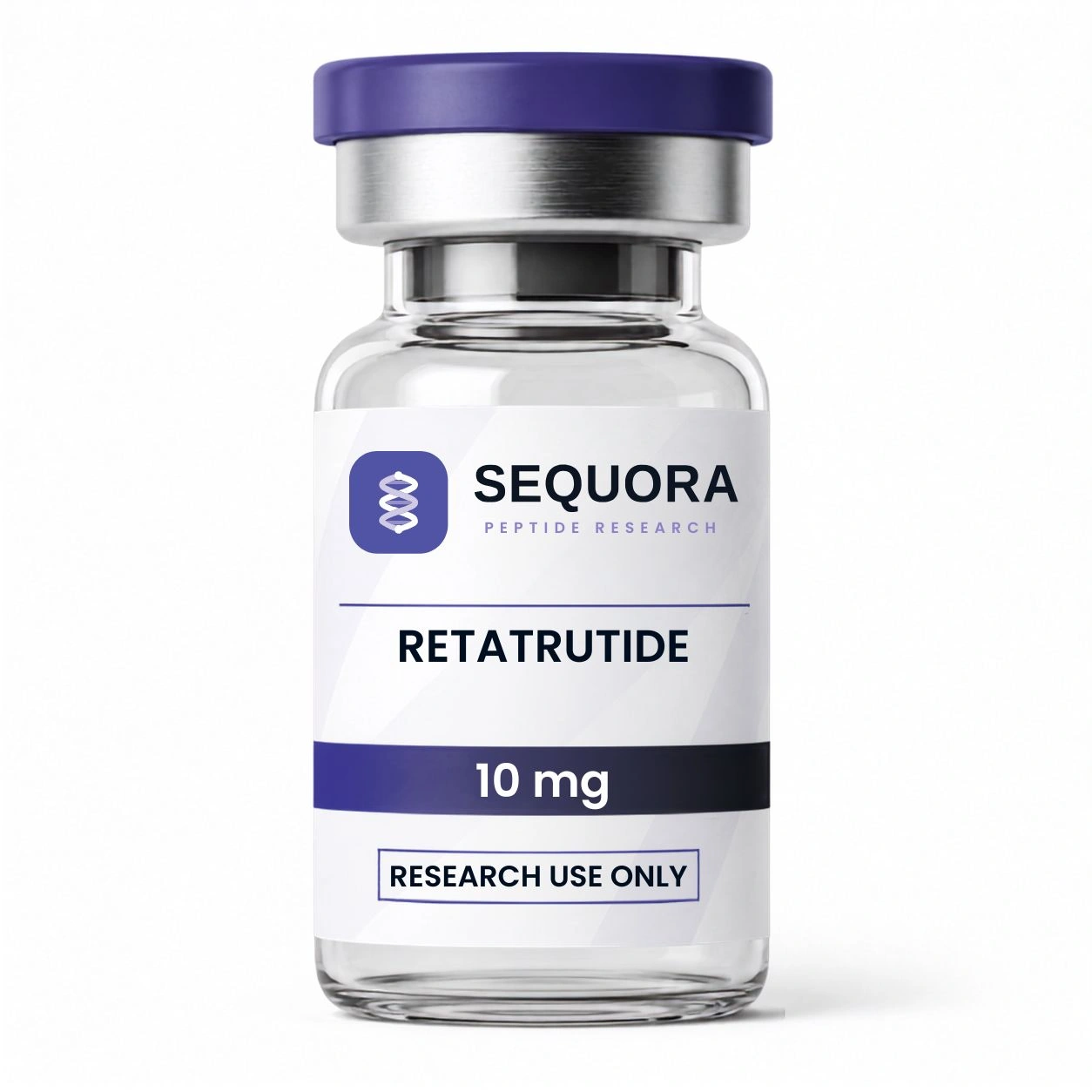
Retatrutide 10mg (LY3437943) is an investigational research peptide studied for its activity across three hormone receptors: GIP, GLP-1, and glucagon. Researchers have examined retatrutide extensively in controlled clinical and scientific research, making it an important subject in modern peptide research. Available from Sequora Peptides for research purposes.
| Molecular Formula | C223H343N45O68 |
|---|---|
| Molecular Mass | 4732.2 g/mol |
| Monoisotopic Mass | 4729.479100 g/mol |
| Polar Area | 2410 Ų |
| Complexity | 13200 |
| XLogP | -41.3 |
| Heavy Atom Count | 336 |
| Hydrogen Bond Donor Count | 74 |
| Hydrogen Bond Acceptor Count | 89 |
| Rotatable Bond Count | 186 |
Every batch is verified for identity and purity by an independent lab before release.
Scan your batch code to pull the full certificate — chromatogram included.
Material compromised in transit is replaced against the original procurement record.
Retatrutide (LY3437943) is an experimental synthetic peptide by Eli Lilly and Company designed to act as a triple hormone receptor agonist that works via activation of the GLP-1, GIP, and glucagon receptors. It is regarded as one of the most advanced peptides at the moment under investigation for obesity, type 2 diabetes mellitus, and other metabolic diseases.
In Phase 2 clinical trials, subjects lost up to 24.2% of their body weight over 48 weeks, depending on the dose. Following these impressive outcomes, researchers have advanced the peptide into Phase 3 studies. These ongoing trials are evaluating its long-term effects on body weight, glucose metabolism, energy expenditure, liver health, and overall cardiometabolic function.
However, despite all of the promising results found in clinical practice, Retatrutide is still an experimental peptide that has not received any regulatory approval for regular use. To purchase Retatrutide 10mg and get a trusted supplier of high-quality research peptide LY3437943, please consider ordering pure and third-party tested Retatrutide produced exclusively for laboratory research.
Retatrutide (LY3437943) is an innovative product produced by Eli Lilly and Company as a next-generation peptide that acts on the GLP-1, GIP, and glucagon receptors. The triple-receptor effect is a result of scientific research conducted by scientists in order to explore whether targeting several metabolic processes will lead to better outcomes compared to previous incretin therapy.
Before starting human clinical trials, Retatrutide was thoroughly tested preclinically for the assessment of receptor binding, pharmacokinetics, and metabolism. The study conducted by the group of researchers and published in the journal Cell Metabolism indicated a balanced agonist activity at the GLP-1, GIP, and glucagon receptors.
After receiving positive results in the preclinical phase of the research, scientists started human clinical Phase 1 trials, which were devoted to exploring safety and tolerability and determining the doses. The findings from this study served as the basis for further obesity and metabolic disease research.
The milestone was driven by the Phase 2 obesity trial results published in the New England Journal of Medicine (NEJM). Participants who received the highest doses achieved an average body weight reduction of up to 24.2% after 48 weeks, putting Retatrutide among the most effective investigational weight-management peptides studied to date. In addition, other health metrics such as waist circumference, blood pressure, and several cardiometabolic risk markers were also improved.
Currently, Retatrutide is undergoing evaluation as part of multiple Phase 3 clinical trials. Ongoing research programs funded by Eli Lilly involve evaluating this drug’s potential use in treating various disorders such as obesity, type 2 diabetes, metabolic dysfunction-associated steatotic liver disease (MASLD), obstructive sleep apnea, and other obesity related-complications.
These studies will offer further insight into the long-term safety profile and effectiveness of Retatrutide treatment. Researchers continue exploring how Retatrutide can affect various processes, including obesity & chronic weight management, type-2 diabetes, glucose metabolism, energy expenditure, metabolic dysfunction associated with steatotic liver diseases (MASLD), cardiometabolic health, body composition & waist circumference, along with various obesity-related complications.
Retatrutide shows promising results from these trials but remains an investigational drug. Further, additional Phase 3 studies are underway for a more detailed understanding of the long-term safety, effectiveness, and overall impact on patients.
Retatrutide is the first investigational compound developed to act on the GLP-1, GIP, and glucagon receptors at once. As mentioned in a study published in Cell Metabolism, the triply-acting compound is aimed at targeting different mechanisms related to the control of appetite, energy expenditure, glucose metabolism, and lipolysis. With all three hormone mechanisms combined in one molecule, scientists hope to observe more significant metabolic changes compared to monoreceptor and dual-receptor agonists.
According to research published in the New England Journal of Medicine, activation of the GLP-1 receptor leads to decreased appetite, delayed gastric emptying, and enhanced glucose-dependent insulin secretion. These processes result in decreased food intake and improved blood glucose regulation, thus representing an area of interest for contemporary obesity and diabetes research.
As reported in Cell Metabolism, activation of the GIP receptor can help to increase insulin secretion and enhance metabolic efficiency. Scientists are still conducting studies to understand how GIP receptor signaling contributes to the reduction of body weight along with the activation of other incretin pathways.
In contrast to the previous incretin treatments, Retatrutide also stimulates the activity of the glucagon receptor. Based on preclinical and clinical evidence reported in the journal Cell Metabolism, glucagon receptor activation can enhance energy expenditure and promote fat oxidation. Researchers think that this extra mechanism may be the cause of the drastic weight loss seen in clinical studies.
As indicated in the Phase 2 clinical study data reported in the New England Journal of Medicine, the combination of GLP-1, GIP, and glucagon receptor stimulation resulted in body mass loss along with improvement in cardiometabolic markers. Researchers keep studying how the activation of all three mechanisms is related to the metabolic benefits of triple receptor agonism that surpass those of single- and double-receptor mechanisms.
While these mechanisms are based on both preclinical and clinical evidence, Retatrutide is still an investigational peptide. Further Phase 3 trials will reveal the effect of triple receptor agonism on metabolic health and safety.
Retatrutide has undergone evaluation through preclinical research and human clinical trials. As early lab experiments proved the action of the triple-receptor agonist, clinical experiments confirmed its effects on body weight loss, blood glucose levels, and cardiometabolic health. The following is the list of the topics investigated to date.
While clinical results have been promising thus far, Retatrutide continues to be an investigational peptide. The ongoing Phase 3 TRIUMPH clinical program of Eli Lilly has been carrying out further studies for Retatrutide for obesity and metabolic diseases.
Retatrutide (LY3437943) is still under investigation as a peptide drug and has not been approved by the United States Food and Drug Administration (FDA) for treating conditions like obesity, type 2 diabetes, and other diseases. According to Eli Lilly, the drug is currently undergoing Phase 3 clinical trial programs known as TRIUMPH to test its safety and efficacy in treating metabolic diseases.
Since the drug development process is ongoing, Retatrutide has not been authorized for clinical use by any of the regulatory bodies, including the FDA, EMA, or MHRA. Scientific researchers have continued evaluating the possible benefits of Retatrutide via controlled clinical studies prior to making any regulatory decision regarding it.
Sequora Peptides’ 10 mg Retatrutide is produced only for research use (RUO). The product is meant for scientific studies in laboratories and should not be used for human consumption.
Storage is very important in order to ensure the stability of Retatrutide.
These are important storage recommendations that will help you preserve the quality of the peptide.
Retatrutide (LY3437943) is a research peptide that is under development by Eli Lilly and Company. Retatrutide is a triple receptor agonist that stimulates GLP-1, GIP, and glucagon receptors. Researchers are studying the efficacy of Retatrutide in various metabolic diseases, including obesity and type 2 diabetes.
Unlike Semaglutide, which stimulates GLP-1 receptors only, and Tirzepatide, which is a dual receptor that stimulates GLP-1 and GIP receptors, Retatrutide is also able to stimulate the glucagon receptor. Scientists believe that the triple action of Retatrutide can lead to better results in energy expenditure and weight reduction, but still, Phase 3 trials are underway.
No. Retatrutide has not been approved by the U.S. Food and Drug Administration (FDA) for therapeutic use.
Based on published and ongoing clinical trials, Retatrutide has been studied for:
No. Retatrutide 10mg from Square Peptides is produced for research use only (RUO). It is not for human consumption or clinical studies.
Retatrutide (LY3437943) is made available for research use only (RUO). This product is designed for scientific research purposes performed by experts and is not for human consumption or therapeutic uses.
Sequora Peptides is not involved in promoting or endorsing the usage of Retatrutide for diagnostic, therapeutic, and/or prevention of any diseases. Researchers should be in accordance with all applicable regulations regarding the acquisition, storage, and use of research products.
COA ✓
COA ✓
COA ✓
Oxytocin 5mg is a synthetic peptide studied in neuroendocrine signaling, receptor activity, and behavioral research. Supplied by Sequora Peptides strictly for laboratory research use only.
This site supplies chemicals strictly for laboratory research. You must confirm both statements below to enter.
Products are supplied for laboratory research use only and are not for human or veterinary use.