
Institutional accounts only · Pricing and quotes released after verified laboratory registration
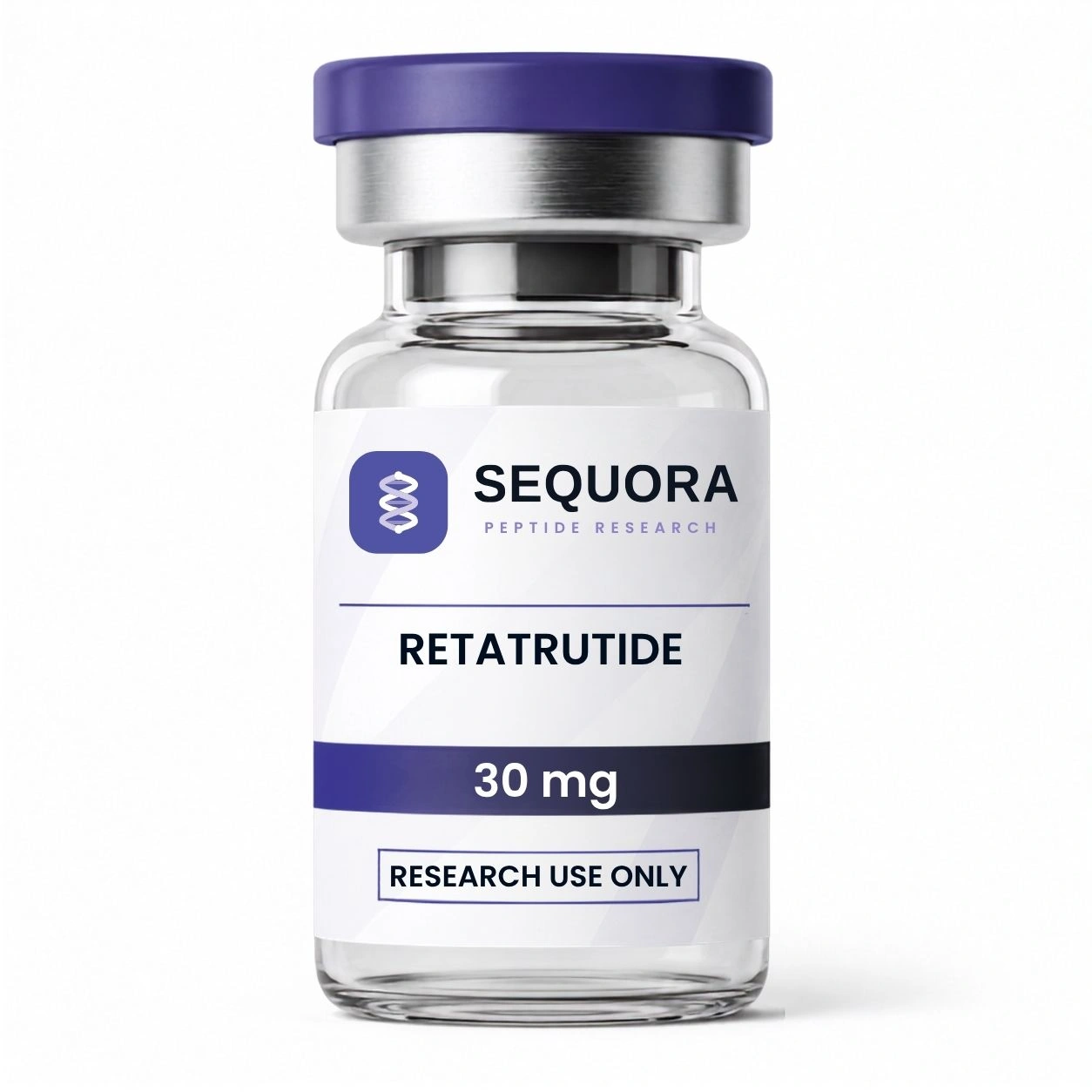
Retatrutide 30mg is an investigational triple-agonist peptide studied for GIP, GLP-1, and glucagon receptor activity. Sequora Peptides supplies Retatrutide 30mg strictly for laboratory research use.
| Molecular Formula | C223H343N45O68 |
|---|---|
| Molecular Mass | 4732.2 g/mol |
| Monoisotopic Mass | 4729.479100 g/mol |
| Polar Area | 2410 Ų |
| Complexity | 13200 |
| XLogP | -41.3 |
| Heavy Atom Count | 336 |
| Hydrogen Bond Donor Count | 74 |
| Hydrogen Bond Acceptor Count | 89 |
| Rotatable Bond Count | 186 |
Every batch is verified for identity and purity by an independent lab before release.
Scan your batch code to pull the full certificate — chromatogram included.
Material compromised in transit is replaced against the original procurement record.
Retatrutide, also known as LY3437943, is an investigational synthetic peptide with triple agonism of glucose-dependent insulinotropic polypeptide receptor (GIPR), glucagon-like peptide-1 receptor (GLP-1R), and glucagon receptor (GCGR). Retatrutide activates GIP, GLP-1, and glucagon receptors, producing an integrated pharmacological signal that influences appetite, glucose metabolism and energy balance. According to the research conducted by Jastreboff et al., in a randomized, phase II obesity trial, the administration of Retatrutide resulted in substantial weight loss over a 48-week period, in a dose-dependent manner.
Retatrutide 30 mg refers to the quantity of retatrutide contained in a particular research preparation. The 30 mg quantity itself does not establish a pharmacological effect or correspond to a clinically validated dose. Published clinical studies have evaluated substantially lower weekly doses, including 1, 4, 8, and 12 mg in the Phase 2 obesity program.
The phase 2 trial from Jastreboff et al. was dosed at 12mg once weekly, while Phase 3 development has evaluated weekly doses up to 12 mg in the pivotal obesity program reported to date.
| Specification | Details |
|---|---|
| Product Name | Retatrutide 30 mg |
| Research Compound | Retatrutide (LY3437943) |
| Peptide Type | Synthetic triple GIP/GLP-1/glucagon receptor agonist |
| Peptide Length | 39 amino acids |
| Chemical Form | Formulation-dependent; sodium-salt chemical records are available |
| Molecular Formula | C₂₂₁H₃₄₂N₄₆O₆₈ |
| Molecular Weight | 4,731.3 g/mol |
| Quantity | 30 mg |
| Appearance | Formulation-dependent; commonly supplied as a lyophilized research preparation |
| Purity | Research-grade quality |
| Research Status | Research Use Only |
Retatrutide was developed as a single-molecule triple agonist that activates the GIP, GLP-1, and glucagon receptors. Researchers designed this peptide to combine several metabolic signaling pathways within one molecule.
According to Sanyal et al., retatrutide is a modified peptide hormone linked to a fatty diacid. This structural modification helps extend its circulation time in the body and supports the prolonged pharmacokinetic profile seen in clinical research.
Early retatrutide research focused on its effects on glucose metabolism, body weight, safety, and pharmacokinetics. Later studies expanded into obesity, type 2 diabetes, and metabolic dysfunction-associated steatotic liver disease, or MASLD.
In a randomized clinical trial, Rosenstock et al. reported dose-dependent changes in body weight and glycemic measures in participants with type 2 diabetes. These findings helped expand scientific interest in retatrutide as a triple receptor agonist for metabolic research.
The mechanism of action of retatrutide involves three different receptors rather than a single target. Retatrutide activates the:
This combined activity is the main feature that separates retatrutide from single- or dual-receptor agonists.
Sanyal et al. reported that retatrutide has strong activity at the human GIP receptor while also activating the GLP-1 and glucagon receptors. Together, these receptor pathways are being studied for their roles in glucose regulation, appetite signaling, energy expenditure, and overall metabolic function.
The GIP receptor is one of the main targets of retatrutide. GIP is an incretin hormone involved in glucose-dependent insulin signaling and metabolic regulation.
Retatrutide was designed with strong activity at the human GIP receptor. Sanyal et al. reported that retatrutide showed greater potency at the human GIP receptor than endogenous GIP in cellular activity studies.
This GIP receptor activity is an important part of the peptide’s overall triple-agonist mechanism.
The GLP-1 receptor is the second receptor activated by retatrutide. GLP-1 signaling is widely studied for its role in glucose regulation, appetite, food intake, and gastrointestinal activity.
Retatrutide activates the GLP-1 receptor as part of its combined metabolic signaling profile. In the Phase 2 trial reported by Jastreboff et al., participants receiving retatrutide showed dose-dependent reductions in body weight over the study period.
These results demonstrate the biological activity of retatrutide’s combined receptor mechanism, although the effects cannot be attributed to GLP-1 receptor activation alone.
The glucagon receptor is the third part of the retatrutide triple-agonist mechanism. This receptor activity is one of the main features that distinguishes retatrutide from many earlier incretin-based compounds.
Glucagon signaling is involved in glucose metabolism, energy expenditure, and substrate utilization. Sanyal et al. described retatrutide as an agonist of the human GIP, GLP-1, and glucagon receptors.
Researchers are particularly interested in glucagon receptor activity because it may add another metabolic pathway to the effects already associated with GIP and GLP-1 signaling.
The main scientific interest in retatrutide comes from its integrated triple-receptor signaling. Instead of targeting only one metabolic pathway, retatrutide activates GIP, GLP-1, and glucagon receptors within a single molecule.
According to Jastreboff et al., adding glucagon receptor agonism to GIP and GLP-1 signaling may influence energy expenditure, substrate utilization, and other metabolic processes.
This combined mechanism is why retatrutide continues to be studied in areas such as obesity, glucose metabolism, type 2 diabetes, and other metabolic conditions.
Research Note: Retatrutide remains an investigational compound. It is not FDA-approved for human use, and research findings should not be interpreted as treatment recommendations. All the products available at Sequora Peptides are strictly for research studies.
Nowadays, the reduction of body weight is one of the most prominent effects of the drug candidate retatrutide. In the context of the Phase 2 obesity trial, Jastreboff et al. “reported mean reductions from baseline in body weight of 8.7% with 1 mg, 17.1% with 4 mg combined-dose groups, 22.8% with the 8-mg combined-dose groups, and 24.2% with 12 mg vs. 2.1% with placebo, at week 48”. Moreover, among the treatment-emergent adverse events, the most frequent events were related to gastrointestinal disturbances and were generally mild to moderate
However, the more relevant part of this study refers to the results of the Phase 3 trial that began in 2022. Eli Lilly announced the topline data from TRIUMPH-1, which revealed that patients who received 12 mg of retatrutide lost an average of 28.3% of their body weight after 80 weeks, whereas 45.3% of them reduced their body weight by 30%. Thus, the results of efficacy are promising, although these are investigational Phase 3 data, which do not confirm the 30 mg dose’s safety or effectiveness.
Retatrutide was also studied in patients with type 2 diabetes. Rosenstock et al. performed a randomized Phase 2 trial and found that compared to placebo and active control groups, retatrutide resulted in significant improvements in several glycemic metrics as well as reductions in body weight, thus supporting the exploration of the triple-receptor agonism concept beyond obesity.
The later Phase 3 data further support the drug’s metabolic properties. According to Eli Lilly’s announcement, in the TRANSCEND-T2D-1 trial, participants with type 2 diabetes experienced, on average, a 2.0% decrease in A1C and a 16.8% decrease in body weight, with the longest treatment duration being 40 weeks. This is, of course, preliminary topline data announced by the company ahead of the full results being published in a peer-reviewed journal. This is different from Rosenstock et al. (2023)’s trial, which has already been published in a peer-reviewed journal.
In addition to trials on obesity, the drug was tested on patients with MASLD (metabolic fatty liver disease). As reported by Sanyal et al., in a phase 2a randomized substudy, treatment with retatrutide for 24 weeks was associated with reductions in liver fat content from baseline versus placebo. Specifically, the decreases were observed in all the treatment groups: 42.9%, 57.0%, 81.4%, and 82.4%, for the 1, 4, 8, and 12 mg groups, respectively. In addition, 86% of the 12 mg group had less than 5% of liver fat at week 24.
The findings suggest that future research should be pursued to determine the drug’s impact on liver disease; however, the authors emphasize that their results are limited by a small number of MASLD patients and the lack of liver histology. Therefore, Sanyal et al. conclude that additional trials are required to establish retatrutide’s efficacy in treating liver disease.
Current retatrutide research includes:
The breadth of these applications reflects the combined GIP, GLP-1, and glucagon receptor activity of the molecule rather than evidence that every potential application has been clinically established. The study of Sanyal et al. provides evidence of significant reductions in liver fat in the studied population with MASLD, while the work by Jastreboff et al. describes the main findings of the phase II trial, proving efficacy in terms of body-weight reduction.
Retatrutide is an Investigational drug, and as of August 2026, it is not approved by the Food and Drug Administration (FDA) or other health authorities and regulators. According to Reuters, retatrutide was still in phase 3 trials as of August 2026 and had not been approved for use.
Accordingly, a Retatrutide 30 mg research preparation should not be represented as an approved medicine or as a clinically established 30 mg treatment. Clinical findings from lower-dose investigational studies cannot automatically be extrapolated to a 30 mg research preparation.
Storage should follow the validated specification for the particular retatrutide research formulation because peptide stability can vary according to formulation, concentration, excipients, moisture, temperature, and light exposure.
A universal post-reconstitution temperature or storage period should not be assigned without formulation-specific stability data.
It is a research formula that contains a certain amount of 30 mg of the peptide called retatrutide that is classified as an experimental agonist of the GIP, GLP-1, and glucagon receptors.
The peptide has been studied in the context of weight loss and weight control, obesity, type 2 diabetes, metabolic liver disease, and a number of other obesity-related conditions.
No. Published clinical trials have studied substantially lower doses, with 12 mg being the highest dose in the major Phase 2 and currently reported Phase 3 programs. Jastreboff et al. evaluated doses up to 12 mg in the Phase 2 obesity trial.
Retatrutide acts by simultaneously activating GIP, GLP-1, and glucagon receptors, producing an integrated metabolic signal. According to the work of Jastreboff et al. (2023), the drug is a triple hormone-receptor agonist.
If supplied as an RUO research preparation, it is intended solely for laboratory research and should not be represented as a human-use pharmaceutical product.
Retatrutide 30 mg, when supplied as a research substance, is for Research Use Only (RUO). Therefore, it is provided for laboratory research purposes only as an RUO and must not be represented or distributed as an approved pharmaceutical product, an approved clinical dose of 30 mg, or as a product for human consumption.
COA ✓

COA ✓

COA ✓
TB-500 10mg is a synthetic peptide studied in cell migration, tissue repair pathways, and actin-related biological research. Supplied by Sequora Peptides strictly for laboratory research use only.
This site supplies chemicals strictly for laboratory research. You must confirm both statements below to enter.
Products are supplied for laboratory research use only and are not for human or veterinary use.