
Institutional accounts only · Pricing and quotes released after verified laboratory registration
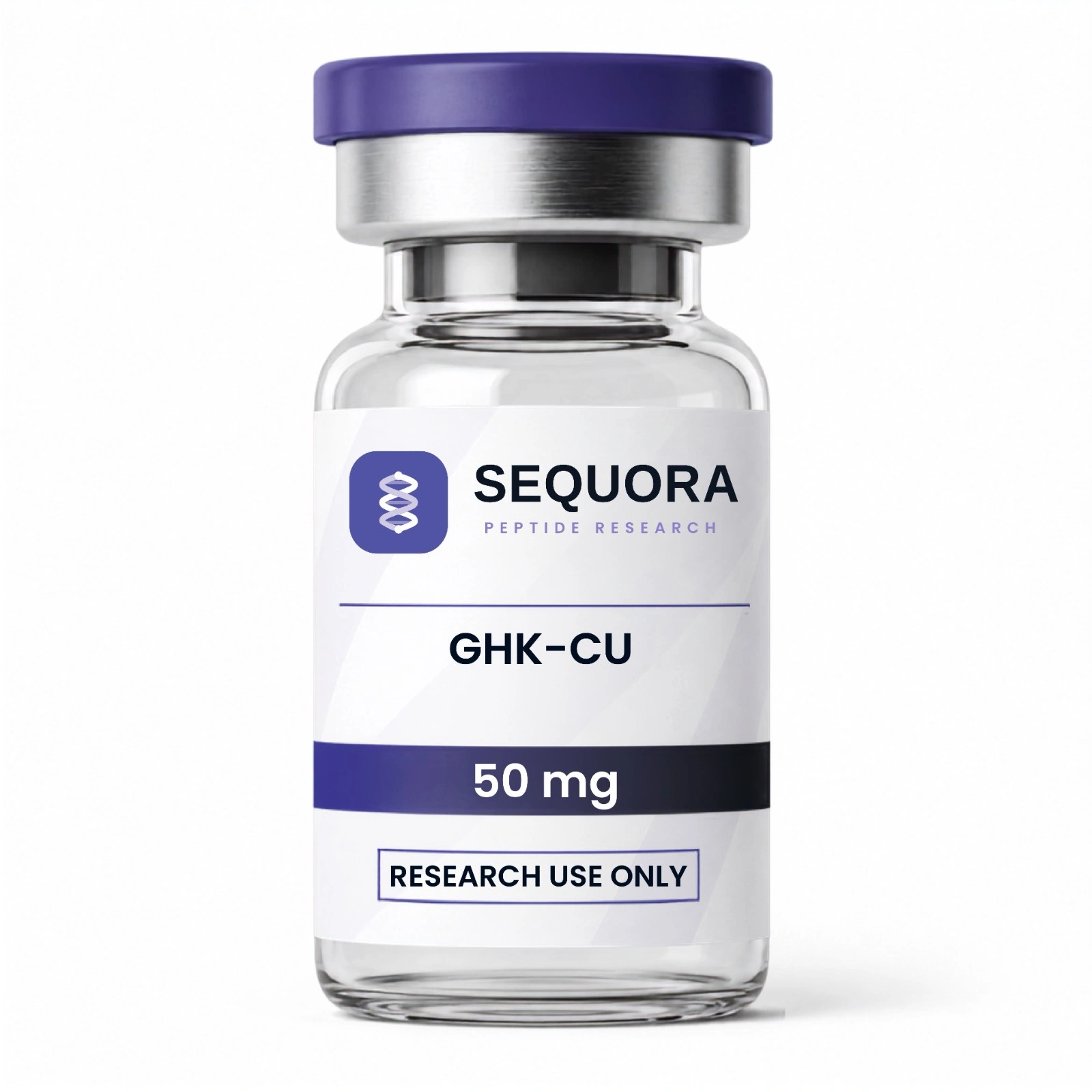
With a research history spanning decades, GHK-Cu 50mg has been investigated for its role in cellular signaling, tissue-related processes, and peptide biology. Researchers continue to study this copper-binding peptide in controlled laboratory settings. Offered by Sequora Peptides for research purposes.
| Molecular Formula | C14H22CuN6O4 |
|---|---|
| Molecular Mass | 401.91 g/mol |
| Monoisotopic Mass | 401.099850 g/mol |
| Polar Area | 178 Ų |
| Complexity | 445 |
| XLogP | -4.8 |
| Heavy Atom Count | 25 |
| Hydrogen Bond Donor Count | 5 |
| Hydrogen Bond Acceptor Count | 7 |
| Rotatable Bond Count | 10 |
Every batch is verified for identity and purity by an independent lab before release.
Scan your batch code to pull the full certificate — chromatogram included.
Material compromised in transit is replaced against the original procurement record.
GHK-Cu, also known as copper tripeptide and copper glycyl-L-histidyl-L-lysine, is the copper-dependent form of the naturally occurring tripeptide glycyl-L-histidyl-L-lysine (GHK). GHK was discovered in human plasma and possesses a high affinity for copper ions, which led to the formation of the GHK-Cu complex.
The studies of GHK were mainly devoted to connective tissue biology, fibroblast biology, extracellular matrix regulation, wound healing, and skin biology. Maquart et al. discovered that GHK-Cu stimulated collagen synthesis in cultured fibroblasts, thus being the first experimental evidence of its participation in extracellular matrix processes.
The biological interest in GHK-Cu was generated by the studies devoted to GHK, copper, and tissue remodeling. Experimental investigations were performed to study collagen synthesis, glycosaminoglycan synthesis, fibroblast activity, matrix metalloproteinases, and wound healing. Maquart et al. revealed the increase in collagen synthesis in fibroblast cultures treated with GHK-Cu, while Siméon et al. demonstrated the influence of GHK-Cu on extracellular matrix, type I collagen, and glycosaminoglycans in wound models.
GHK-Cu 50 mg refers to a defined quantity of the copper tripeptide prepared for laboratory research. The amount itself does not establish a particular biological effect, and research findings obtained with specific concentrations, formulations, or administration methods should not automatically be extrapolated to every 50 mg research preparation.
GHK-Cu has been identified as a result of studying GHK and its properties related to copper binding. GHK is a relatively small tripeptide, which consists of glycine, histidine, and lysine, and according to databases, it can be regarded as a natural peptide that can form complexes with copper ions. Pickart and Margolina discuss various experiments related to the regenerative and protective properties of GHK and GHK-Cu in terms of their impact on the production of extracellular matrix, the behavior of fibroblasts, healing, and inflammation.
The initial laboratory experiments were based on collagen production and the role of fibroblasts in the wound. In particular, Maquart et al. state that GHK-Cu promoted collagen production in fibroblasts at low concentrations.
The subsequent studies went beyond collagen and started exploring the process of extracellular matrix remodeling. According to Maquart et al., GHK-Cu stimulated the production of matrix metalloproteinase-2 and tissue inhibitor of metalloproteinase in dermal fibroblast cultures, implying that GHK-Cu might regulate not only collagen synthesis but matrix remodeling as well.
Cellular actions of GHK-Cu were mostly studied in fibroblasts and other cells associated with tissue maintenance and repair. Fibroblasts represent major producers of collagen and other components of the extracellular matrix and therefore are widely used as an experimental model to study the actions of GHK-Cu.
Pollard et al. examined GHK-Cu on growth and proliferation of normal and irradiated human dermal fibroblasts. The experiments showed that GHK-Cu enhanced growth rate and increased the production of basic fibroblast growth factor and vascular endothelial growth factor in irradiated fibroblasts.
GHK-Cu was also studied in connection with wound-related extracellular matrix formation. According to Siméon et al., GHK-Cu administration in experimental wounds increased the levels of type I collagen and glycosaminoglycans.
This means that GHK-Cu was studied within different biological mechanisms and not within one single pathway. Nevertheless, actions observed in cell cultures or animal models cannot be considered as proof of similar actions in humans.
Research involving GHK-Cu includes:
The diverse applications in experimentation can be attributed to the role played by GHK-Cu in various processes that maintain tissues. Pickart & Margolina provided a review of research regarding the effects of GHK on collagen, elastin, glycosaminoglycans, fibroblast function, wound healing, and protection of cells.
GHK-Cu mechanism of action is quite complicated and cannot be simplified to one type of receptor-mediated process. GHK represents a tripeptide with high potential for copper ion binding, which leads to the formation of the copper-peptide complex studied for its influence on extracellular matrix metabolism, activity of fibroblasts, growth factor production, inflammation pathways, and remodeling processes. According to Pickart & Margolina, there are many cellular pathways involved in GHK-related biological activity.
The GHK peptide is made up of three amino acids: glycine, histidine, and lysine. This type of molecule is capable of forming complexes with copper ions. The ability to bind copper ions is important in the biological study of GHK-Cu since the copper-bound form has been studied independently from the non-complexed molecule. According to Pickart and Margolina, GHK-Cu is a biologically active copper-peptide complex with various influences in different cellular functions. In addition, the chemical databases recognize GHK-Cu as distinct from other forms of the molecule and copper complexes.
The synthesis of collagen is among the important topics researched in the early laboratory studies of GHK-Cu. In cell culture studies, Maquart et al. found that GHK-Cu promotes collagen synthesis. Such results have provided experimental proof of the link between GHK-Cu and the synthesis of the extracellular matrix. This has made GHK-Cu the subject of further studies of connective tissue and its regulation.
It is also possible to study GHK-Cu in relation to extracellular-matrix turnover and not only collagen synthesis. Simeon et al. have found in dermal fibroblast experiments that GHK-Cu promotes MMP-2 synthesis along with changes in tissue inhibitors of metalloproteinases, namely TIMP-1 and TIMP-2. Such results show that GHK-Cu can influence various substances responsible for extracellular-matrix remodeling.
The role of fibroblasts and growth factor production has also been considered as part of the GHK-Cu study. The fibroblast is a very significant cell in the connective tissue system since it helps in the formation of the extracellular matrix. According to the work of Pollard et al., it was found that irradiated human fibroblasts showed growth in numbers as well as the early production of bFGF and VEGF after GHK-Cu application.
This experiment provides the basis for the use of GHK-Cu studies on fibroblast and growth factor signaling in cellular systems. But it should be noted that cell culture experiments cannot be regarded as evidence of efficacy in clinical conditions.
Also, the inflammatory and immune response pathways have been studied in the laboratory setting with respect to GHK-Cu. Specifically, the peptide was evaluated for possible impact on gene expression associated with inflammatory response and tissue homeostasis. Pickart and Margolina provided an overview of laboratory findings that suggest the possible effect of GHK-Cu on gene expression and inflammatory signaling.
It is especially important to note that inflammatory signaling is intimately related to extracellular matrix turnover and tissue repair. However, the observed effects are dependent upon the experimental conditions in which GHK-Cu was tested. Thus, it is important not to call these findings evidence of an anti-inflammatory effect but to consider them experimental observations only.
Tissue repair and wound healing mechanisms form yet another field where the use of GHK-Cu has been studied. Research experiments involving GHK-Cu have been carried out to study its effects on fibroblast activity, extracellular matrix production, growth factor expression, and several other related activities that occur during tissue remodelling. Pollard et al. observed the influence of GHK-Cu on the growth and growth factor production of irradiated fibroblasts, whereas Maquart et al. showed increased collagen production in cultured fibroblasts.
Overall, such findings give biological rationale for future research involving GHK-Cu as a factor in wound healing and tissue remodelling systems. It should be noted, though, that cell- and experiment-based evidence does not prove the ability of GHK-Cu to exhibit the same effects on human beings.
The effect of GHK-Cu on skin has drawn considerable attention since collagen, elastin, glycosaminoglycans, and fibroblast function play an important role in the formation of skin tissue. Studies in animals have looked into the potential for GHK-Cu to influence these physiological processes.
In vitro effects of collagen induction were observed by Maquart et al. In addition, Siméon et al. found that application of GHK-Cu led to increased production of type I collagen and glycosaminoglycans in experimentally induced wounds.
There is relatively little research conducted on humans. One such randomized study was performed by Miller et al. in people who had undergone CO₂ laser resurfacing. There was no statistically significant difference observed in erythema healing or objectively measured wrinkles and skin quality. Still, there was a trend toward greater patient satisfaction in the group receiving GHK-Cu treatment.
This example shows the importance of separating experimental from clinical research. The former may reveal biological effects that do not necessarily prove that a specific topical preparation yields clinically valuable effects.
Wound healing is another research topic for GHK-Cu. Various experimental studies have studied the effect of GHK-Cu on fibroblast activity, collagen synthesis, glycosaminoglycan synthesis, and extracellular matrix restructuring in the process of tissue repair.
Thus, Siméon et al. noted enhanced production of wound tissues, enhanced production of type I collagen and glycosaminoglycans after GHK-Cu administration in experimental conditions.
Similar results were achieved by Pollard et al. (2005) who observed the effect of GHK-Cu on the growth and growth factor production of irradiated human dermal fibroblasts in vitro.
These experimental results suggest further laboratory study of the effects of GHK-Cu in wound biology; however, they do not indicate that GHK-Cu research product is an approved wound treatment product.
The experimental basis of GHK-Cu consists primarily of laboratory and preclinical research involving extracellular-matrix remodeling, fibroblast activity, wound biology, and growth-factor expression. Siméon et al. demonstrated that GHK-Cu increased MMP-2 expression and the secretion of TIMP-1 and TIMP-2 in cultured dermal fibroblasts, supporting its investigation in extracellular-matrix remodeling.
Human clinical research remains limited. In a randomized study following CO₂ laser resurfacing, Miller et al. found no significant differences in erythema resolution, wrinkles, or objectively assessed skin quality between GHK-Cu and control groups, although patient-reported satisfaction was higher in the GHK-Cu group.
Current research involving GHK-Cu includes:
The diversity of these applications reflects the peptide’s interaction with several biological processes. Pickart and Margolina summarized evidence connecting GHK-related activity with tissue remodeling, cellular protection, extracellular-matrix production, and repair mechanisms.
GHK-Cu 50 mg, referred to as a research-grade compound, should not be confused with the drug that has been approved by the relevant authorities. The classification and permitted uses of the compound, as well as its regulation, depend on the location, formulation, and use. Findings of experiments with GHK-Cu cannot be taken to imply its approval for treatment of any illness.
Storage shall follow the validated specification of the specific research formulation since the stability of peptides may vary according to formulation, concentration, additives, temperature, moisture, light, and many other environmental factors.
It is impossible to assign a universal temperature and storage period to each and every GHK-Cu 50 mg preparation after reconstitution.
GHK-Cu 50 mg stands for a particular amount of copper-bound tripeptide GHK that has been researched mainly for connective tissue, fibroblast, extracellular matrix, skin, and wound healing studies.
Studies include collagen synthesis, fibroblast biology, extracellular matrix remodeling, wound-healing models, growth factor expression, and skin biology.
Scientific evidence confirms such biological activity in certain models. Maquart et al. proved induction of collagen synthesis in cultured fibroblasts treated with GHK-Cu.
A general clinical statement cannot be made based on existing scientific evidence. Human trials have provided controversial results, and experimental data should not be regarded as clinically proven therapy.
The storage should meet the specifications for the particular preparation that needs to be protected from moisture, heat, light, and any kind of temperature changes.
If provided as a research-use-only (RUO preparation, it is intended for laboratory research purposes only and is not supposed to be presented as a human-use product.
All products sold by Sequora Peptides are intended strictly for research purposes only. They are not intended for human or veterinary use, consumption, diagnosis, treatment, or any other clinical application.
COA ✓
COA ✓

COA ✓
TB-500 is a synthetic research peptide related to thymosin beta-4 and is studied for its role in cell migration, tissue repair pathways, and angiogenesis. It is intended strictly for laboratory research and is not approved for human or veterinary use.
This site supplies chemicals strictly for laboratory research. You must confirm both statements below to enter.
Products are supplied for laboratory research use only and are not for human or veterinary use.