
Institutional accounts only · Pricing and quotes released after verified laboratory registration
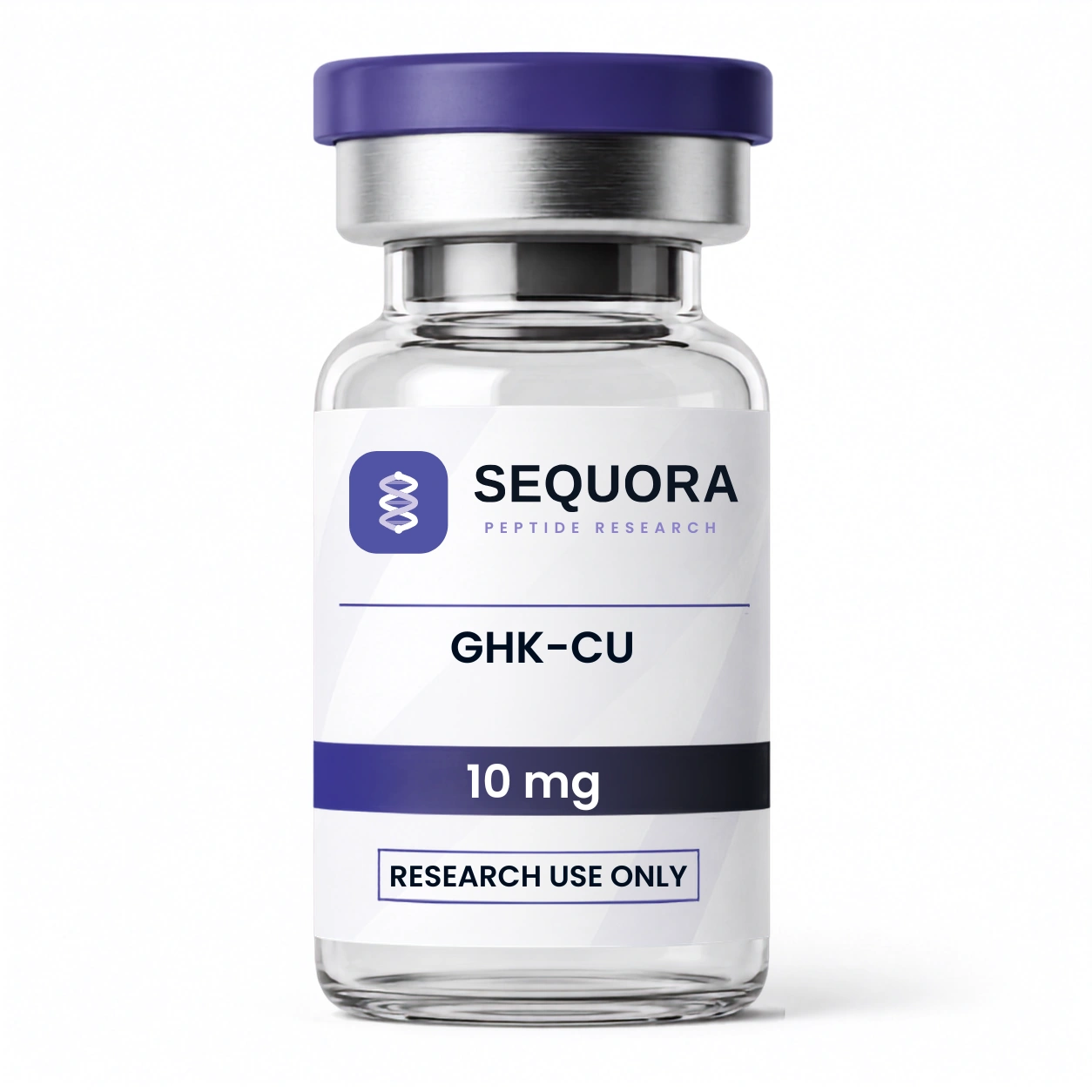
GHK-Cu 10mg is a copper-binding tripeptide widely studied in cellular repair, extracellular matrix activity, and peptide signaling research. Intended strictly for laboratory research use only.
| Molecular Formula | C14H22CuN6O4 |
|---|---|
| Molecular Mass | 401.91 g/mol |
| Monoisotopic Mass | 401.099850 g/mol |
| Polar Area | 178 Ų |
| Complexity | 445 |
| XLogP | -4.8 |
| Heavy Atom Count | 25 |
| Hydrogen Bond Donor Count | 5 |
| Hydrogen Bond Acceptor Count | 7 |
| Rotatable Bond Count | 10 |
Every batch is verified for identity and purity by an independent lab before release.
Scan your batch code to pull the full certificate — chromatogram included.
Material compromised in transit is replaced against the original procurement record.
GHK-Cu (Glycyl-L-Histidyl-L-Lysine Copper) is a naturally occurring tripeptide bound to copper discovered by Dr. Loren Pickart in human plasma during his research at the University of California, San Francisco (UCSF) in the early 1970s. The peptide has since become one of the most widely studied copper peptides in the field of regenerative medicine as researchers study the role of the peptide in tissue regeneration, skin biology, wound healing, hair follicles, and cell regeneration.
In the process of studying its biological effects, scientists found that the level of GHK-Cu declines with age, leading them to conduct further studies on the effect of GHK-CU on maintaining healthy tissues. According to “Regenerative and Protective Actions of the GHK-Cu Peptide in the Light of the New Gene Data” published in the International Journal of Molecular Sciences, GHK-Cu regulates the expression of about 4,000 human genes, including genes responsible for collagen formation, extracellular matrix remodeling, antioxidant protection, inflammation, and tissue regeneration.
The ability of GHK-Cu to regenerate has been confirmed by prior studies. As noted in The Human Tripeptide GHK and Tissue Remodeling in the Journal of Biomaterials Science, Polymer Edition, GHK-Cu is essential in tissue remodeling since it helps in collagen production, cell-to-cell communication, and extracellular matrix maintenance under laboratory settings.
GHK-Cu is still being studied today in laboratory and clinical studies regarding skin aging, wound healing, hair biology, and regenerative medicine. Although findings from studies published so far are promising, scientists are still researching the molecular mechanism, safety, and other uses of GHK-Cu through various scientific studies.
If you need GHK-Cu 10mg or a reliable supplier of research-grade GHK-Cu, Sequorapeptide.com manufactures high-quality GHK-Cu and is third-party tested only for laboratory use.
GHK-Cu has been the subject of investigation for over 50 years, which makes it one of the most researched copper peptides for use in regenerative medicine. Since the time of its discovery, various roles of this peptide in wound healing, skin regeneration, hair growth, inflammation, antioxidative effects, and tissue remodeling have been examined. Most of what we know about GHK-Cu is based on the work done in laboratory and animal experiments, as well as on clinical studies.
The history of scientific exploration of GHK-Cu dates back to 1973, when Dr. Loren Pickart discovered this tripeptide in human blood plasma while investigating factors responsible for tissue regeneration and healthy aging. His studies revealed the high affinity of GHK for copper ions, which allows it to form GHK-Cu – a naturally occurring complex with multiple biological functions.
One of the most important discoveries in the field of GHK-Cu occurred many years later. In the article entitled “Regenerative and Protective Actions of the GHK-Cu Peptide in the Light of the New Gene Data,” which was published in the International Journal of Molecular Sciences, scientists discovered that GHK-Cu affects the expression of about 4,000 human genes. These genes include those that are responsible for the synthesis of collagen, antioxidation, inflammation, remodeling, and regeneration of tissues.
In the article published in BioMed Research International, GHK-Cu showed biological properties related to collagen synthesis, wound healing, angiogenesis, and remodeling of the extracellular matrix in experimental settings.
At present, GHK-Cu is being studied in several areas within biomedical sciences, namely:
While the evidence obtained thus far is promising, most of the information regarding mechanisms involved comes from experiments performed in laboratories and preclinical studies. Further clinical research is required to determine the biological activity of GHK-Cu.
Unlike most of the research peptides, GHK-Cu is a natural copper peptide that can be found in human blood, saliva, and urine. Its bioactivity is explained by the ability to bind copper ions and control several cellular processes such as tissue regeneration, inflammation, antioxidant effects, and extracellular matrix remodeling. As was mentioned in Regenerative and Protective Actions of the GHK-Cu Peptide in the Light of the New Gene Data in the International Journal of Molecular Sciences, GHK-Cu controls the expression of thousands of human genes responsible for regeneration and cellular repair.
The best-known function of GHK-Cu is the ability to take part in collagen production and extracellular matrix remodeling. As stated in BioMed Research International, GHK-Cu stimulates collagen synthesis and fibroblast activity and promotes extracellular matrix organization.
There is a very strong relationship between GHK and copper ions that makes it possible for scientists to explore its functions in the processes of copper transportation and cell protection. In the article Regenerative and Protective Actions of the GHK-Cu Peptide in the Light of the New Gene Data, it was revealed that GHK-Cu has shown antioxidant activity by affecting the mechanisms connected with oxidative stress and cell protection.
As stated in the article The Human Tripeptide GHK and Tissue Remodeling in the Journal of Biomaterials Science, Polymer Edition, GHK-Cu stimulates cell signaling responsible for tissue remodeling, wound healing, and the maintenance of the extracellular matrix.
Another special feature of GHK-Cu is the impact it has on gene expression. A study conducted in the International Journal of Molecular Sciences found that GHK-Cu is associated with 4,000 human genes, with genes responsible for inflammatory reactions, antioxidant response, tissue repair, and regeneration of cells among others. Further research continues to discover the roles played by GHK-Cu in all this.
Though all these mechanisms have been tested in laboratory and pre-clinical studies, further human studies are required to explore the biological effects of GHK-Cu in humans.
GHK-Cu has been researched in the lab, animal, and human studies for more than 50 years. Most of the published research is centered around the use of the copper peptide for skin regeneration, wound healing, hair biology, and tissue remodeling. Some of the research that presents the key results is presented below.
A study published in BioMed Research International proves that GHK-Cu stimulates collagen production, fibroblast activity, and extracellular matrix remodeling.
The Human Tripeptide GHK and Tissue Remodeling – research published in the Journal of Biomaterials Science, Polymer Edition proved that GHK-Cu shows biological activity related to tissue remodeling, angiogenesis, and wound healing.
Scientists have researched GHK-Cu in relation to hair follicles. According to a researcher, GHK-Cu exhibits biological activity connected to hair follicle biology and scalp health.
Numerous clinical trials involving humans have been conducted using GHK-Cu treatments for skin health and photoaging. According to a study published in the Journal of Drugs in Dermatology, patients observed positive changes in their skin after treatment; however, the researchers stressed that more extensive controlled trials should be conducted.
These results are indeed promising; however, the compound still needs more investigation.
While a significant portion of the literature available on GHK-Cu has come from laboratory research, there are certain studies involving human participants that have assessed the effects of GHK-Cu on dermatological and cosmetic subjects.
An article featured in the Journal of Drugs in Dermatology reported that topical formulations of GHK-Cu have helped improve the texture, elasticity, and appearance of fine lines. In addition, histology has shown that GHK-Cu could increase collagen production and dermal remodeling.
In another study, published in BioMed Research International, the researchers reviewed both the laboratory evidence and human literature to establish GHK-Cu’s efficacy in skin repair and regeneration.
Despite all this evidence, the majority of the human research has focused on the topical applications of GHK-Cu instead of the injectable variety.
GHK-Cu is a naturally existing copper peptide that is being studied extensively in various areas of research on regeneration and skin diseases. As indicated by ClinicalTrials.gov, there have been numerous clinical trials that studied the effect of GHK-Cu on skin health, wound healing, and tissue regeneration.
As of now, GHK-Cu has not been approved by the Food and Drug Administration (FDA) as a prescription medicine for the treatment, cure, or prevention of any medical condition. Although studies support further scientific research due to the biological potential of GHK-Cu, more extensive and large-scale trials are required to prove its safety and efficacy.
GHK-Cu 10mg produced by Sequora Peptides is available for research purposes only (RUO). It is for scientific research and is not intended for human use.
Correct storage aids in the stability of GHK-Cu during laboratory studies.
These recommendations help preserve peptide quality and support reliable research outcomes.
GHK-Cu (Glycyl-L-Histidyl-L-Lysine Copper) is a naturally occurring tripeptide containing copper that was discovered by Dr. Loren Pickart in human plasma. In Regenerative and Protective Actions of the GHK-Cu Peptide in the Light of the New Gene Data, in the International Journal of Molecular Sciences, GHK-Cu has been extensively researched in connection with wound healing, tissue repair, collagen synthesis, and skin regeneration.
Scientists have researched GHK-Cu in studies related to skin aging, wound healing, hair follicle biology, extracellular matrix remodeling, and regenerative medicine. Despite all the promising results, scientists are still studying its biological function and application possibilities in laboratory and clinical trials.
No. GHK-Cu has not been FDA-approved as a prescription drug to treat, cure, or prevent any illness in the United States. The GHK-Cu 10 mg provided by Square Peptides is RUO only.
No. The substance is produced for laboratory and scientific research purposes only. It is not meant for internal usage, treatment purposes, or self-application.
The lyophilized peptide needs to be stored at 2°C–8°C (36°F-46°F). After it is dissolved, it needs to be kept under refrigeration, repeated freezing/thawing avoided, and proper sterile laboratory methods used to ensure peptide stability.
GHK-Cu 10mg is supplied for Research Use Only (RUO). This product is meant for laboratory research use by trained personnel and should not be ingested or taken as treatment or therapy under any circumstances.
Sequora Peptides does not claim that GHK-Cu can be used to diagnose, treat, cure, or prevent any diseases. It is the sole responsibility of the researchers to ensure that all purchases, handling, storage, and usage of this product comply with all legal requirements.
This product should only be used under laboratory conditions by trained scientists.

COA ✓

COA ✓
TB-500 10mg is a synthetic peptide studied in cell migration, tissue repair pathways, and actin-related biological research. Supplied by Sequora Peptides strictly for laboratory research use only.
COA ✓
This site supplies chemicals strictly for laboratory research. You must confirm both statements below to enter.
Products are supplied for laboratory research use only and are not for human or veterinary use.