
Institutional accounts only · Pricing and quotes released after verified laboratory registration
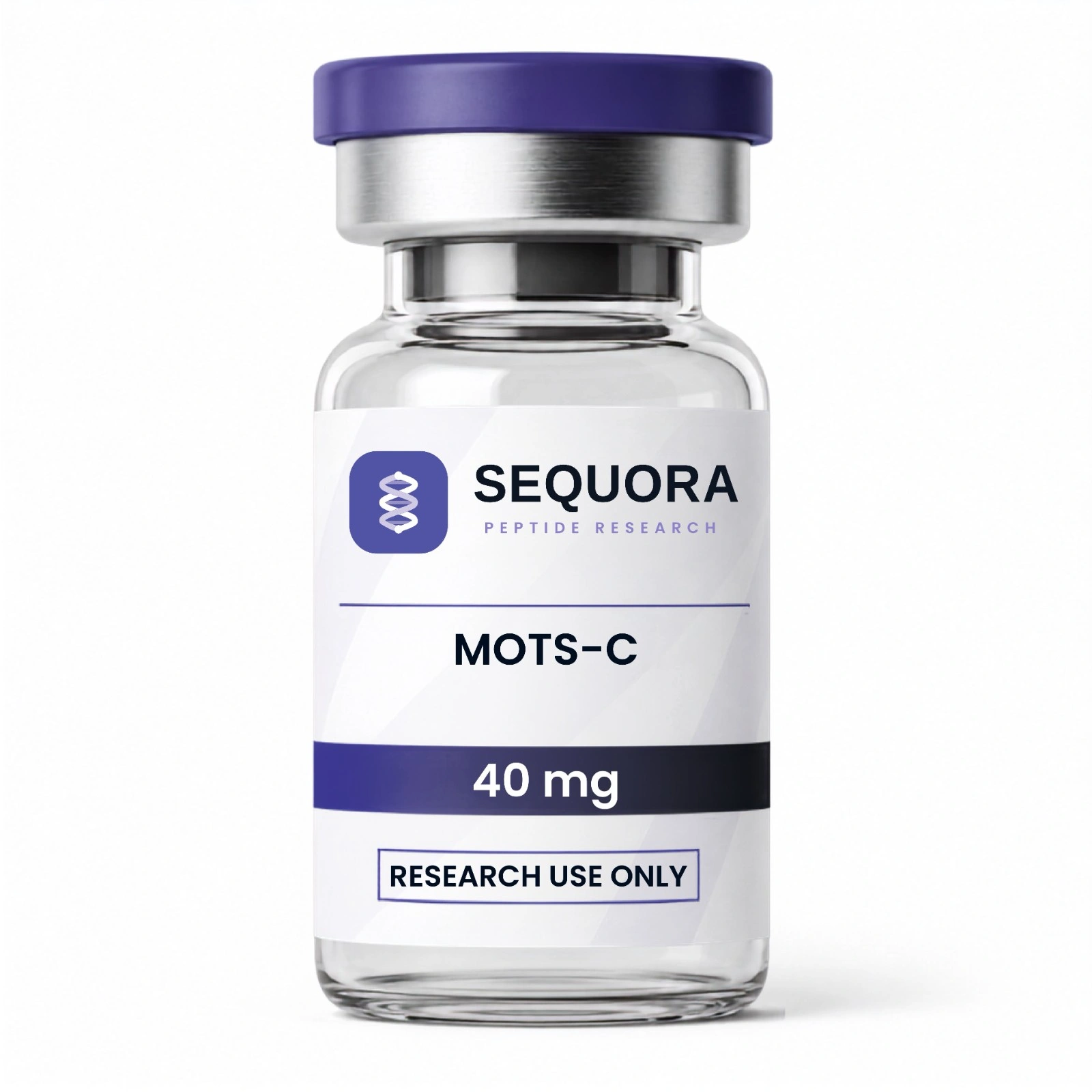
Researchers have shown growing interest in MOTS-C 40mg, a mitochondrial-derived peptide studied for its relationship with cellular metabolism and energy regulation. Research continues to examine MOTS-C and its role in metabolic and mitochondrial pathways. Available from Sequora Peptides for laboratory research.
| Molecular Formula | C101H152N28O22S2 |
|---|---|
| Molecular Mass | 2174.6 g/mol |
| Monoisotopic Mass | 2173.104261 g/mol |
| Polar Area | 895 Ų |
| Complexity | 4450 |
| XLogP | -14.2 |
| Heavy Atom Count | 153 |
| Hydrogen Bond Donor Count | 32 |
| Hydrogen Bond Acceptor Count | 34 |
| Rotatable Bond Count | 52 |
Every batch is verified for identity and purity by an independent lab before release.
Scan your batch code to pull the full certificate — chromatogram included.
Material compromised in transit is replaced against the original procurement record.
MOTS-C 40mg is a research-grade mitochondrial-derived peptide available from Sequora Peptides for laboratory research purposes. MOTS-C, short for mitochondrial open reading frame of the 12S rRNA-c, is a 16-amino-acid peptide encoded within the mitochondrial 12S rRNA region. Unlike most biologically active peptides, which are encoded by nuclear DNA, MOTS-C originates from mitochondrial DNA, making it an important subject in mitochondrial signaling and metabolic research.
Scientific interest in the MOTS-C peptide increased after researchers identified its potential role in communication between mitochondria and other cellular systems. In a landmark study, Lee et al. described MOTS-C and investigated its involvement in metabolic homeostasis and insulin sensitivity. Since then, researchers have examined MOTS-C in areas including glucose metabolism, skeletal muscle metabolism, cellular stress responses, AMPK signaling, exercise adaptation, adipocyte function, and aging-related biological pathways.
Further research has expanded our understanding of MOTS-C as a mitochondrial signaling peptide rather than a molecule associated with a single biological target. Zheng et al. reviewed the available scientific literature and discussed its investigated roles in metabolic regulation, exercise physiology, mitochondrial function, and cellular responses to metabolic stress.
At Sequora Peptides, MOTS-C 40mg is supplied specifically for controlled laboratory and research applications. The 40mg quantity refers only to the amount of peptide provided and should not be interpreted as evidence of therapeutic effectiveness, clinical safety, or an established dosage. Researchers should evaluate factors such as peptide identity, sequence, purity, formulation, and analytical documentation when selecting MOTS-C for experimental work.
Research Use Only: MOTS-C 40mg from Sequora Peptides is intended strictly for laboratory research and is not approved for human or veterinary use.
| Specification | Details |
|---|---|
| Product Name | MOTS-C 40 mg |
| Peptide Name | MOTS-c / Mitochondrial open reading frame of the 12S rRNA-c |
| Peptide Type | Mitochondrial-derived peptide |
| Peptide Length | 16 amino acids |
| Sequence | MRWQEMGYIFYPRKLR |
| Molecular Formula | C₁₀₁H₁₅₂N₂₈O₂₂S₂ |
| Molecular Weight | 2174.6 g/mol |
| Research Quantity | 40 mg |
| Research Status | Research Use Only (RUO) |
The discovery of MOTS-c began from studies involving mitochondrial DNA, in which a search for novel bioactive peptides was performed. It is known that earlier, humanin was discovered as a mitochondrial-derived peptide; thus, searching for new short open reading frames coding bioactive molecules became important. Lee et al. discovered a short open reading frame within mitochondrial 12S rRNA, coding for an unknown 16-amino acid peptide called MOTS-c, and the study described its involvement in metabolic regulation.
The first experiments were mostly done in the field of metabolic homeostasis and muscle tissue. Lee et al. reported that MOTS-c influenced the folate cycle and linked de novo purine biosynthesis with activation of AMP-activated protein kinase (AMPK), a major cellular energy-sensing pathway. In mice, treatment with MOTS-c prevented insulin resistance associated with aging and high-fat feeding and reduced diet-induced obesity in the experimental models studied. These findings established an important preclinical basis for investigating MOTS-c in metabolic research, although animal findings cannot automatically be extrapolated to humans.
Research on MOTS-c has focused particularly on cellular energy metabolism. Experimental evidence indicates that skeletal muscle is an important tissue in which MOTS-c-related metabolic effects have been examined. According to Lee et al. MOTS-c’s effect on metabolic pathways concerning folate metabolism and AMPK activation gave a biochemical explanation of MOTS-c’s effects on glucose metabolism.
More research was done to establish if MOTS-c affects metabolic processes other than glucose metabolism. According to Kim et al., in mice, MOTS-c positively affected insulin sensitivity and the plasma metabolic pathways involving sphingolipids, monoacylglycerol, and dicarboxylate metabolism. In addition, their study found that MOTS-c treatment resulted in increased beta-oxidation and decreased fat deposition in obese mice induced by diet.
Work has also been conducted regarding MOTS-c in adipose tissue. Lu et al. found that MOTS-c treatment in ovariectomized mice led to less weight gain and insulin resistance, with brown-fat activation being increased. The investigators further reported that AMPK inhibition attenuated some of the observed metabolic effects, supporting a role for AMPK-associated signaling in that experimental model.
Current research involving MOTS-c includes:
The diversity of these areas reflects the broad experimental interest in mitochondrial-derived peptides. Nevertheless, results from individual models may not be generalizable to describe an overall biological mechanism. In their review about MOTS-c and its link to aging and aging-related disorders, Mohtashami et al. highlighted the nascent state of knowledge on the biological mechanisms of MOTS-c.
However, the specific mode of action of MOTS-c is yet to be fully understood. Existing literature suggests that the biological function of MOTS-c might be mediated by a number of metabolic pathways other than the receptor-mediated mechanism. According to Lee et al., these pathways include the blockage of the folate cycle, modification of purine synthesis, increased levels of AICAR, and finally, the activation of AMPK.
AMPK is an important player when it comes to sensing the energy state in a cell. MOTS-c has been studied in relation to this pathway because of the effects it has on energy metabolism. Lee et al. have demonstrated experimental evidence of the link between MOTS-c and AMPK.
The MOTS-c peptide has been intensely studied using numerous animal models of insulin resistance. In a study by Lee et al., it was found that the administration of MOTS-c increased insulin sensitivity and prevented insulin resistance in aged mice and mice fed a high-fat diet.
Other studies have been done on skeletal muscle. According to Reynolds et al. MOTS-c improved physical performance and affected the metabolism of skeletal muscles, metabolic stress adaptation in myoblasts, and metabolic and proteostatic genes in mice. This study has also indicated that the expression of MOTS-c in skeletal muscle and circulation in humans was regulated by exercise.
Experimental work involving humans has thus examined whether circulating MOTS-c levels change with exercise. D’Souza et al. investigated the impact of acute exercise on plasma and muscle MOTS-c concentrations in humans. While these results validate research on MOTS-c as a mitochondria-derived exercise-responsive peptide, they do not provide proof that MOTS-c administered from the outside causes the same physiological effect.
A lot of research into MOTS-c is still pre-clinical, including research involving mice for metabolic disorders, obesity, insulin resistance, adipose tissue biology, skeletal muscle metabolism, and exercise capacity. In particular, Lee et al. found protection from diet-induced obesity and insulin resistance, and more recent experimental research looked at the role of MOTS-c in lipid metabolism and metabolic adaptations.
Furthermore, research on MOTS-c has been carried out on muscle atrophy and metabolic dysfunctions. Kumagai et al. have found that MOTS-c was negatively correlated with myostatin levels in humans, and MOTS-c had an impact on muscle cell atrophy in myotubes and obese mice in a diet-induced obesity experiment. The impact was mediated through the following pathways: AKT, FOXO1, mTORC2, and PTEN.
Finally, aging may be considered yet another significant sphere for further research. According to Reynolds et al., the intermittent use of MOTS-c led to enhanced physical performance and healthspan indices in aging mice. Besides, the research discovered a link between MOTS-c and skeletal muscle metabolism and stress response. Nevertheless, this information does not confirm any anti-aging properties of MOTS-c in humans.
Human research on MOTS-c has mostly focused on endogenous levels of circulation, exercise effects, and relationship with metabolic status instead of clinical administration. Ramanjaneya et al. found that lipid infusion elevated levels of circulating MOTS-c in human subjects and that insulin reduced some of these effects, thus indicating that MOTS-c levels can change based on metabolic status in human beings.
It should be noted that human biological findings are distinct from evidence on the safety or efficacy of the drug through human administration. In the FDA’s 2026 briefing, it was reported that the literature review carried out by the agency did not find any study where the use of compounded MOTS-c or MOTS-c acetate had been done in human beings. Thus, the clinical relevance of human findings could not be defined.
Some of the current experimental studies using MOTS-c involve metabolic homeostasis, insulin resistance, skeletal muscle physiology, exercise physiology, fat cell metabolism, mitochondrial signaling, and age-related loss of physical ability. Zheng et al. stated that MOTS-c is a mitochondrial-derived peptide that could have physiological implications in both metabolic and exercise physiology. However, further studies should be conducted before such biological effects are used therapeutically.
MOTS-c 40 mg is to be considered as experimental research material rather than an FDA-approved drug product. FDA briefing materials of July 2026 clarify that neither MOTS-c nor MOTS-c acetate is in FDA-approved drug products and there is limited nonclinical information for in vitro and rodent studies only. FDA (2026) has identified limited human safety and efficacy data and suggested that bulk drug substances related to MOTS-c not be listed on the 503A Bulks List.
Short introduction paragraph stating that storage will depend on the specific research-grade formulation and validated stability data from the manufacturer/lab.
MOTS-C 40 mg means a research amount of the 16-amino acid mitochondrial-derived peptide called MOTS-C. 40 mg indicates the amount of research material and is not an indication of a dose.
The scientific study of MOTS-C is on metabolic homeostasis, insulin sensitivity, glucose metabolism, skeletal muscle biology, exercise adaptation, adipose metabolism, and aging. Lee et al. set many of these research areas by conducting experiments on metabolic homeostasis and insulin resistance.
There has been experimental evidence to suggest that the metabolic pathway for folate metabolism, purine biosynthesis, AICAR, and AMPK activation is the mode of action of MOTS-c. Lee et al. have established the experimental basis for the mode of action.
No. FDA (2026) has stated that neither MOTS-c nor MOTS-c acetate are ingredients of an FDA-approved drug. In addition, there is inadequate data about the safety and effectiveness of the drug in humans.
As a Research Use Only (RUO) formulation of the drug, MOTS-C 40 mg is meant for research only.
MOTS-C 40 mg is supplied as a Research Use Only (RUO) reagent for appropriate laboratory use.
It must not be promoted as an FDA-approved drug substance, a clinically tested therapy, or a substance that can be ingested by humans. The scientific literature to date comprises robust preclinical data, whereas the human data is still lacking and fails to provide any proof of safety and efficacy of the exogenous administration of MOTS-c. According to the FDA (2026), there was insufficient safety and efficacy data on MOTS-c drug substances in humans.

COA ✓
Tesamorelin 10mg is a synthetic GHRH analog studied for growth hormone signaling, endocrine function, and metabolic research. Supplied by Sequora Peptides strictly for laboratory research use only.

COA ✓
NAD+ is a naturally occurring coenzyme widely studied in cellular energy metabolism, mitochondrial function, and redox biology. Supplied strictly for laboratory research use only and not approved for human use.
COA ✓
This site supplies chemicals strictly for laboratory research. You must confirm both statements below to enter.
Products are supplied for laboratory research use only and are not for human or veterinary use.