
Institutional accounts only · Pricing and quotes released after verified laboratory registration
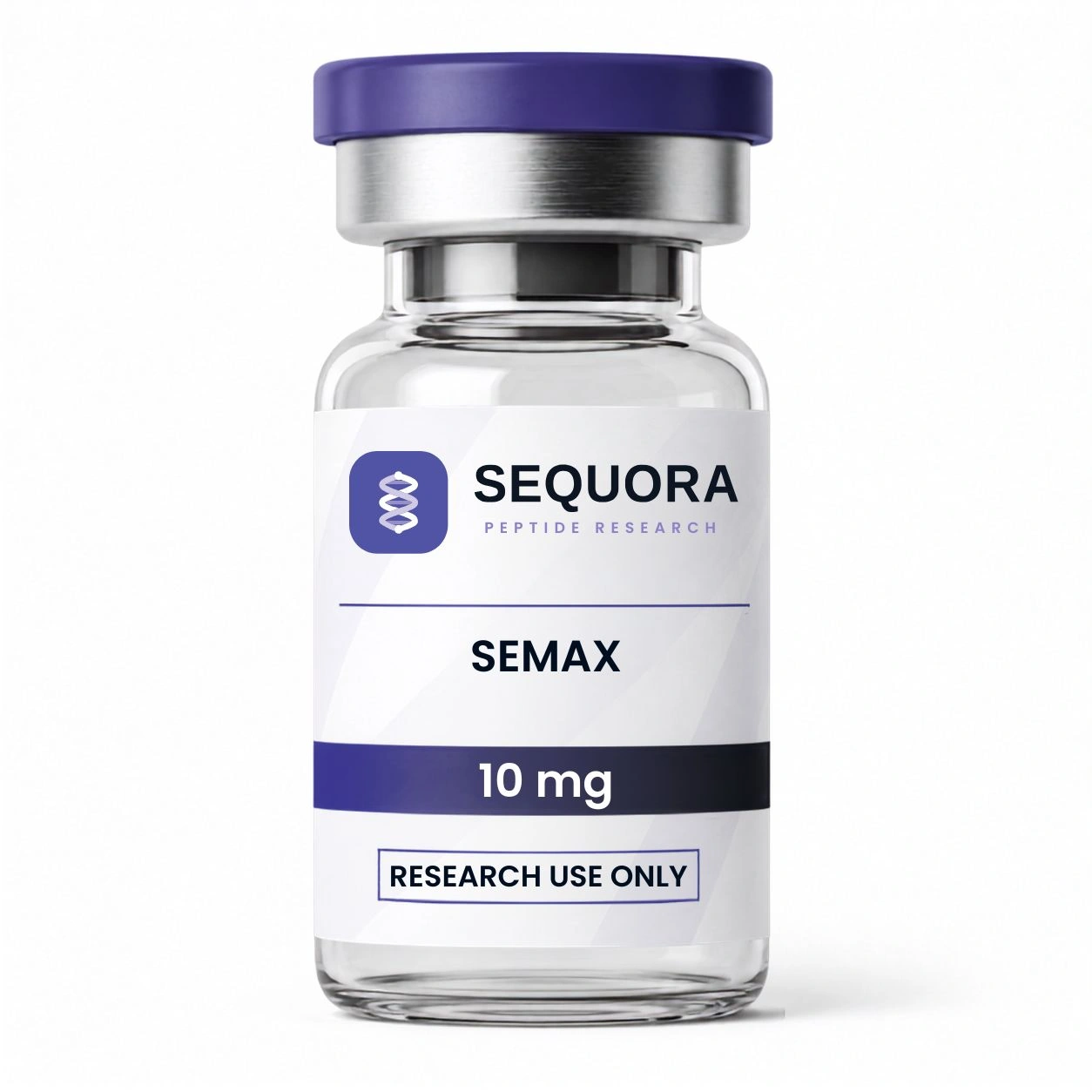
Semax 10mg is a synthetic research peptide studied for its activity in neurological, cognitive, and neuroprotective research models. Each vial is intended strictly for laboratory research use only and is not for human use.
| Molecular Formula | C37H51N9O10S |
|---|---|
| Molecular Mass | 813.9 g/mol |
| Monoisotopic Mass | 813.347963 g/mol |
| Polar Area | 304 Ų |
| Complexity | 1490 |
| XLogP | -3.1 |
| Heavy Atom Count | 57 |
| Hydrogen Bond Donor Count | 9 |
| Hydrogen Bond Acceptor Count | 11 |
| Rotatable Bond Count | 16 |
Every batch is verified for identity and purity by an independent lab before release.
Scan your batch code to pull the full certificate — chromatogram included.
Material compromised in transit is replaced against the original procurement record.
Semax is a synthetic heptapeptide with the amino acid sequence Met-Glu-His-Phe-Pro-Gly-Pro. It was developed from the N-terminal region of adrenocorticotropic hormone (ACTH) and is commonly described as an analogue of ACTH(4–10). Structurally, Semax contains the ACTH(4–7) sequence linked to a Pro-Gly-Pro (PGP) tripeptide. This modification was designed to improve peptide stability while preserving its neurobiological activity.
Scientific research on Semax dates back several decades. An early review by Ashmarin et al. (1997) described the development and investigation of Semax as an ACTH-derived regulatory peptide. Since then, researchers have studied Semax in areas such as neuropeptide signaling, neuronal adaptation, cognitive neuroscience, cerebral ischemia, neurotrophic signaling, and peptide pharmacology.
A major area of Semax research involves its relationship with neurotrophic factors. Experimental studies in animal models have examined its effects on brain-derived neurotrophic factor (BDNF) and nerve growth factor (NGF), two signaling proteins involved in neuronal survival, synaptic plasticity, and nervous-system adaptation.
For example, Dolotov et al. (2006) reported changes in BDNF and TrkB expression in the rat hippocampus following Semax exposure. Other experimental research has reported changes in BDNF and NGF gene expression in different regions of the rat brain, further supporting scientific interest in Semax and neurotrophic signaling.
Semax has also been investigated in experimental models of cerebral ischemia, oxidative stress, neuronal injury, inflammatory signaling, and neuroprotection. These studies have helped researchers explore how synthetic regulatory peptides may influence gene expression and cellular responses within the nervous system.
Over the past several decades, Semax has therefore become a subject of laboratory, animal, and limited clinical research involving:
Despite the existing research, the complete molecular mechanisms associated with Semax remain under investigation, and additional controlled studies are needed to clarify its biological activity across different experimental systems.
Researchers looking to buy Semax 10mg can obtain research-grade Semax from Sequora Peptides, with batch documentation available for quality verification. Semax 10mg is supplied strictly for controlled laboratory research and analytical applications.
Research Use Only: Semax 10mg is intended exclusively for laboratory research. It is not intended for human or veterinary use.
| Characteristics | Details |
| Product Name | Semax 10mg |
| Peptide Sequence | Met-Glu-His-Phe-Pro-Gly-Pro |
| Molecular Formula | C₃₇H₅₁N₉O₁₀S |
| Molecular Weight | 813.93 g/mol |
| Synonyms | ACTH (4–7)-Pro-Gly-Pro |
| PubChem CID | 9811102 |
| CAS Number | 80714-61-0 |
| Peptide Length | 7 amino acids (Heptapeptide) |
| Appearance | White to off-white lyophilized powder |
| Purity | Research-grade quality |
| Solubility | Sterile water or bacteriostatic water for laboratory research |
| Storage | Refrigerated (2°C–8°C); long-term storage at −20°C |
| Research Use | Research Use Only (RUO) |
The peptide has been studied for several decades now in such areas of science as neuroscience, neuropharmacology, and biochemistry of peptides. Designed as a synthetic analog of the ACTH (4–10) fragment, the compound has caught the attention of scientists owing to its effects on the regulation of neurotrophic factors, neuroprotective properties, and gene expression. After its development at the Institute of Molecular Genetics of the Russian Academy of Sciences, the compound has helped advance scientific understanding of its biological activity in numerous laboratory and clinical studies.
The peptide was developed in the 1997s by Professor Ivan Ashmarin and colleagues as a synthetic analog of the ACTH (4–10) fragment with the addition of a Pro-Gly-Pro tripeptide fragment. This modification was aimed at making the peptide stable yet maintaining its biological activity (Ashmarin & Kamensky, 1997).
One of the most important breakthrough studies carried out by Medvedeva et al. (2014) focused on the gene expression alterations that happen under the influence of Semax in experimental cerebral ischemia. The study revealed that Semax is capable of regulating various genes that control neurotrophic signaling, inflammation, and neuron adaptability. Some previous experiments conducted by Medvedeva and colleagues had shown an increase in the expression of some neurotrophic factors such as BDNF and NGF; thus, this fact also contributed to scientific interest in Semax as a research peptide.
At present, the peptide is still studied in various fields of science, namely:
Despite the promising results achieved experimentally, further investigation is necessary in order to understand the mechanism of action of the peptide.
Despite the fact that the mechanism of Semax’s action is not yet fully understood, laboratory experiments have shown that the effects of the peptide involve numerous molecular processes responsible for neuronal signaling, rather than neurotransmission. Some of these are regulation of neurotrophic factors, gene expression, oxidative stress response, and neurotransmitter systems. All these mechanisms remain under investigation in the course of laboratory studies.
One of the most well-researched effects of Semax on the brain is connected with its influence on neurotrophic signaling. The results of the experiments conducted by Dolotov et al. (2006) and Medvedeva et al. (2014) have shown that Semax increases the expression of genes related to BDNF and NGF in the case of experimental cerebral ischemia. Since these factors are responsible for neuronal survival and plasticity, as well as for adaptive processes within the nervous system, Semax can be used as an instrument in research on neurotrophic regulation.
Transcriptomic analysis has revealed that Semax is capable of affecting the expression of a wide range of genes responsible for inflammation, stress, apoptosis, and neural tissue regeneration. According to Medvedeva et al. (2014), the compound is capable of affecting different signaling pathways after experimentally induced ischemia, which indicates that its action is not limited to a single target.
Several laboratory experiments have been conducted to examine if Semax affects the neurotransmitter systems in the central nervous system. It has been found through experiments that the effects of Semax may be linked with modulation of dopaminergic, serotonergic, and glutamatergic signaling pathways responsible for learning and memory formation. These findings have placed Semax in the spotlight of research in the field of cognitive neuroscience and peptide pharmacology (Ashmarin & Kamensky, 1997; Dolotov et al., 2006).
Oxidative stress has been found to be one of the major factors associated with the development of neuroinjury and aging in the nervous system. Experimental research has been done to investigate whether Semax exerts any effect on antioxidant defenses and adaptation in conditions of oxidative stress. Some preclinical studies have described oxidative stress biomarker changes after Semax administration, although further studies are needed to elucidate the molecular mechanisms. Therefore, oxidative stress is a hot topic for Semax studies.
Semax has undergone various tests using laboratory experiments, animals, and a few clinical trials in Russia. Published literature has studied the biological effects of Semax regarding neuroprotective, neurotrophic signaling, cerebral ischemia, oxidative stress, and cognitive functions. Although numerous results have been found to contribute to the knowledge of Semax biology, further international clinical studies are required to confirm these results.
The other area of Semax research is related to its neuroprotective effects. According to experimental studies conducted by Medvedeva et al. (2014), Semax regulates the genes that are associated with inflammatory response, neuron survival, and tissue adaptation after experimental cerebral ischemia. Thus, Semax can be considered an essential research peptide in the field of neuroprotection.
Several laboratory experiments have been conducted in order to explore the effects of Semax on the neurotrophic factors. In the study by Dolotov et al. (2006), it was found that Semax affects the increased expression of brain-derived neurotrophic factor (BDNF) and nerve growth factor (NGF).
In addition, studies have been conducted regarding the influence of Semax on the oxidative stress system in nervous tissue. In pre-clinical trials, changes were observed in terms of the oxidative stress system and the antioxidant defense system following treatment with the peptide. While these results are still promising, more research needs to be done to uncover the molecular mechanisms behind them (Sudarkina et al., 2021).
Very few human studies, carried out by Russian scientists, have explored the biological effects of Semax in neurophysiological conditions. While promising results have been obtained, most of the research was done using small sample sizes. Therefore, further randomized multicenter clinical trials need to be performed in order to draw scientific conclusions.
Further research is ongoing for Semax in various aspects of neuroscience and peptides. The current areas of investigation include:
While a great number of lab tests have proven to be successful, further research is ongoing to determine the exact mechanisms behind the results obtained.
Even after more than three decades of scientific research, there is still much to know about Semax since several major biological aspects of this drug are yet to be clarified. Even though various experiments have shown the presence of neurotrophic signaling, gene expression, and neuronal adaptation, some of these data need further validation via larger independent experiments.
The scientific community is currently researching several important issues, such as:
Thus, the answers to these questions will provide additional insight into the Semax biological activity.
It is presently considered an experimental research peptide in various parts of the world and is currently being studied in various laboratory and clinical research settings.
Presently, Semax is not approved by the Food and Drug Administration (FDA) of the United States or by the European Medicines Agency (EMA) for any kind of diagnosis, treatment, cure, or prevention of diseases. Hence, Semax provided by research peptide companies is meant only for laboratory research purposes.
Semax 10mg provided by Sequora Peptide is provided for Research Use Only (RUO) and is not meant for human or animal use.
Proper storage ensures the stability and integrity of Semax during laboratory testing.
Semax is a heptapeptide synthesized using the modification of the ACTH (4–10) fragment and introduction of the Pro-Gly-Pro moiety into the sequence. The substance has been studied extensively in the sphere of neuroscience with a view to the effect of neurotrophic signaling, neuroprotection, and cognitive biology.
Semax is used in scientific studies associated with the problems of neuroprotection, cerebral ischemia, learning and memory, neurotrophic factors, oxidative stress, neuroinflammation, and peptide pharmacology. Despite numerous positive results obtained in the lab environment, more studies are still needed.
No. Semax is not approved by the U.S. Food and Drug Administration (FDA) for the treatment, prevention, and/or diagnosis of any diseases.
Lyophilized Semax 10mg should be stored at 2°C to 8°C, whereas vials meant for long-term storage may be stored at −20°C. Once the drug is dissolved, it should be refrigerated, and the solution should be protected from freeze-thaw cycles.
No. Semax 10mg from Sequora Peptide is meant exclusively for research purposes.
Semax 10mg produced by Sequora Peptide is designed for research purposes only. The product is to be used for scientific study purposes only by professional researchers and lab experts.
The product is not meant for oral administration, veterinary use, diagnosing, treating, curing, or preventing any disease. No claims about the potential therapeutic uses of the research peptide can be made by Sequora Peptide.
It is the responsibility of researchers to follow all relevant legislation and regulations concerning buying, storing, handling, and usage of research materials.
COA ✓
COA ✓

COA ✓
This site supplies chemicals strictly for laboratory research. You must confirm both statements below to enter.
Products are supplied for laboratory research use only and are not for human or veterinary use.