
Institutional accounts only · Pricing and quotes released after verified laboratory registration
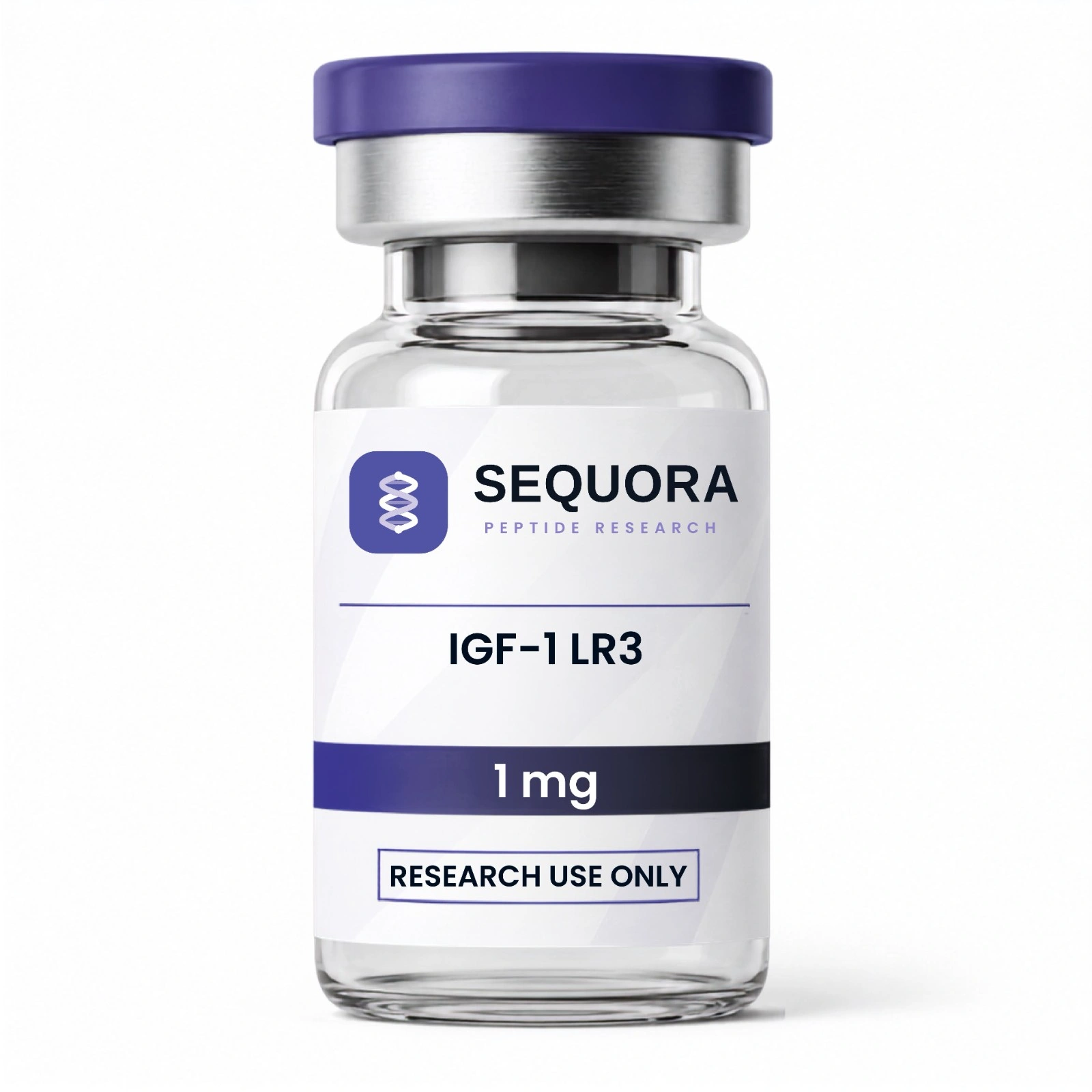
IGF-1 LR3 1mg is a modified form of insulin-like growth factor-1 studied in research involving cell growth, signaling, and metabolic pathways. Its extended activity makes IGF-1 LR3 a subject of interest in laboratory research. Available from Sequora Peptides for research purposes.
| Molecular Formula | C400H625N111O124S9 |
|---|---|
| Molecular Mass | 9111 g/mol |
| Monoisotopic Mass | 9105.340000 g/mol |
| Polar Area | 4120 Ų |
| Complexity | 24500 |
| XLogP | -82.1 |
| Heavy Atom Count | 644 |
| Hydrogen Bond Donor Count | 142 |
| Hydrogen Bond Acceptor Count | 172 |
| Rotatable Bond Count | 330 |
Every batch is verified for identity and purity by an independent lab before release.
Scan your batch code to pull the full certificate — chromatogram included.
Material compromised in transit is replaced against the original procurement record.
Insulin-like growth factor-1 Long R3 (IGF-1 LR3), also known as Long R3 IGF-I or Long Arg3 IGF-I, is a modified analogue of human insulin-like growth factor-1 (IGF-1) that has been investigated primarily in experimental cell culture, molecular biology, and animal research. The molecule was developed by modifying the structure of native IGF-I to alter its interaction with IGF-binding proteins (IGFBPs) while retaining activity at the type 1 IGF receptor (IGF-1R). Recombinant IGF-I analogs having substituted third position residues were characterized by King et al., and the production of such analogs was reported after expression in E. coli.
IGF-1 LR3 is different from normal IGF-1 due to the substitution of arginine in position 3 and the extra N-terminal extension. The differences were studied since IGFBPs are known to regulate the availability and activity of IGF peptides. Francis et al. reported that alterations involving the third residue and related structural modifications could substantially reduce IGF-binding-protein interactions while retaining receptor-related biological activity.
The designation “1 mg” refers to the nominal quantity of material in a research preparation and does not represent a clinically established therapeutic dose. IGF-1 LR3 1 mg, described as a Research Use Only (RUO) material, should therefore be regarded as an experimental research reagent rather than an approved therapeutic product.
| Specifications | Details |
| Product Name | IGF-1 LR3 1 mg |
| Peptide | Long R3 Insulin-Like Growth Factor-1 (IGF-1 LR3) |
| Peptide Length | 83 amino acids |
| Molecular Weight | Approximately 9.1 kDa |
| Modification | Substitution of Arg for Glu at position 3 and addition of a 13-amino-acid N-terminal extension |
| Research Quantity | 1 mg |
| Form | Typically supplied as a lyophilized research material |
| Research Use | Research Use Only (RUO) |
The development of IGF-I analogues was based on the observation that the biological behavior of IGF-I is influenced not only by receptor binding but also by its association with IGFBPs. These proteins can bind circulating IGFs and modify their distribution, clearance, and access to receptors. Researchers therefore investigated modified IGF-I molecules designed to reduce this binding.
King et al. prepared analogs of IGF-I where the amino acid in position 3 was replaced by arginine or glycine from glutamic acid, and their physiological actions were determined, providing the foundation for subsequent research on R3-IGF-I.
Further work examined combinations of structural changes. The Long R3 form incorporates both the Arg3 modification and an N-terminal extension. Francis et al. demonstrated that changes in IGF-I structure could alter the relative contribution of receptor binding and IGFBP binding to the biological potency of the analogue.
Native human IGF-I is a peptide growth factor whose biological actions are mediated principally through IGF-1R. Long R3 IGF-I retains the core IGF-I structure while incorporating two principal modifications: an N-terminal extension of 13 amino acids and replacement of the third amino acid with arginine. The resulting molecule contains 83 amino acids rather than the 70 amino acids of mature native IGF-I.
According to King et al., recombinant IGF-I analogs that include the R3 substitution were successfully made, and they proved to be recombinant proteins that can be studied in terms of their biological properties (King et al., 1992).
The importance of the structural alteration is most noticeable in its connection with the binding to IGFBPs. According to Prelle et al., Long R3 IGF-I has at least three orders of magnitude lower affinity for IGFBPs in comparison with native IGF-I.
This is due to the fact that IGFBPs regulate IGFs through binding to IGF peptides, affecting their mobility, bioavailability, and receptor binding. Thus, reduced binding by IGFBPs is a key experimental feature of Long R3 IGF-I.
Ballard et al. reported that IGF-I displayed substantially greater affinity for IGFBP-3, IGFBP-4, rat plasma IGFBPs, and L6 myoblast binding proteins than LR3IGF-I, while the reduced association with IGFBPs was accompanied by greater biological activity in cultured L6 myoblasts.
This observation provides an important explanation for why LR3 can behave differently from native IGF-I in experimental systems containing IGFBPs. The difference does not necessarily mean that LR3 has intrinsically greater receptor activity under every experimental condition. Rather, reduced sequestration by binding proteins can increase the fraction of the analogue available to interact with cellular targets.
Prelle et al. also reported a drastic reduction in IGFBP affinity for Long R3 IGF-I and showed that the biological impact of IGF-I and LR3 was differential in the regulation of IGFBP and IGF-1 receptor-related gene expressions in bovine embryos, thereby proving that the two ligands have different biological impacts within the same system.
The biological activity of IGF-1 LR3 is associated primarily with the IGF-1 receptor signaling system. Binding of IGF-I-family ligands to IGF-1R can initiate intracellular signaling involving pathways that regulate cellular growth, survival, metabolism, and differentiation. However, findings involving native IGF-I should not automatically be interpreted as direct evidence for identical activity by LR3.
Experimental work has specifically examined the ability of Long R3 IGF-I to activate IGF-1R. Voorhamme and Yandell reported that Long R3 IGF-I activated the type I IGF receptor in HEK293 cells and observed dose-dependent receptor activation.
More recent receptor-specific experimental work has also demonstrated that LR3 can activate IGF-1R but that its receptor response can differ quantitatively from native recombinant IGF-I. Janssen et al. found that recombinant Long R3 IGF-I produced substantial IGF-1R stimulation, although its EC50 was higher than that of recombinant human IGF-I in their KIRA assay.
This is relevant in that it demonstrates that reduced IGFBP binding and receptor affinity are distinct qualities. LR3 may possess a decreased binding ability with IGFBP, yet be capable of activation of the IGF-1R receptor system; however, its apparent ability to activate is contingent upon the environment, concentration, and receptor system, and the presence of IGFBP.
A large body of the literature regarding IGF-1 LR3 deals with cell culture experiments. Since IGFBPs may hinder IGF action in cellular systems that contain serum or other protein components, LR3 was studied as an experimental growth factor with decreased binding capacity to IGFBPs.
Morris and Schmid compared Long R3 with insulin in serum-free Chinese hamster ovary cell cultures and found that Long R3 supported cell growth and viability and was better able to sustain viability under their production conditions than insulin.
Further research in HEK293 cells has revealed some more facts on receptor signaling. In particular, according to Voorhamme and Yandell, Long R3 IGF-I stimulates growth and viability of HEK293 cells grown in the absence of serum and activates IGF-1R and insulin receptors in this experimental setting.
At the same time, in the same work, it was also found that the effect was dose-dependent and even that the effect at high doses could be weaker, leading to a bell-shaped curve. In particular, Voorhamme and Yandell observed that there was greater activation of receptors by Long R3 IGF-I at low doses than by insulin and IGF-I, whereas at high doses activation of IGF-1R was less pronounced.
The data in question confirm the potential usefulness of Long R3 IGF-I as a tool for experimental research. The results cannot, however, be taken as evidence of its effectiveness in the treatment of human patients.
However, long R3 IGF-I analog has also been tested on animal models. In these studies, it was seen that changes in IGFBP binding can affect the biological effect of IGF-I analogs; however, significant interspecies differences have also been observed in these studies.
In marmoset and pig animal models, IGF-I analogs were compared to native IGF-I. According to Tomas et al., the analogs of IGF-I showed greater effects in decreasing the levels of plasma glucose than native IGF-I.
The researchers found that the variants were generally two- to three-fold more potent than native IGF-I for lowering plasma glucose at the nadir, while the cumulative glucose-lowering effect over four hours was substantially greater. Tomas et al. further reported that the relative potency of the analogues corresponded in part with their IGFBP and IGF-I receptor binding characteristics.
Additional studies conducted on other animal models have provided evidence of why these results cannot be extended to other animals. According to Dunaiski et al., treatment with Long R3 IGF-I in pigs reduced average daily weight gain, feed consumption, plasma IGFBP-3, IGF-I and insulin levels, as well as growth hormone activity.
Similarly, Conlon et al. found that seven days of Long R3 IGF-I infusion in guinea pigs stimulated organ growth but did not significantly alter body-weight gain, feed intake, feed-conversion efficiency, or carcass composition.
Together, these studies demonstrate that the biological effects of LR3 depend strongly on the experimental model and physiological context.
Current experimental uses of IGF-1 LR3 include:
The strongest and most reproducible research context is laboratory cell culture and molecular investigation. Morris and Schmid demonstrated the utility of Long R3 in serum-free CHO-cell systems, while Voorhamme and Yandell demonstrated its activity in HEK293 culture, supporting its use as an experimental growth-factor reagent.
The available literature on Long R3 IGF-I is predominantly based on laboratory and animal research rather than controlled human clinical trials specifically evaluating IGF-1 LR3. Therefore, evidence from native IGF-I, mecasermin, or other IGF-related products should not be presented as clinical evidence for IGF-1 LR3.
IGF-1 LR3 should also be distinguished from FDA-approved recombinant human IGF-I products. The fact that native IGF-I has an established medical product does not establish regulatory approval for the Long R3 analogue.
Accordingly, IGF-1 LR3 1 mg marketed as Research Use Only should not be described as an FDA-approved drug or as a treatment for growth disorders, metabolic conditions, muscle conditions, or other diseases.
Storage should follow the validated specifications supplied for the particular research-grade formulation. Because peptide stability can depend on formulation, concentration, container, solvent, temperature, and handling conditions, universal storage periods should not be assigned without formulation-specific stability data.
IGF-1 LR3 1 mg is a research compound containing some amount of Long R3 IGF-I that is an analog of IGF-I featuring an Arg3 substitution and an N-terminal extension.
The difference lies in the Arg3 substitution and N-terminal extension (13 aa). Prelle et al. noted a significant decrease in the affinity of IGFBPs to Long R3 IGF-I compared to the natural one.
Yes, there have been some findings of IGF-1R activation by some researchers. Voorhamme and Yandell looked into the dose-dependent IGF-1R activation by Long R3 IGF-I in HEK293 cells.
It is studied mainly as a reagent for the purpose of IGF signaling, IGFBP biology, cell culture, cell growth and viability, and comparison of IGF-I analogs.
IGF-1 LR3 itself should not be represented as an FDA-approved therapeutic drug. Research involving native IGF-I or approved IGF-I products does not establish approval of the LR3 analogue.
When supplied as an RUO research material, IGF-1 LR3 1 mg is intended for qualified laboratory research and should not be presented as a product for human consumption or disease treatment.
IGF-1 LR3 1 mg, described as a research-grade material, is intended for Research Use Only (RUO).
The material should be used in the laboratory setting by appropriate individuals only. The material is not to be labeled or sold as a pharmaceutical preparation, nutritional supplement, or therapy for any medical condition, nor should it be offered for human consumption.
COA ✓

COA ✓
COA ✓
This site supplies chemicals strictly for laboratory research. You must confirm both statements below to enter.
Products are supplied for laboratory research use only and are not for human or veterinary use.