
Institutional accounts only · Pricing and quotes released after verified laboratory registration
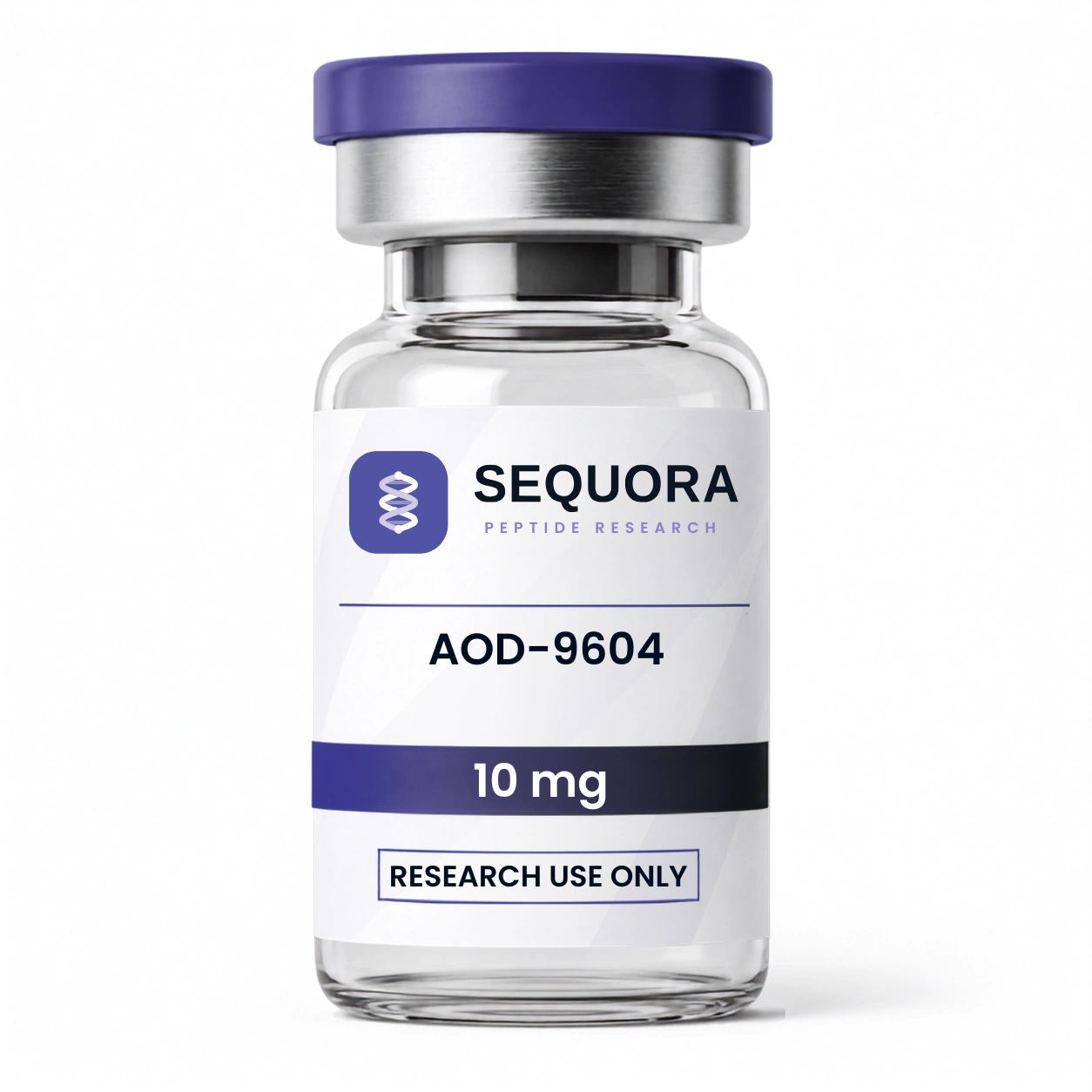
AOD 10mg is a research peptide available from Sequora Peptides for laboratory research and scientific studies. Researchers study AOD-9604 to learn more about its properties and activity. Order AOD 10mg for research purposes from Sequora Peptides.
| Molecular Formula | C78H123N23O23S2 |
|---|---|
| Molecular Mass | 1817.1 g/mol |
| Monoisotopic Mass | 1816.858273 g/mol |
| Polar Area | 798 Ų |
| Complexity | 3860 |
| XLogP | -11.4 |
| Heavy Atom Count | 126 |
| Hydrogen Bond Donor Count | 27 |
| Hydrogen Bond Acceptor Count | 28 |
| Rotatable Bond Count | 42 |
Every batch is verified for identity and purity by an independent lab before release.
Scan your batch code to pull the full certificate — chromatogram included.
Material compromised in transit is replaced against the original procurement record.
AOD-9604, short for Anti-Obesity Drug 9604, is a synthetic research peptide developed from the C-terminal end of human growth hormone (HGH).
AOD-9604 is made up of 16 amino acids and was developed from the C-terminal region of human growth hormone. It is based on the HGH 177–191 fragment but includes a small synthetic modification introduced during development.
The name “9604” comes from the original development code assigned to the peptide during its research program. It is not related to its amino acid sequence or molecular weight. The abbreviation AOD stands for Anti-Obesity Drug, reflecting the peptide’s original purpose during development.
Scientists first began studying AOD-9604 in the 1990s as researchers searched for a way to separate the fat metabolism effects of human growth hormone from its growth-promoting effects. The goal was to create a peptide that could be used to study fat metabolism without causing the increase in Insulin-like Growth Factor-1 (IGF-1) that is commonly seen with full-length HGH.
Over the years, AOD-9604 has been investigated in laboratory experiments and several human clinical studies. Researchers have explored its role in fat metabolism, lipid metabolism, obesity research, and adipose tissue biology. While these studies have expanded scientific understanding of the peptide, AOD-9604 remains a research peptide and continues to be studied for its biological activity.
Today, AOD-9604 continues to be studied in metabolic research because of its unique relationship with human growth hormone. If you are looking for AOD-9604 10 mg, or searching for the best place to buy AOD-9604, Sequora Peptides provides pure, third-party tested AOD-9604 manufactured for laboratory research purposes only.
Peptide Name: AOD-9604
Amino Acid Sequence:
Tyr–His–Phe–Lys–Val–Leu–Arg–Ile–Val–Gln–Cys–Arg–Ser–Val–Glu–Gly–Ser–Cys–Gly–Phe
Peptide Length: 16 amino acids
Derived From: Human Growth Hormone (hGH) Fragment 177–191 with an additional N-terminal tyrosine residue
Molecular Formula: C₈₉H₁₄₈N₂₈O₂₇S₂
Molecular Weight: Approximately 1,816.1 g/mol
CAS Number: 221231-10-3
Appearance: White to off-white lyophilized powder
Vial Size: 3 mL sterile glass vial
Contents: Lyophilized AOD-9604 peptide
Research Use: For laboratory research only. Not intended for human or veterinary use.
Scientists developed AOD-9604 while studying human growth hormone (HGH). They wanted to understand if a small part of HGH could influence fat metabolism without producing the many other biological effects associated with the full hormone.
Human growth hormone contains 191 amino acids and affects several functions in the body, including growth, tissue repair, protein synthesis, and the production of Insulin-like Growth Factor-1 (IGF-1). Researchers believed that only a small region near the end of the hormone was responsible for its effects on fat metabolism.
This idea led scientists to isolate and modify that specific region, creating AOD-9604. The goal was to develop a peptide that could be studied for its role in metabolic pathways without behaving like full-length human growth hormone.
Since then, AOD-9604 has been investigated in laboratory experiments and human clinical studies. Researchers continue to study the peptide to better understand its biological activity and how it differs from complete HGH.
Since its discovery, AOD-9604 has been investigated in animal models, laboratory experiments, and human clinical trials. Researchers have studied its effects on fat metabolism, obesity, lipid metabolism, glucose regulation, cartilage regeneration, and overall safety. Below is a chronological overview of the most important AOD-9604 studies.
Scientists first became interested in AOD-9604 during the 1990s while studying human growth hormone. At the time, researchers were trying to understand whether the part of HGH responsible for fat metabolism could work independently from the part responsible for growth. This idea eventually led to the development of AOD-9604. During the early laboratory studies, researchers investigated how the peptide behaved in animal models and cell-based experiments. These laboratory studies investigated how AOD-9604 affected fat metabolism in both cell cultures and animal models. These studies formed the basis for later clinical research. These early findings encouraged scientists to continue developing the peptide and eventually move into human clinical trials.
T9. 2015–Present – Cartilage and Regenerative Research
More recent laboratory research has investigated whether AOD-9604 may influence cartilage biology and tissue regeneration.
These studies are still in the early research stage, but they have broadened interest in AOD-9604 beyond metabolic science.
Today, scientists continue to study AOD-9604 in several areas of peptide science, including:
Although AOD-9604 has been studied in multiple laboratory and human clinical trials, it remains a research peptide intended for scientific investigation.
Unlike many research peptides, AOD-9604 was not designed to act like the full human growth hormone. Instead, scientists developed it to study the specific part of HGH that may be involved in fat metabolism. While researchers continue to investigate its exact mechanism of action, several laboratory and clinical studies have provided valuable insights into how AOD-9604 may work at the cellular level.
The key interest in AOD-9604 was developed due to its potential involvement in fat metabolism.
Many researchers believe that the AOD-9604 peptide has the potential to interact with certain signalling pathways in adipose (fat) tissue. It is important to note that, unlike full-length HGH, AOD-9604 appears to focus on metabolic activity rather than growth-related functions.
It is one of the reasons scientists have continuously investigated AOD-9604 in labs to study its lipid metabolism and body fat regulation potential.
Many research studies have been completed to investigate if AOD-9604 has any influence on lipolysis. Lipolysis is a natural process involved in fat breakdown. Through lipolysis, fat is broken down into fatty acids and glycerol.
Some animal studies reported an increase in lipolytic activity after exposure to AOD-9604. Moreover, researchers also observed changes in fat metabolism without the hormonal effects normally associated with human growth hormone.
Lipogenesis is the process through which the body converts excess energy into stored fat.
In laboratory studies, researchers have explored whether AOD-9604 may influence biological pathways involved in fat storage. Some experimental findings suggest the peptide may reduce the activity of pathways associated with lipid accumulation.
This area remains an active field of research, and additional studies are needed to better understand its long-term biological effects.
Furthermore, some animal studies also gave researchers a better understanding of how AOD-9604 may work. During these studies, researchers reported increased expression of β3-adrenergic receptors in adipose tissue. These receptors are involved in fat metabolism and energy balance. Their activation has been linked to the breakdown of stored fat within fat cells.
This finding helped researchers better understand why AOD-9604 became a promising peptide for metabolic research.
Researchers also wanted to see if AOD-9604 could keep its metabolic activity without increasing Insulin-like Growth Factor-1 (IGF-1). This was important because full human growth hormone usually increases IGF-1 levels.
Several clinical studies found little to no increase in IGF-1 after AOD-9604 was used. This suggested that the peptide worked differently from full human growth hormone.
Scientists are still studying this difference. More research is needed to understand exactly how AOD-9604 works and why it behaves differently from HGH.
Although AOD-9604 is derived from human growth hormone, it behaves very differently from human growth hormone.
The main difference is in their amino acid structure. Research studies show that human growth hormone contains 191 amino acids and it affects many biological processes, including growth, tissue repair, protein synthesis, and the production of Insulin-like Growth Factor-1 (IGF-1).
On the other hand, AOD-9604 contains only 16 amino acids from the C-terminal region of HGH. So the difference is clear. It is only a small fragment; it does not appear to activate the full range of hormonal responses seen with complete human growth hormone.
This unique design is one of the reasons scientists selected AOD-9604 for metabolic research.
Proper storage helps maintain the stability and quality of AOD-9604 throughout its shelf life. Following the recommended storage conditions can help protect the peptide from moisture, heat, and light.
The lyophilised (freeze-dried) AOD-9604 peptide should be stored in a refrigerator between 2°C and 8°C (36°F–46°F). Keep the vial sealed until it is ready to be used for research.
For long-term storage, many laboratories store unopened peptide vials in a freezer at -20°C (-4°F) to help preserve stability.
Once reconstituted with a suitable laboratory-grade solution, AOD-9604 should be stored in a refrigerator at 2°C to 8°C.
Avoid repeated freeze-thaw cycles, as they may affect peptide stability over time.
Store the vial away from direct sunlight and excessive heat. High temperatures may reduce peptide stability.
Always keep the vial in its original container when possible.
When handling AOD-9604:
Following proper storage and handling procedures helps maintain the integrity of the peptide throughout laboratory research.
AOD-9604 is a synthetic research peptide derived from the C-terminal region of human growth hormone (HGH). It consists of 16 amino acids and has been widely studied for its role in fat metabolism and metabolic research.
Scientists have studied AOD-9604 in several research areas, including:
Research is still ongoing to better understand its biological activity.
No, AOD-9604 is only a small fragment of human growth hormone. Full HGH contains 191 amino acids, while AOD-9604 contains 16 amino acids. It was developed to study metabolic pathways without producing the full biological effects of HGH.
To create AOD-9604, scientists added an extra Tyrosine amino acid at the N-terminus to stabilize the molecule and prevent it from breaking down too quickly in the body. It is a purely synthetic alteration
Clinical studies have generally reported that AOD-9604 does not produce a significant increase in circulating IGF-1 levels. This is one of the characteristics that makes it different from full-length human growth hormone.
Yes, every batch of Square Peptides AOD-9604 10mg undergoes independent third-party testing to verify purity, identity, and quality. A Certificate of Analysis (COA) is available for every batch.
If you are looking for where to buy AOD-9604 or the best place to buy AOD-9604, Square Peptides offers research-grade AOD-9604 10mg manufactured to strict quality standards. Every batch is third-party tested and supported by a Certificate of Analysis (COA).
No, AOD-9604 sold by Square Peptides is intended for research use only. It is not intended for human consumption, diagnosis, treatment, or disease prevention.
FOR RESEARCH USE ONLY (RUO). NOT FOR HUMAN OR VETERINARY USE.
AOD-9604 sold by Square Peptides is intended exclusively for laboratory research and scientific investigation by qualified researchers and licensed institutions.
This product is not intended for human consumption, veterinary use, therapeutic use, or diagnostic purposes. It has not been approved by the U.S. Food and Drug Administration (FDA) or any other regulatory authority for the diagnosis, treatment, cure, or prevention of any disease.
By purchasing this product, the customer acknowledges that:
Square Peptides makes no representations regarding the suitability of this product for any use other than legitimate laboratory research. Misuse of this product is strictly prohibited.
COA ✓
Sermorelin 10mg is a synthetic GHRH analog studied in growth hormone signaling and endocrine research. Supplied by Sequora Peptides strictly for laboratory research use only.
COA ✓
COA ✓
This site supplies chemicals strictly for laboratory research. You must confirm both statements below to enter.
Products are supplied for laboratory research use only and are not for human or veterinary use.