
Institutional accounts only · Pricing and quotes released after verified laboratory registration
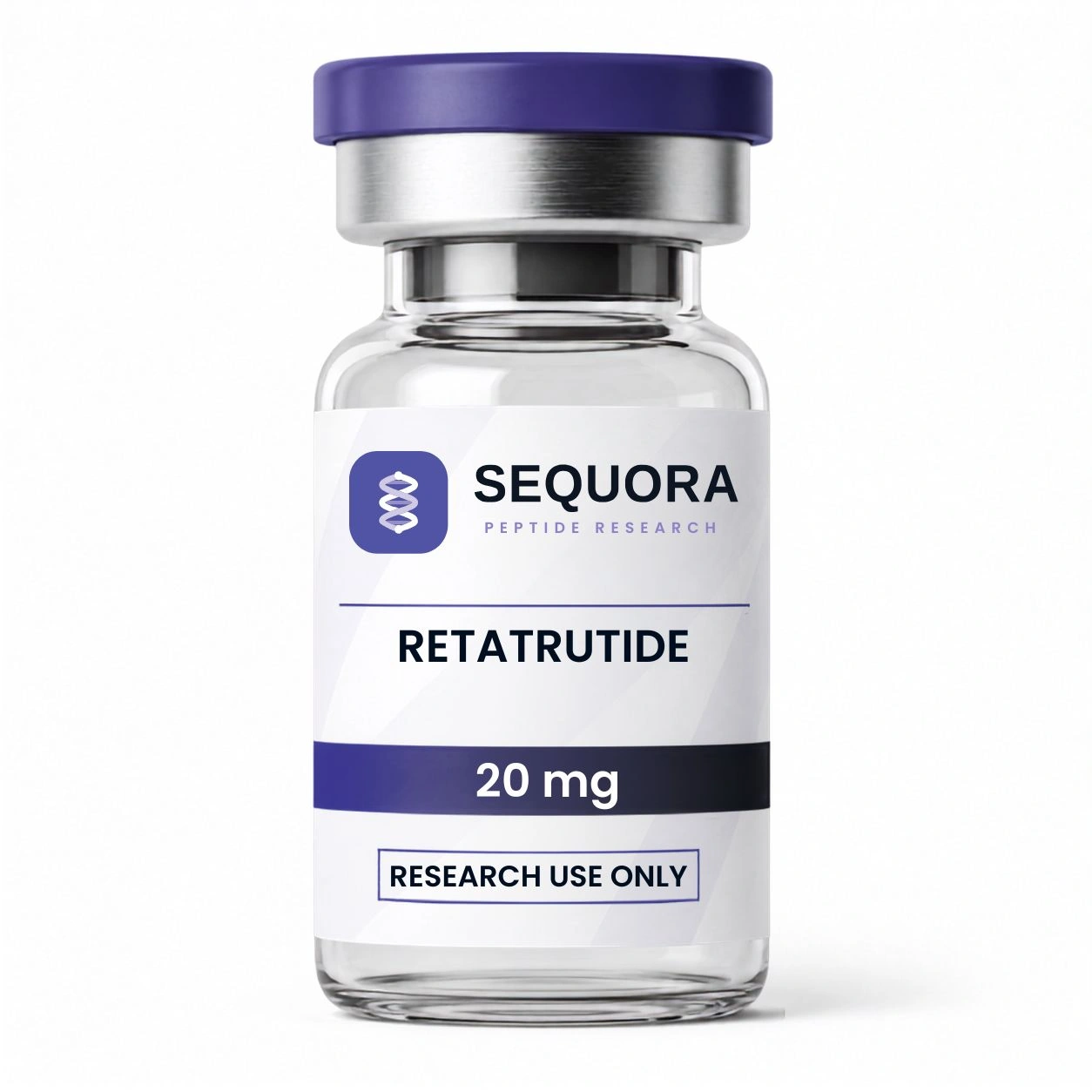
Research interest in Retatrutide has grown significantly since clinical studies began evaluating its unique triple-receptor activity. The 20mg Retatrutide format is offered by Sequora Peptides for researchers conducting laboratory and scientific investigations into this investigational peptide and its molecular characteristics.
| Molecular Formula | C223H343N45O68 |
|---|---|
| Molecular Mass | 4732.2 g/mol |
| Monoisotopic Mass | 4729.479100 g/mol |
| Polar Area | 2410 Ų |
| Complexity | 13200 |
| XLogP | -41.3 |
| Heavy Atom Count | 336 |
| Hydrogen Bond Donor Count | 74 |
| Hydrogen Bond Acceptor Count | 89 |
| Rotatable Bond Count | 186 |
Every batch is verified for identity and purity by an independent lab before release.
Scan your batch code to pull the full certificate — chromatogram included.
Material compromised in transit is replaced against the original procurement record.
Retatrutide (LY3437943) is an experimental synthetic peptide that aims to activate three metabolically relevant G-protein-coupled receptors: the glucose-dependent insulinotropic polypeptide receptor (GIPR), the glucagon-like peptide-1 receptor (GLP-1R), and the glucagon receptor (GCGR).
While current drugs for diabetes treatment either act on a single receptor or two of the three mentioned ones, Retatrutide is a single peptide molecule designed to activate three receptors: GIPR, GLP-1R, and GCGR. As highlighted by Jastreboff et al., it results in dose-dependent reductions in body weight, with dose-related gastrointestinal adverse events and increases in heart rate.
The term Retatrutide 20 mg refers to the dose of the medication under study in the laboratory. In the case of Retatrutide 20 mg, the dose does not necessarily indicate an actual dosage used in clinical trials or in any way imply approval of such a dose for treatment. Clinical trials have explored far smaller dosing per week, namely 1, 4, 8, and 12 mg in phase 2 obesity studies. According to Jastreboff et al., the largest dose studied in that trial was 12 mg per week.
Retatrutide was developed by Eli Lilly as an investigational peptide intended to simultaneously engage GIP, GLP-1, and glucagon receptor pathways. Its pharmacological concept is based on combining complementary metabolic signals rather than relying on activation of a single incretin receptor.
Jastreboff et al. evaluated retatrutide in adults with obesity in a randomized, placebo-controlled phase 2 study involving 338 participants. The investigators reported substantial dose-dependent weight reductions over 48 weeks, with the 12 mg group showing a least-squares mean reduction of 24.2% from baseline compared with 2.1% with placebo.
Retatrutide has subsequently progressed into a broad phase 3 development program. In 2026, Lilly reported positive topline results from several TRIUMPH trials, although these newer results should be distinguished from peer-reviewed publications because detailed results from some trials were still awaiting publication.
Most of the studies about retatrutide have been carried out with respect to metabolic regulation, energy balance, glucose homeostasis, and body weight biology. The GLP-1R and GIPR agonist activities might have the potential to affect glucose-dependent insulin secretion and appetite mechanisms, whereas GCGR activity might provide additional actions related to energy expenditure and substrate metabolism.
The researchers Jastreboff et al. suggested that using the combination of GLP-1 and GIP receptor agonists along with GCGR activation could produce better results in terms of energy intake, substrate metabolism, and energy expenditure. Such a mechanism is one of the reasons why retatrutide has become an important experimental model for studying multi-receptor metabolic pharmacology. The multi-receptor pharmacology of retatrutide has made it a valuable experimental tool for the study of co-ligation of incretin and glucagon receptors in metabolism studies.
In addition, there have been studies about the metabolic effects of retatrutide in people suffering from type 2 diabetes mellitus. Rosenstock et al. performed a randomized phase 2 study where retatrutide was compared with placebo and dulaglutide in people with type 2 diabetes.
The mechanism of retatrutide should not be reduced to a single receptor pathway. Its defining pharmacological characteristic is simultaneous activity at three receptors—GIPR, GLP-1R, and GCGR—which may produce complementary effects on appetite, glucose metabolism, energy expenditure, and body-weight regulation.
The activation of the GLP-1 receptor has been associated with glucose-stimulated insulin secretion, regulation of glucagon secretion, gastroenteric actions, and central actions, including appetite and feeding.
As per the opinions of Jastreboff et al., retatrutide is a triple receptor agonist of GIP, GLP-1, and glucagon with dose-dependent effects on body weight and gastroenteric tolerability in phase 2 studies in obese individuals.
The second aspect of the pharmacological action of retatrutide is the GIP receptor activation. GIP signaling is responsible for nutrient-induced insulin secretion and metabolic regulation. Unlike GLP-1 and glucagon receptor action, GIP receptor signaling is not considered an independent effect of retatrutide.
Activation of GCGR comes next in the process of action of retatrutide. The glucagon pathway can affect energy expenditure and substrate utilization at the hepatic level. As indicated by Jastreboff et al., glucagon receptor activation can work alongside incretin pathways to influence energy expenditure and substrate utilization.
The biological value of retatrutide is in the combination of these three signaling mechanisms. Instead of explaining retatrutide activity through any of these receptors individually, the research is focused on the effect of concurrent activation of GIPR, GLP-1R, and GCGR on the overall metabolic profile.
It should be mentioned that the experimental results for retatrutide cannot be extrapolated from the known effects of any receptor agonist.
Research concerning retatrutide is mostly dedicated to its influence on appetite regulation and energy balance. In the phase 2 obesity study, weight loss depended on the dose of retatrutide; moreover, no plateau was observed within 48 weeks. Jastreboff et al. found that with the 12 mg dose of the drug, the percentage of body weight reduction was 24.2%.
Research on obesity is the most significant field of clinical study related to retatrutide. The phase 2 trial was an initial demonstration of dose-related weight loss effects of retatrutide, while phase 3 trials focused on testing this substance in larger cohorts at longer treatment intervals.
As of May 2026, the TRIUMPH-1 trial conducted by Lilly revealed that patients who received 12 mg of retatrutide lost an average of 28.3% of their body weight at 80 weeks of treatment compared to 19.0% in those who received 4 mg of retatrutide.
Additional topline phase 3 results announced in July 2026 included TRIUMPH-2, which studied adults with obesity or overweight and type 2 diabetes, and TRIUMPH-3, which studied adults with severe obesity and established cardiovascular disease. Lilly reported average weight reductions of up to 20.8% and 22.6%, respectively, at 80 weeks.
Retatrutide has also been evaluated in adults with type 2 diabetes. The purpose of these investigations has included assessment of glycemic control, body weight, insulin-related physiology, and safety.
In a phase 2 trial on type 2 diabetic adults, Rosenstock et al. discovered that retatrutide brought about improvements in the measures of blood glucose and weight compared to the placebo group, with gastrointestinal adverse effects being a significant part of the study’s safety.
The results suggest further studies of triple receptor agonism to study the interaction between glucose control and metabolism.
Safety assessment continues to play an important role in retatrutide development. During the obesity study phase 2 trial, the most frequent side effects included those associated with the gastrointestinal system; however, these side effects were considered mild to moderate. A dose-related increase in heart rate was found by the investigators to peak after about 24 weeks, after which it began to decline. These results were documented by Jastreboff et al.
Since retatrutide is still under investigation, its safety profile and physiological effects are being studied.
The development process of Retatrutide has already moved beyond the laboratory experiment stage, and it has already undergone clinical phases 2 and 3. In the study conducted by Jastreboff et al., the drug exhibited impressive weight loss in obese subjects, while Rosenstock et al. used it on patients with type 2 diabetes.
By 2026, multiple phase 3 trials had reported positive topline results, but retatrutide remained an investigational compound rather than an approved medicine. Lilly stated in July 2026 that it planned to submit a Biologics License Application to the FDA in the first quarter of 2027.
Current retatrutide research includes:
The continuing TRIUMPH program has expanded research into populations with obesity, type 2 diabetes, cardiovascular disease, knee osteoarthritis pain, and obstructive sleep apnea.
Retatrutide remains an investigational compound and has not been approved for human therapeutic use by the FDA or another regulatory authority as of August 2026. Eli Lilly states that retatrutide has not been approved by any regulatory agency and that products claiming to contain retatrutide outside Lilly-sponsored clinical research should not be regarded as approved medicines.
Therefore, a research-grade Retatrutide 20 mg preparation should be described as a Research Use Only (RUO) material and should not be represented as an approved pharmaceutical product.
Storage should follow the validated specification for the particular research formulation because peptide stability can depend on formulation, concentration, excipients, temperature, moisture, light exposure, and other environmental conditions.
A universal post-reconstitution temperature and storage period should not be assigned without formulation-specific stability data.
By Retatrutide 20 mg, we understand an experimental substance of Retatrutide, the dose of which is 20 mg, and retatrutide is an experimental drug, a compound that stimulates GIP, GLP-1, and glucagon receptors.
Retatrutide was primarily researched for obesity, weight management, glucose metabolism, type 2 diabetes, and energy balance.
No. The 20 mg quantity identifies the amount of material in a research preparation. It should not be interpreted as an approved or clinically established dose. Phase 2 obesity studies evaluated weekly doses up to 12 mg. Jastreboff et al. reported the clinical outcomes for those studied doses.
Not yet. As of August 2026, retatrutide has not been FDA-approved and is still under investigation. According to Lilly, it intends to submit its BLA in the first quarter of 2027.
Storage will depend on the validation process that was used for the specific research formulation. Lyophilized and reconstituted forms may vary in stability; hence, the information about the specific formulation is better than general information.
If it is supplied as a research reagent, then the material is intended for laboratory research only, and it cannot be presented as a human drug product.
At Sequora Peptides, Retatrutide 20 mg, Retatrutide 10mg, Retatrutide 15mg, and 30mg are offered as a research reagent is Research Use Only (RUO).
This chemical is intended for scientific research only and should not be presented as an approved drug product or for human use. Researchers should adhere to research guidelines when using research reagents.
COA ✓
COA ✓
COA ✓
This site supplies chemicals strictly for laboratory research. You must confirm both statements below to enter.
Products are supplied for laboratory research use only and are not for human or veterinary use.