
Institutional accounts only · Pricing and quotes released after verified laboratory registration
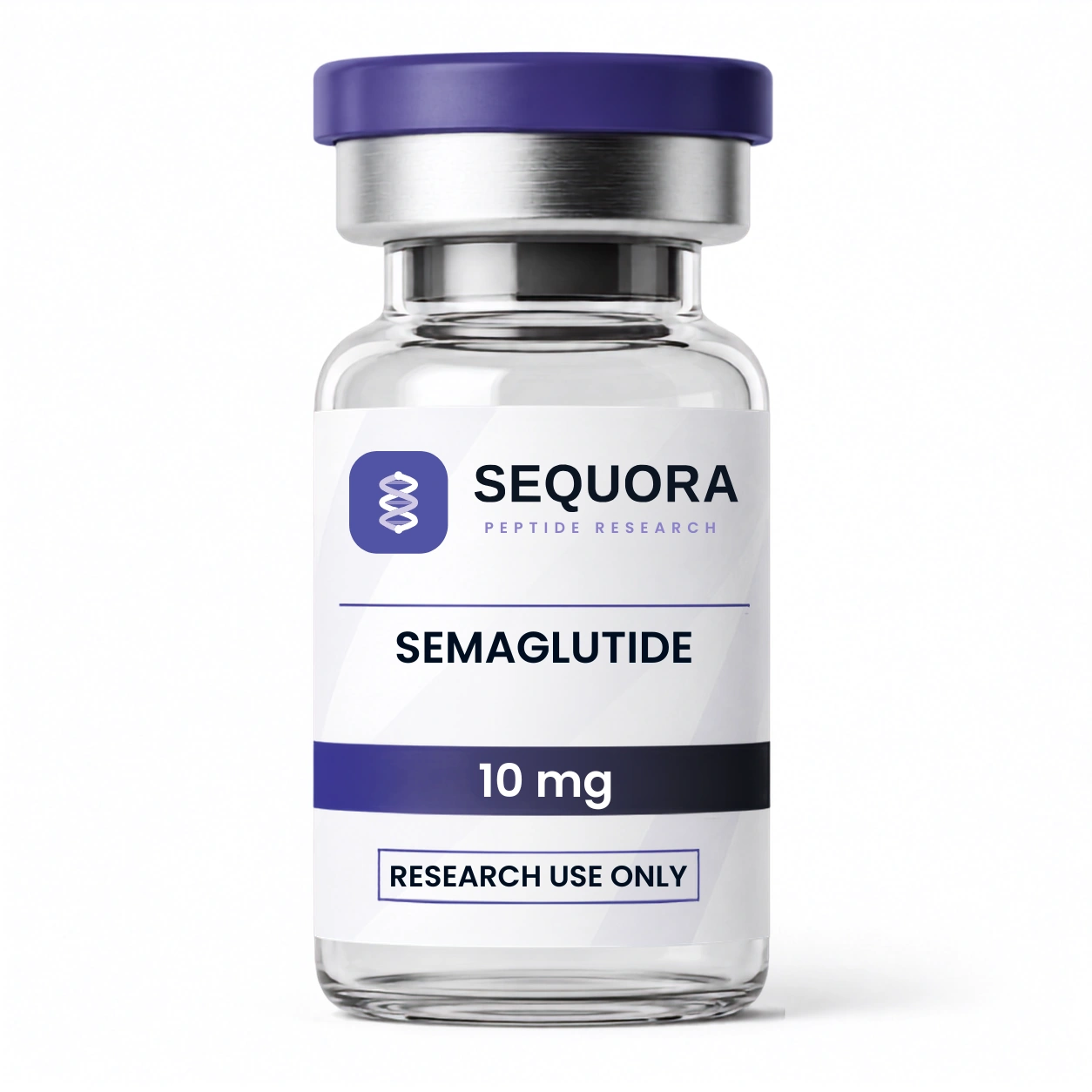
Semaglutide 10mg is a research compound studied for its activity at the GLP-1 receptor. Researchers investigate semaglutide in studies involving glucose regulation, receptor signaling, and related biological pathways. Available at Sequora Peptides for research purposes.
| Molecular Formula | C187H291N45O59 |
|---|---|
| Molecular Mass | 4114 g/mol |
| Monoisotopic Mass | 4111.115377 g/mol |
| Polar Area | 2250 Ų |
| Complexity | 12200 |
| XLogP | -43.5 |
| Heavy Atom Count | 347 |
| Hydrogen Bond Donor Count | 72 |
| Hydrogen Bond Acceptor Count | 88 |
| Rotatable Bond Count | 180 |
Every batch is verified for identity and purity by an independent lab before release.
Scan your batch code to pull the full certificate — chromatogram included.
Material compromised in transit is replaced against the original procurement record.
Semaglutide is a synthetic peptide analog of human glucagon-like peptide-1 (GLP-1), a naturally occurring hormone involved in glucose regulation, insulin secretion, appetite signaling, and gastrointestinal function. Through peptide engineering, semaglutide was modified to improve its resistance to enzymatic degradation and extend its biological activity compared with native GLP-1. These properties have made semaglutide one of the most extensively studied GLP-1 receptor agonists in modern metabolic research. (Knudsen & Lau, 2019; Müller et al., 2019)
Native GLP-1 has a very short biological half-life because it is rapidly broken down by enzymes such as dipeptidyl peptidase-4 (DPP-4). Semaglutide was designed with structural modifications that provide greater resistance to enzymatic degradation and prolong its activity. At the same time, it retains strong binding activity at the GLP-1 receptor, allowing researchers to investigate prolonged GLP-1 receptor signaling and its effects on metabolic pathways.
Semaglutide has been extensively investigated in both preclinical research and large-scale clinical studies. Scientists have examined its effects on glucose metabolism, insulin secretion, appetite regulation, gastric emptying, cardiovascular physiology, and body-weight regulation. These studies have contributed significantly to the scientific understanding of GLP-1 receptor signaling and its role in metabolic physiology. (Marso et al., 2016; Wilding et al., 2021; Müller et al., 2019; Drucker, 2018)
Today, semaglutide research continues across areas such as endocrinology, obesity research, diabetes research, cardiovascular science, metabolic biology, and peptide pharmacology. Researchers continue to study GLP-1 receptor activation, downstream signaling pathways, metabolic regulation, and the broader physiological effects associated with sustained GLP-1 receptor activity.
Research Use Only: At Sequora Peptides, Semaglutide 10mg supplied for research purposes is intended strictly for laboratory investigation and is not intended for human or veterinary use.
| Specification | Details |
|---|---|
| Peptide Name | Semaglutide |
| Peptide Type | GLP-1 Receptor Agonist |
| Amino Acid Length | 31 amino acids |
| Molecular Formula | C₁₈₇H₂₉₁N₄₅O₅₉ |
| Molecular Weight | 4113.58 g/mol |
| CAS Number | 910463-68-2 |
| PubChem CID | 56843331 |
| Appearance | White to off-white lyophilized powder |
| Vial Size | 3 mL sterile glass vial |
| Contents | Lyophilized Semaglutide peptide |
| Purity | Research-grade quality |
| Research Use | Intended exclusively for laboratory research. Not intended for human or veterinary use. |
Semaglutide has been extensively studied through laboratory research, preclinical investigations, and large-scale clinical trials. This body of research has helped scientists better understand GLP-1 receptor signaling, glucose metabolism, appetite regulation, energy balance, cardiovascular biology, and peptide pharmacology.
Semaglutide research builds on decades of work involving glucagon-like peptide-1 (GLP-1) and the broader incretin system. Key studies have examined its molecular design, receptor activity, pharmacokinetics, metabolic effects, and clinical outcomes. Important publications include the developmental work by Lau et al. (2015), the cardiovascular outcomes research by Marso et al. (2016), the STEP 1 trial by Wilding et al. (2021), and major reviews by Knudsen & Lau (2019) and Müller et al. (2019).
The development of semaglutide emerged from earlier research into GLP-1 biology and incretin-based signaling. Native GLP-1 has useful biological activity, but it is rapidly degraded in the body, particularly by the enzyme dipeptidyl peptidase-4 (DPP-4). This short duration of activity created an important challenge for researchers developing longer-acting GLP-1 receptor agonists.
A major study by Lau et al. (2015) described the molecular design and development of semaglutide. Researchers introduced specific structural modifications to improve the molecule’s stability and extend its biological activity.
These modifications included an amino acid substitution that increased resistance to DPP-4 degradation and the addition of a C18 fatty diacid side chain connected through a linker. The fatty acid component promotes reversible binding to albumin, which contributes to the prolonged pharmacokinetic profile of semaglutide.
Before extensive clinical development, semaglutide was investigated in laboratory and preclinical models to evaluate several important characteristics, including:
These early studies helped establish the scientific basis for later semaglutide research. (Lau et al., 2015; Knudsen & Lau, 2019)
Following preclinical development, semaglutide was evaluated through several large international clinical research programs. These studies examined its effects on metabolic regulation, glucose control, cardiovascular outcomes, body-weight regulation, and other physiological processes associated with GLP-1 receptor activation.
One important study was the SUSTAIN-6 trial, reported by Marso et al. (2016). This cardiovascular outcomes trial evaluated semaglutide in participants with type 2 diabetes who were considered to have elevated cardiovascular risk.
The study contributed important evidence regarding the cardiovascular effects associated with semaglutide treatment and expanded scientific understanding of the relationship between GLP-1 receptor agonism and cardiovascular biology.
Another major research program involved the STEP trials, which investigated semaglutide in the context of body-weight regulation and obesity-related metabolic research.
The STEP 1 trial, published by Wilding et al. (2021), examined semaglutide in adults with overweight or obesity. The study provided important information about the effects of prolonged GLP-1 receptor activation on appetite regulation, energy intake, body weight, and metabolic physiology.
Together, studies such as SUSTAIN-6 and STEP 1 have made semaglutide one of the most extensively investigated compounds within the GLP-1 receptor agonist class.
A major area of semaglutide research focuses on its interaction with the GLP-1 receptor.
GLP-1 receptors are expressed in several tissues involved in metabolic regulation. When activated, these receptors participate in biological processes associated with glucose-dependent insulin secretion, appetite signaling, gastrointestinal activity, and energy balance.
Semaglutide acts as a GLP-1 receptor agonist, meaning that it binds to and activates the GLP-1 receptor. Researchers use studies of semaglutide to better understand how prolonged GLP-1 receptor signaling influences metabolic and physiological pathways.
Reviews by Drucker (2018), Knudsen & Lau (2019), and Müller et al. (2019) provide broader scientific context on GLP-1 biology, receptor signaling, and the development of GLP-1-based compounds.
Semaglutide continues to be studied across a wide range of scientific disciplines. Current and established research areas include:
Research in these areas continues to expand scientific understanding of how GLP-1 receptor activation affects metabolic and physiological processes.
Semaglutide has become an important research compound because it combines strong GLP-1 receptor activity with structural modifications that significantly extend its biological duration compared with native GLP-1.
Its development has also provided researchers with a useful model for studying how peptide engineering can modify stability, receptor activity, enzyme resistance, albumin binding, and pharmacokinetics.
Research involving semaglutide therefore contributes not only to the understanding of GLP-1 biology, but also to broader areas of metabolic science, peptide chemistry, endocrinology, cardiovascular research, and pharmacology.
Major studies and reviews, including Lau et al. (2015), Marso et al. (2016), Wilding et al. (2021), Knudsen & Lau (2019), and Müller et al. (2019) continue to form an important part of the scientific literature surrounding semaglutide and GLP-1 receptor research.
After over ten years of experiments conducted in laboratories and clinical tests on Semaglutide, the scientific studies have proved that Semaglutide is one of the most researched GLP-1 receptor agonists. According to research findings published by Lau et al. (2015), Marso et al. (2016), Wilding et al. (2021), as well as scientific review articles written by Drucker (2018) and Muller et al. (2019), the future research areas of metabolism will include:
Despite the number of investigations into Semaglutide carried out so far, further scientific research can help understand the mechanisms and biological effects of this drug better.
Semaglutide works primarily by acting as a glucagon-like peptide-1 (GLP-1) receptor agonist. Native GLP-1 is rapidly degraded by the enzyme dipeptidyl peptidase-4 (DPP-4), which gives it a short duration of activity. Semaglutide was structurally modified to increase resistance to enzymatic degradation and extend its biological activity. These properties allow researchers to study prolonged GLP-1 receptor signaling and its effects on metabolic physiology. (Lau et al., 2015; Knudsen & Lau, 2019; Drucker, 2018)
The primary mechanism of action of semaglutide is the activation of GLP-1 receptors. These receptors are involved in several physiological processes related to glucose regulation, insulin secretion, appetite signaling, gastrointestinal function, and energy balance.
When semaglutide binds to the GLP-1 receptor, it activates intracellular signaling pathways that influence metabolic and hormonal responses. This receptor activity forms the basis for many of the biological effects studied in semaglutide research. (Müller et al., 2019; Drucker, 2018)
A major area of semaglutide research involves glucose metabolism. GLP-1 receptor activation has been shown to enhance glucose-dependent insulin secretion from pancreatic beta cells.
Researchers have also studied how GLP-1 signaling affects glucagon secretion and overall glucose homeostasis under different metabolic conditions. Importantly, these effects are closely linked to glucose availability, making GLP-1 signaling an important pathway in metabolic research. (Knudsen & Lau, 2019; Drucker, 2018)
Semaglutide has also been extensively investigated for its effects on appetite regulation and energy intake.
GLP-1 receptors are present in regions of the central nervous system involved in hunger, satiety, and feeding behavior. Activation of these pathways may influence appetite-related signaling and reduce energy intake under studied condi
Correct storage ensures that Semaglutide remains stable, pure, and biologically active throughout all laboratory studies.
The lyophilized Semaglutide peptide should be stored in a refrigerator at temperatures ranging from 2°C to 8°C. For long-term storage, most laboratory facilities store the unopened vials at temperatures below -20°C. The vial should remain closed until laboratory use.
Once reconstituted in an appropriate laboratory-grade diluent, the peptide solution should be stored in a refrigerator at 2°C to 8°C. Freeze and thaw cycles should be minimized to preserve peptide stability.
The vial should be kept away from direct exposure to sunlight, heat, and moisture. Stable storage will contribute to the preservation of the quality of the peptides during experimental procedures.
Sterile procedures must be applied in the laboratory when manipulating the samples.
Semaglutide is a synthetic peptide analog of glucagon-like peptide-1 (GLP-1). It has been the subject of much investigation concerning its interaction with GLP-1 receptors and glucose metabolism, appetite control, and metabolic physiology.
It was synthesized by scientists in order to extend the action time of the natural GLP-1 due to structural changes that make it more resistant to DPP-4 degradation.
Semaglutide is a subject of research in glucose metabolism, endocrinology, obesity, cardiovascular physiology, pharmacology of peptides, neuroendocrine physiology, and metabolic control.
Unopened lyophilized vials of Semaglutide should be stored at 2°C-8°C for routine storage or at -20°C for prolonged storage. The solution after reconstitution should be kept at 2°C-8°C.
No. The semaglutide intended for laboratory experimentation is only meant to be used in such experiments. They are not supposed to be taken by human beings or animals, or used for treatment or diagnostic purposes.
FOR RESEARCH USE ONLY (RUO). NOT FOR HUMAN OR VETERINARY USE.
Semaglutide is provided solely for laboratory research and scientific studies carried out by professional researchers and licensed organizations.
This product is not meant for human use as a means of diagnosis, treatment, curing, or preventing diseases. This product can only be handled by professional laboratory technicians.
It is the responsibility of the buyer to comply with all laws relating to the purchasing, storage, handling, and use of research material.
COA ✓
COA ✓
COA ✓
This site supplies chemicals strictly for laboratory research. You must confirm both statements below to enter.
Products are supplied for laboratory research use only and are not for human or veterinary use.